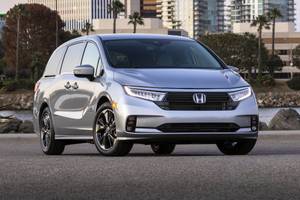
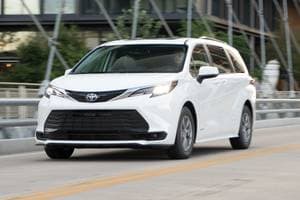
Style and stigma be damned, this is a minivan test. A test of utility and usability. A test of family hauling and cargo carrying. A test where practicality overshadows pride. Specifically, it's a comparison test of the 2011 Toyota Sienna and 2010 Honda Odyssey, both vying to be recognized as the warrior queen of the minivan segment. And it's a test any real man should read with honor.
Though the minivan is an unpretentious standard of reference in family haulers, it is still the most practical vehicle in this role. Easier to drive than an SUV or a crossover, a minivan will not only carry more kids and cargo but also shame SUV-style competitors at the gas pump. Equipped with a reasonably powerful V6 engine, the minivan even offers a modest, although useful, towing capacity. Love them or hate them, there's no arguing with the minivan's cost/benefit ratio. Real men will acknowledge this, social stigma or not.
Both the Toyota Sienna and Honda Odyssey have been winners in our previous Inside Line minivan comparison tests. The current-generation Odyssey has prevailed in these comparisons for more than three years, although this five-year-old design from Honda is due for replacement next year. Meanwhile, the fully redesigned 2011 Toyota Sienna has come to the market with a barrage of features, a new transmission and a kickass, take-no-prisoners attitude. OK, we fabricated that last bit to keep the men reading, but even a glance at the new Sienna makes it obvious that Toyota has Honda directly in its sights.
Sorting out which of these minivans is best is the role of our scoring system, which weights the final result according to price (20 percent), fuel consumption (15 percent), feature content (25 percent), a 29-point evaluation by the editors (20 percent), performance (15 percent) and finally editorial preference (5 percent).
The Players
Both vans in this test are top-of-the-line, front-wheel-drive examples. This 2010 Honda Odyssey is a Touring model, which comes with standard equipment that includes eight-passenger seating, leather seat upholstery, a navigation system, a premium audio system, rear-seat entertainment and much, much more. It also comes with an as-tested price of $41,465.
The list of standard equipment in the 2011 Toyota Sienna Limited is more impressive. Among its features are 18-inch tires, keyless ignition/entry, a JBL 10-speaker premium audio system and Toyota's Safety Connect telematics. This particular Limited also came with the $1,800 Limited Convenience package, which adds rain-sensing wipers and high-intensity-discharge headlamps. It includes the $890 Advanced Technology package, which brings adaptive cruise control, a pre-collision preparedness system and hill-assist control. These amenities raise the Sienna's as-tested price to $41,990, some $525 more than the Odyssey. But from a price standpoint this is a fair fight.
In truth, both these vans are as laden with features as most luxury cars. In fact, each carries such a comprehensive list of features that we found it difficult to differentiate one from the other. For example, the list of features common to both includes such elaborate convenience items as triple-zone climate control, power liftgate, back-up camera and sensors, multiadjustable power seats with memory and hands-free Bluetooth connectivity.
By the Numbers
When it comes to the shadow these two eight-passenger vehicles cast on the pavement, the dimensional differences don't make much of a difference. Surprisingly, the older 2010 Honda Odyssey is the longer overall of the two by 1.9 inches (and here we thought all new cars were getting bigger). When it comes to wheelbase, however, the Sienna's 119.3-inch measurement exceeds the Odyssey's 118.1 inches. And even though it has more features, the Sienna weighs less than the Odyssey, some 4,586 pounds versus 4,612 pounds.
If you don't like beeps, then stay as far away from the Toyota as possible.
Not that anyone who buys one will care too much, but both the Odyssey and Sienna are powered by a 3.5-liter V6 engine. Honda rates its power plant at 244 horsepower at 5,700 rpm and 245 pound-feet of torque at 4,900 rpm, and the Odyssey utilizes a five-speed automatic transmission to put that power to the ground. The Sienna's V6 (a four cylinder is optional) cranks out more power than the Honda with 265 hp at 6,200 rpm and 245 lb-ft of torque at 4,700 rpm. A new six-speed automatic with a manual-shift feature is standard for the Sienna.
The Seating Showdown
Here's where this test is won or lost. It's in these details that the soccer moms of the world decide the fate of the minivan. And it's here where the aging Honda still holds its own.
Largely, this is because the Odyssey's interior design has so much space-efficiency and practicality that its utility hasn't been surpassed by any important advances in vehicle architecture. Eight-passenger seating capacity isn't unique to the Odyssey (the Sienna offers it as an option), yet we've found that it offers a small but useful margin of utility for occasional duty. The center seat in the second row is small, but it quickly transforms into a center console with cupholders or can be removed to make pass-through space between the seats.
The 2010 Honda Odyssey's lightweight, simple-to-remove second-row seats also offer a measure of utility unavailable in the Sienna Limited. With the center seat/console removed, they can slide together to improve ease of access to the third row through the passenger-side door. They weigh 62 pounds each and can be removed by anybody with a reasonably strong back.
In contrast, the 2011 Toyota Sienna Limited comes standard with second-row "lounge seating," which means that its two second-row seats are reclining captain's chairs with footrests that extend. These recliners were comfortable, but you have to be the right size, and any of our editors taller than 5-foot-9 disdained them. If you're a little too big, then you find your shoes resting against the front seatbacks, and if you're really big, your feet just won't fit anywhere at all.
Still, the Sienna's seats are mounted on sliders in the floor, so they can be moved very far forward to provide easy access to the third row. At the same time, we found that doing so requires so much effort that it probably can't be done by a child. These seats also weigh 76 pounds each — enough to probably preclude their removal unless you're desperate.
B-List Seating
The third-row seats in both the Odyssey and Sienna vans are split 60/40 and fold flat into the floor. When the seats were deployed, we found the Sienna's third-row legroom more accommodating than the Odyssey partially because its second-row seats have a long range of fore/aft adjustability and partially because there's simply more space.
Folding these third-row seats into the floor is a very different procedure in each of these vans. In the Odyssey the act requires a two-handed reach-and-pull technique and significant effort. Even an average-size male has to lean far into the van and pull the seats upright, which is a bit of a balancing act. Still, only about 4 seconds are required to drop one side of the seat into the floor.
The Sienna's power-operated third row deploys in 18 seconds, although you have to reach up to the top of the hatch where the button is and then hold it down. It takes just 11 seconds to stow one side of the split seat, and double that time or use both hands if you want both sides stowed. Anyone dealing with children will likely prefer this power-operated feature over the Honda's manual operation, so score one for Toyota.
Other back-of-the van observations? Both the Odyssey and the Sienna have a power-operated hatch that opens in about 7 seconds and closes in about 10 seconds, both have 12-volt outlets in the rear cargo area and both offer six grocery bag hooks in the seat-well cargo hold.
Practical Matters
If you don't like beeps, then stay as far from the 2011 Toyota Sienna as possible. It beeps any time a power-operated door is opened or closed. It beeps when the seats are stowed or deployed. And it beeps should its driver dare to maneuver remotely near anything while parking. There's also a delay when you remotely open its side and hatch doors, as if it's asking, "Are you sure?" We were sure every time.
Meanwhile, the Sienna's modern interior design is welcome. Large, easy-to-read and intuitively arranged buttons scored points over the Odyssey's older design.
Both vans offer an immense amount of interior storage. The Odyssey's dual door pockets seem like an ideal design in a vehicle with such vast interior space and the possibility of carrying so many people and their stuff. The Odyssey also scores for its storage bin in the second-row footwell, a concealed compartment that can keep large items (like a purse) out of sight. But the Sienna fought back with massive glovebox space, something the Odyssey lacks.
By virtue of an exterior design that has a lower waistline, the 2010 Honda Odyssey offers better visibility front and rear. Its materials look slightly dated, but they compare well with the Toyota Limited's use of fake wood trim. We doubt it's a coincidence that the small fitment defects we saw in this pre-production Sienna were the same as those we've seen in production Toyotas.
Behind the Wheel
Toyota has changed its approach to ride quality in the Sienna compared to the other family-oriented vehicles in its product lineup. It doesn't float down the highway and instead stays settled on the road, and the result inspires far more confidence. But don't get us wrong, there's still a huge emphasis on comfort, something we found agreeable except when rolling across the sort of choppy concrete slabs you find on overused freeways, especially here in California. Despite its long wheelbase, the Sienna's ride is too busy over such surfaces.
For all the Sienna's newfound emphasis on driving dynamics, the Honda Odyssey remains the leader when it comes to the way a minivan should drive. Though the Odyssey is massive, it still drives like a car in a way that no other manufacturer can achieve. There's a sublime balance between comfort and just enough control to feel safe and reassured. Honda has nailed the subtleties.
Of these two minivans, only the 2011 Toyota Sienna has a gated lever for its six-speed transmission, something that lets you more precisely control engine braking, which is very useful in a vehicle that's likely to be driven while heavily loaded.
Performance
The Sienna V6's extra 20 ponies turn up in full force in acceleration tests, where Toyota's minivan scoots to 60 mph from a standstill in only 7.9 seconds (7.6 seconds with 1 foot of rollout like on a drag strip). The quarter-mile is also dispatched quickly, some 15.8 seconds at 90.5 mph. This performance is considerably quicker than that of the Odyssey, which requires 8.8 seconds to reach 60 mph (8.5 seconds with 1 foot of rollout like on a drag strip) and goes through the quarter-mile in 16.6 seconds at 84.8 mph.
The braking distance required to stop from 60 mph is much the same for these two minivans, with the Toyota coming to a stop in 127 feet, some 3 feet shorter than the Odyssey. The real story, however, isn't that the Sienna stopped shorter. Rather, it's that after only four stops the Odyssey's brake pedal went soft and stopping distances began to increase. In fact, the Odyssey's brake pedal action subsequently became so soft that it dramatically compromised effectiveness. If driving on mountain roads is a common experience for you, the Toyota Sienna's braking performance should sway you.
What the 2010 Honda Odyssey lacks in straight-line gusto it makes up for through our 600-foot slalom course. Its fastest run of 61.7 mph is 1.1 mph faster than the Sienna, which has a very aggressive calibration for its stability control system. More important, the Honda's conventional hydraulic-assist power steering proves well weighted in its effort level and offers intuitive action and feel, while the Sienna's electric-assist system makes the steering feel numb, particularly off-center where it lacks feedback.
Neither van allowed its stability control to be fully disabled — a trait that was most obvious on the skid pad. Here the Toyota's larger 18-inch tires helped it produce 0.77g in lateral acceleration versus the Odyssey's 0.74g performance.
Fuel consumption was a virtual wash between the two. Over the course of more than 1,000 miles, the Sienna nudged the Odyssey by an insignificant 0.1 mpg, 20.5 mpg versus 20.6 mpg.
You Can't Lose
Both these vans are immensely capable and neither exhibits any significant shortcomings. In other words, you'll be making a solid choice with either one. But there can only be one winner. And in this case, it's the 2011 Toyota Sienna.
There's no arguing with the Sienna Limited's high-value features when one considers the relatively minor $525 premium you'll pay for them. Most of these — like iPod integration, adaptive cruise control and keyless ignition/entry — are just examples of the latest convenience technology and will likely be available on the new 2011 Honda Odyssey next year. The quality of the Sienna's interior isn't as nice as we'd like, but what it lacks in materials quality it more than makes up for in design. Then there's the fact that the 2011 Toyota Sienna has a power advantage over the 2010 Honda Odyssey, yet still matches the Honda's fuel-efficiency.
Though it might not be the vehicle of every man's dreams, the 2011 Toyota Sienna is simply the best value in minivans sold today. At least until next year.
The manufacturers provided Edmunds these vehicles for the purposes of evaluation.

Add A Comment »
fibber2 says:
05:59 AM, 02/28/2011
This turns out to be a very timely comparison for us, as we are currently van shopping to replace our 2002 Ody EX that now has around 137k on the clock. This would be our 4th minivan, so we have certain priorities and expectations.
We really don't like the new body & interior styling of the 2011 Ody. It seems as though they've tried to make it more appealing to the SUV buyer and it's lost some of the minivan character that we've grown to appreciate. Outward visibility from the drivers seat was simply awful given the higher beltline and thick D pillars.
In addition to dealership drives, we've rented both a 2011 Sienna LX (last month) and a 2009 (?) Ody EX from Hertz previously. So this makes it rather awkward for us. Shopping for a new 2011 Sienna against a program car / off lease 2009/2010 used Ody. I know - it doesn't make much sense. The Sienna LX is so aggressively priced that buying a used Ody seems crazy. Yet from an interior comfort and flexibility standpoint, we still see the Ody as the better van. The mid row seats on the Sienna were terribly uncomfortable, the step-in height was higher, and the load floor with seats folded was uneven. Outward visibility on the Sienna was only tolerable thanks to the std backup camera.
Our quest continues (yep, we looked at the Nissan, then kept on looking!).
carfind1 says:
09:29 AM, 10/11/2010
I've been waiting 10years for this van. i own a 2001 Ody LX that has served my family well. I think I will get the loaded out Touring Elite and keep it for 10+ years also. The 2011 Odyssey's bumps in horsepower and torque easily compensate for the extra burden, leaving this once again among the liveliest minivans on the road. The 2011 Odyssey's bumps in horsepower and torque easily compensate for the extra burden, leaving this once again among the liveliest minivans on the road.
http://www.carsfind.net
donr3 says:
01:15 PM, 08/29/2010
I bought a new 2007 Toyota Sienna and it has been nothing but trouble. Defect after defect.
Sienna jerks hard right which in less than 2 seconds propells Sienna into other lane-very, very dangerous.
Toyota has not mastered electrics.
A. The rear hatch motor has turned defective twice.
B. The motor in the driver's outside mirror became defective and would run 100% of the time the engine was running. This Toyota electric defect cost me almost $700.00 replace.
C. The GPS is so defective it instructs the driver to make U-turn in the middle of freeways.
It is time for Toyota to replace the American executives and staff and replace them with Japanese executives and technicians who know how to construct good vehicles rather than run the price up and place defective vehicles on the American highways and roads.
I will not be purchasing another Toyota product.
Don Ror
DLu says:
07:10 AM, 07/14/2010
Just took a round trip from NH to Chicago. The run-flats for the AWD is the worst idea ever for a minivan -- nobody we called carried the stupid thing. We had to get a regular tire on to get home on time. And one lug nut seemed to have cross-threaded so that it ripped off the screw part. The dealer later replaced that for free, although the guy muttered some BS about, "This is normally not under warrantee but since it's new we'll replace it for free." WTF, it's a manufacturing defect!
Although my sample size is just one, I am unhappy with the corners that Toyota seems to be cutting. The plastic trim pieces have little fibers or frizz at the edges, feels like 2-grit sandpaper, and the sliding doors open with a loud "thunk."
The navigation is horrible, we actually brought our Garmin.
The good things are that the transmission responses with reasonable alacrity when you need to pass, even uphill, and ... well, it's overall reasonably functional.
Even though I saved about $6k off the MSRP, in retrospect I would have been happier with the XLE, maybe even the LE. This is NOT a $45k vehicle (our MSRP). I don't regret getting a Sienna, just regret not getting the cheap version (throwing FAKE wood on the Limited interior does not make it a luxury vehicle).
pbanders says:
02:43 PM, 06/02/2010
We owned a 2004 Sienna XLE LTD FWD until yesterday, when we traded it for a new 2011 Sienna Limited FWD. For anyone who actually DRIVES their minivan daily, and on trips with real roads (i.e. high speed limits, braking, bad weather, etc.) the idea that the Honda is remotely comparable is laughable. Brakes that start fading after one application at speed? Sounds like our '97 Dodge Caravan, completely unacceptable. The 2010 Honda's styling is similar to the previous gen Sienna, the 2011 is far more updated and attractive. My kids (both under 12) had ZERO problems moving the seats on the long rails. Engine performance is far better, much less thrashing on mountain climbs when you've got almost a full second faster 0-60 mph. Hope Honda can keep up, because the 2011 Sienna is a winner.
DLu says:
08:09 PM, 04/25/2010
btw, I have not found the 6-spd to hunt gears yet; what I did notice is that its torque is nowhere near enough so the slightest hill at any speed will require it to downshift.
Mileage so far is about 21 in mixed driving with the AWD (the same route gets me 22 mpg with the G37x, as a comparison).
DLu says:
08:06 PM, 04/25/2010
@ colloquor,
Couple of observations...
1. For people who like the room to haul people and cargo, the minivan is a reasonable alternative to SUV's. The Toyota Landcruiser lists for about $60-65k, which is even more ludicrous to me because it has less cargo room (sure, it can go off-road but I don't go off road so it's ludicrous to me). How is $40k for a minivan more ludicrous than $40k for a car/SUV/truck/whatever? Our G37x is $40k and it carries only 4 people and has a tiny trunk, and the keyless access doesn't work nearly as well as the Sienna ...
An expensive minvan simply does not allow you to show off your $45k because nobody will ever think that a Sienna can cost as much as a 335i.
2. You must not like the "bells and whistles" in any car. Many $40k-plus cars come standard with xenons etc (even the cheaper Mazda3 has it as an option) and they won't break more frequently just because they are in a minivan. It would be quite expensive too if you don't know how to replace a few basic items yourself.
Perhaps your point is that minivans are supposed to be utilitarian and practical. Well, a cargo van is even roomier and quite affordable, while many people who buy $50k-plus SUV's "need" the practicality of more cargo room.
+1 ohfive for being cool-headed. I actually thought I'd never own a Toyota product, only because they make the most boring cars these days (Supra was pretty bad-ass), so I am by no means a Toyota fan. However, it makes me laugh that every time the media hypes up something, people act like it's the first time anyone has come across it. Audi and BMW have had problems with unintended acceleration; Ford had fiascos with exploding gas tanks and SUV's that killed people in combination with Firestone tread separation, etc etc.
Driving will ALWAYS be dangerous (kills more young people under age 40 than all other diseases, cancer etc combined), especially if you are not careful and if you don't know how to control your car in emergency situations. Do your homework before you buy a car. If you don't know whether a Sienna had unintended acceleration problems, raise your hand and ask.
DLu says:
07:17 PM, 04/25/2010
@ toroger28,
Perhaps I am misunderstanding your desire for cigarette lighters, but there are a myriad of 12V and even 120V (for household 2-prong-type plugs) power outlets for your electronics, for the second and third rows. Cigarette lighter-type outlets require an adaptor; with the 2011 (i don't know about the last generation) Siennas, you have both options (and multiples of each!). Test drive one and you'll figure out for yourself if that's good enough. :)
toroger28 says:
04:24 PM, 04/22/2010
It's roomy and comfortable. However, the middle seat of the second row, the seat is feel chessy. The seat is too soft. Also, kind of disappointed that there are no cigarette lighter slot for the second and third rows seat to use. This is a huge problem for us, because when we travel for long distance, the second and third row seat are unable to charge their phones and ipod.
DLu says:
06:34 AM, 04/09/2010
Just got the Limited (sucker for the dual moonroof and the keyless access/"Smart Key") AWD with "premium" package (they call come with the dang package). The only SUV/Crossover I entertained is the CX09, which has too small of a cargo area behind the 3rd row. Oh, and AWD is nice in NE.
I think the ride is surprisingly controlled, like the article says. This thing, compared to the 2004 RX330 AWD (the only other fuddy car I've driven recently) for example, is less like a floating boat. The steering, though overly light, is just a bit more responsive than the RX to be tolerable.
BTW, there are practically no 2010 Siennas left around here, so much for the incentives. We got a good deal on the 2011, about 1300 below "invoice." I'm happy so far. :)