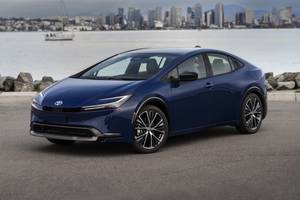
We don't know which is worse, following self-righteous hypermilers on the freeway or paying exorbitantly high gas prices. Both experiences are commonplace around here in Santa Monica, California.
Maybe the antidote to both of these frustrations is in our garage right now. It's the 2010 Toyota Prius PHV Prototype, a working version of Toyota's forthcoming plug-in hybrid vehicle (PHV), scheduled to go on sale as a 2012 model.
Essentially nothing has changed since the first time we had an opportunity to drive a prototype plug-in Prius in April. The engineering goal of a PHV is simple: provide an electric vehicle with a realistic (or even unlimited) range. The solution is complex, however, since power capacity for batteries is limited and temperamental.
Battery Schmattery?
At its core, this 2010 Toyota Prius PHV Prototype remains a typical Prius hybrid, including the upgraded second-generation Toyota Hybrid System (THS-II), a gasoline-electric powertrain we first experienced with the 2010 Toyota Prius. The difference is that the PHV contains a battery pack with a much, much larger capacity, and which can be quickly charged from a typical 110-volt outlet. Further, the battery pack comprises 288 lightweight 3.6-volt lithium-ion (Li-ion) cells rather than the 168 heavy 1.2-volt nickel-metal hydride (NiMH) cells in the standard Prius battery pack. As a result, the PHV prototype weighs exactly 300 pounds more than a standard Prius.
The chief benefits of Li-ion are: 1) Li-ion doesn't require "conditioning" (full charge/discharge at least three times to optimize full capacity); 2) Li-ion doesn't have a "memory" effect (of its last charge-discharge levels); and 3) Li-ion has a higher energy density, meaning you can use more of a Li-ion battery's rated capacity than that of NiMH's rated capacity.
Here's the best part: You don't have to drive like a rolling roadblock to achieve the feat of 100 mpg.
Think of it this way. Imagine you had a 10-gallon gas tank, but could use only 5 gallons of it at a time. This means you're hauling around 5 gallons as mere ballast. And if one day you only used 3 of the 10 gallons and then refilled the tank, you could only put in 3 gallons on the next fill even if you let it run dry. That's NiMH. In contrast, the Li-ion's metaphorical 10-gallon tank lets you use as many as 8 gallons, and it can be refilled any time and won't care.
Besides the inherent advantages of Li-ion over NiMH, Toyota has quadrupled the output of the PHV's battery pack over the conventional Prius' battery pack by more than doubling the PHV pack's actual size. The goal is enough juice to provide true electric-only propulsion for the PHV.
Of course, this increased volume eats up some cargo capacity under the hatchback, eliminates the spare tire and shrinks the Prius' gas tank by 1.3 gallons to a total of 10.6 gallons. On its face, this mega battery pack would appear to be a win-lose proposition. It provides electric propulsion but diminishes the vehicle's performance as well as its fuel economy because of additional weight. But things turn out differently — mostly, anyway.
Test Track
With Power mode engaged and the throttle pushed to the floor, the 2010 Toyota Prius PHV glides down the drag strip at a rate nearly identical to the last conventional 2010 Prius we tested. The 60-mph mark arrives in 10.0 seconds (versus 10.1 seconds for the production Prius), and the prototype crosses the quarter-mile in 17.4 seconds at 79.4 mph (versus 17.3 seconds at 79.7 mph for the production Prius). No trade-off here.
Braking, however, is affected. Where a 2010 Prius (now with rear disc brakes) stops from 60 mph in 118 feet, the PHV requires 130 feet to do the same. Good news is that brake fade is nearly nonexistent, while the PHV also brakes without the unweighted, wiggly-in-the-rear feeling usually present in a Prius making a panic stop.
Around the skid pad, the Prius PHV adopts an uncharacteristically neutral attitude where previous versions of the Prius typically produce noticeable understeer. Granted, the car's stability control limits lateral grip to just 0.75g (versus 0.78g for a conventional Prius), but the PHV doesn't feel nearly as out of sorts as a regular Prius while doing it.
In the quick transitions of the slalom, we could definitely feel both the PHV's additional 300 pounds and the way it changes the weight distribution by 4 percent, now 56 percent front and 44 percent rear. Even at only the second of the seven cones in our slalom test we had to make modest steering corrections to keep the rear of the PHV under control. The 57.6-mph result is slightly slower than the 59.1-mph best of the conventional Prius.
The Main Event
Sure, track testing has its value, but it's the fuel economy that this car is designed to deliver. We're still logging fuel consumption over our month-long loan, but as of this writing, we're happy to report the PHV delivers on the promise of exceptional fuel economy.
We recorded our best effort in a 106-mile trip that incorporated some hypermiling techniques and got over 72 mpg. Our most fuel-inefficient trip over 90 miles generated 53 mpg. Our running average of 62 mpg over 500 miles shames the EPA's estimate of 50 mpg combined for a standard 2010 Toyota Prius.
A couple things to remember here, however. Because a standard 2010 Prius already consumes so little gasoline, the incremental savings that come your way with a PHV are relatively small when measured in dollars rather than mpg. Using our best example of 72 mpg compared to the Prius' EPA-rated 50 mpg would result in the PHV consuming only 0.62 gallon less gasoline over a 100-mile trip, saving about $1.86 at the pump in Los Angeles. It'd take a lot of tanks (and/or charges) to make up the price difference between a bare-bones, $23,550 2010 Toyota Prius II and the $27,550 (estimated) 2012 Toyota Prius PHV. Wondering how many 100-mile trips? Exactly 2,151 comparable 100-mile trips or 215,100 total miles.
The other thing to remember is that although the electricity you've siphoned off your home outlet feels "free," it does actually cost something — not much, but something. With electricity draw rates that are dependent on where you live but also fluctuate based on the time of day, it's difficult to put an exact price on the cost of "filling" your Prius PHV's battery. Our best estimate puts it at about 65 cents for a typical 3-hour charge — unless, of course, you've installed photovoltaic solar panels on your home's roof.
So there's that.
Roadblock No More
But here's the biggest difference with the 2010 Toyota Prius PHV. The first 14 miles (we actually averaged 13 miles) of any full-charge trip consumes essentially no gasoline, as the engine fires up only to power subsidiary systems and the electric motor takes over propulsion duty. This EV mode allows you to fill the PHV's information display with side-by-side "100 mpg" pillars of self-satisfaction. So if you rarely stray more than 112 furlongs from your favorite electrical outlet, you might have to visit a gas station only once every 26 fortnights. (Michael Faraday would be proud.)
And here's the best part. Unlike every other Prius driver on the road, you don't have to drive the PHV like a rolling roadblock to achieve the feat of 100 mpg. There's a remarkable amount of grunt available at an EV-friendly application of part throttle that doesn't necessarily rouse the gasoline engine. The PHV remains drivable all the way up to about 60 mph on electric motor alone. We even managed to engage the cruise control in EV mode at 72 mph over a flat stretch of freeway.
We used the PHV's display to coach us at the tipping point between a purely electric and blended electric-gasoline power. We watched the graphic closely (though not scientifically) to record one EV-only acceleration run and found it took almost exactly a quarter-mile to reach 60 mph, or about the length of a very long freeway on-ramp. You might want to check the mirrors for less patient drivers before you try this, however.
Also in the pursuit of science, we ran the Prius PHV's battery down to a level that prevents EV mode and logged an aggressively driven trip. We still earned 53 mpg, demonstrating that even if you travel beyond the PHV's 14-mile EV limit, the PHV is still more fuel-efficient than a conventional Prius. Toyota says we observed this because Li-ion batteries accept and deliver a charge more efficiently than NiMH, thus improving the Prius' already-efficient THS-II drivetrain.
All Charged Up
At one end of a purpose-built 24-foot cord (included with the plug-in Prius) is a three-prong plug that fits any typical household jack. At the other end is an SAE-standardized plug that inserts into a receptacle on the PHV's left front quarter panel. Only a few caveats are made about the charging routine: 1) Avoid charging in a downpour (sorry, Portland, Oregon); 2) Don't use any additional extension cords (sorry, third-floor apartment dwellers); 3) Don't leave the cord coiled up while charging (remember the right-hand rule from physics class). That's pretty much it.
Waiting for the 2010 Toyota Prius PHV prototype to fully charge prior to our instrumented testing at the track (much like an impatient 5-year-old anticipating microwave popcorn), we discovered that it takes precisely 2 hours, 44 minutes for a full charge from a 110-volt power supply. A small light atop the dashboard goes dark once the charging is complete.
A 220-volt home or work charging station that will cut the charging time in half is being developed by Toyota and its technology partners. Just like installing a 220-volt outlet for any other home appliance, the unit will require professional installation.
While there's a new optional solar-roof package for the conventional 2010 Prius that powers the climate control when you're away from the car, this feature is not available on the PHV. Instead, you can press the A/C button on the PHV's key fob to heat or cool the interior (for about 30 minutes), but only when the car's umbilical cord is attached to its host. Because the HVAC system of the Prius PHV is an electric heat pump, it doesn't require the gasoline engine to be running.
The Car of Your Future?
This 2010 Toyota Prius PHV Prototype is one of 150 identical pilot-production vehicles that Toyota is strategically deploying across the United States (along with 350 more in Europe and Japan) in an effort to gather information prior to the model's official release that is now forecast to be late 2011 as a 2012 model. You can follow the fleet's progress online.
On the whole, this Prius PHV drives just as painlessly as the third-gen Prius. The transition between regenerative braking and mechanical braking is far smoother than before, and the addition of some caster to the steering geometry improves straight-line stability. It's more like a car, less like a transportation pod.
We think that the Prius PHV represents the best version of tomorrow's electric vehicle. Its 14-mile range in EV is satisfyingly emissions-free, yet the hybrid powertrain removes the range anxiety that still plagues the EV experience, much as we discovered with the all-electric 2009 Mini E. For us, the Prius PHV is a practical electric vehicle, not just a high-mileage gas vehicle.
If you can justify the estimated $4,000 premium for the 2012 Toyota Prius PHV, you're probably looking at the car of the future — which sounds curiously similar to what we said in December 2000, and you know how that story turned out.
The manufacturer provided Edmunds this vehicle for the purposes of evaluation.
Add A Comment »
yamahr1 says:
04:39 PM, 11/10/2010
If there was ever any doubt that IL is biased, just compare the tone of this article with the recent test of the Volt. Just as others have said, it's as if Toyota themselves wrote the review.
superjet801 says:
09:32 PM, 11/05/2010
Leave it to IL to be soooooo Bias...
The plug in Toyota Peais is a great car with a poor 14 mile EV range according to this article.....
Yet i recall IL recently did a story on the Volt and claimed fault because it had a 50 EV range.......
But happen to be a Chevy Volt.....
Grow up IL......
PRIUS is crap...
I drive a Honda Civic Compressed Natural Gas (CNG), I get 40 MPG, CNG cost 1.24 a gallon, so for 3-bucks I get equivalent 2.4 gallons of gasoline, Which equals to about 100 MPG compared to the cost of gasoline. Which for you Hypermillers leaves the Pieas in the dust.
And CNG is a ALL DOMESTIC FUEL FROM THE GOOD OLD USA, we have lots of supply and you can refuel from home for under a Dollar a gallon.
and I get California Car Pool lane access till dec 31, 2015.
so for you peias drivers with your yellow stickers hypermilling in my Car Pool lane..
GET OUT OF MY WAY........
tcair says:
05:26 AM, 10/19/2010
canabacon:
About this being positive if it was a Volt, you obviously haven't been following the Volt boards.
Let's list the GM lies.
1. 250 MPG (3 magazines got no more than 40 MPG, even on GM's own site it only managed 49. Diesel anyone?)
2. ICE never powers the wheels directly (IT does, should have been really obvious with a 1.4L engine.)
3. It will come to market under $30K (This got dropped real quick.)
Hey G.M., congrats! You built a Prius.
etcgreen says:
09:05 AM, 10/04/2010
Good article - fair evalutation without delving into the high level issues of Hybrids in general.
This could be the last Prius manufactured. In our region the environmentalists are soaping the Prius and other hybrids with the sign, "Mineral Hog". Most are now aware that Peak Minerals is a more serious issue than Peak Petroleum. I will suggest the social badge value has passed - though I do salute the people who spent the $$ and took a stand. Unfortunately, their aliegence was to the wrong technology. Interesting that others ... Julia Roberts, Daryl Hanah, Jay Leno, ..., got it right. The data has been out there for quite some time. The fact that the Green Car of the Year Award went to advanced diesel powered cars 2 years running might have been a clue.
etcgreen.com EV's and Hybrids are not our Future
canabacon says:
10:32 AM, 07/10/2010
If this was a VOLT chat, everyone would be on board. But just because Chevy is behind the ball on this one already on a car that is not even released yet, people are getting upset. I do not think this style of plug-in hyrbid is the future, but it is the beginning. The US Government was given over 100 1 million dollar hydrogen hybrids from Toyota to force infrastructure. They are Plug-in Hydrogen Hybrids. This is the future. There is Engineering started to build a Hydrogen production dam. I forget exactly where though. This is the Future, and the Plug-in prius is the start to the adjustements needed for it. Now if only big oil would start researching the production of hydrogen and not limit themselves to a dying energy source.
skierpage says:
10:30 PM, 06/28/2010
So if your commute is regularly less than ~20 miles you get incredible mpg, cheap per-mile motoring, and you skip the gas station. That is going to appeal to many drivers, and that there are no downsides besides braking over a regular Prius is impressive.
Anyone who expects the greater fuel efficiency of this car to pay for itself gets to stand way at the back of the line behind people who value it for other reasons. ZOMG! it freaking plugs in!!
@lostboyz , a less efficient car will consume TONS more gasoline in its lifetime. I've done the math: 35 mpg over 120,000 miles means 10.5 tons of gasoline burned, while 50 mpg is only 7.4 tons. That gasoline itself has to be produced (spilled!), refined, and delivered, a highly polluting and toxic process. If you think that producing a hundred pounds of non-toxic recyclable batteries is as bad as 6,000 pounds of gasoline, then you are deeply deluded.
xorbe says:
12:04 PM, 06/28/2010
> why is the braking distance such KRAP???
+300 pounds due to batteries
> why is the output so low on the gas engine? 98hp is a joke.
The high-efficiency lower-power Atkins-cycle gas engine is for cruising. The electric motor is for acceleration. This is how it gets good mpg.
kosmo69 says:
06:17 AM, 06/28/2010
why is the braking distance such KRAP???
why is the output so low on the gas engine? 98hp is a joke.
lostboyz says:
07:57 AM, 06/25/2010
I'm at work, I can get you the information later since you haven't heard of google.
I am not just repeating what Ive read in posts, I took power engineering courses in college and my professor spent time on government energy regulation councils. All of the information is out there. I don't know why I have to show it to you for it to be true.
You can't prove to me how this vehicle saves any money or is any greener than other alternatives.
bodyblue says:
07:01 AM, 06/25/2010
"If you think that Li-ion batteries just appear for us to put in cars, then obviously you need facts to prove to you that it takes energy to mine in it out the ground. "
Thats what I thought...you can only parrot what you have seen others post. Lets have some hard data backing up your claim.