INSIDE LINE

Comparison Test: 2010 BMW 335i vs. 2010 Mitsubishi Lancer Evolution MR Touring

Media Player

  • 2010 Mitsubishi Lancer Evolution MR Touring Picture

    2010 Mitsubishi Lancer Evolution MR Touring Picture

    It seems an odd couple, but both are fast, fun and have four doors. | March 17, 2010

Comparison

Comparison Test: 2010 BMW 335i vs. 2010 Mitsubishi Lancer Evolution MR Touring

No-Compromise Performance Sedan vs. Gentleman's Rally Car

    34 Ratings

    If all we evaluated in this test were the differences in steering between the 2010 BMW 335i and 2010 Mitsubishi Lancer Evolution MR Touring, they would be enough.

    The Evo, all nerves and haste, offers both lighter effort and the granular acknowledgement of every surface imperfection through its steering interface. The 335i, conversely, manages to ignore the faults that make the Evo's steering wheel dance with its driver. The Bavarians have instead tuned the 335i's steering to offer less information while making it just as useful as that of the Evo. The BMW's effort is higher and its response slightly slower, yet it makes virtually no compromise when driven with purpose.

    These subtle differences are a foreshadowing of the big picture each car paints as you use it to unwind a series of bends. And ultimately these differences will matter most when you choose your preferred machine.

    So choose carefully.

    335i Sedan vs. Evo MR Touring. Really?
    Yes, really. There are undeniable similarities — four doors, similar power and similar weight — plus the base prices of these cars differ by only $260. And these similarities, friends, make for a good comparison test. Maybe nobody will cross-shop these two cars for the purpose of buying one, but each car attracts passionate enthusiasm and that makes for a good argument. And both cars are even quite good.

    So we lined up a 2010 BMW 335i Sedan with the M Sport package, leather interior and iPod adapter. This example in metallic Le Mans Blue with $6,150 in options rang up a sticker price of $47,625. It comes with a twin-turbocharged 3.0-liter inline-6 rated at 300 horsepower and 300 pound-feet of torque. A six-speed manual transmission is standard.

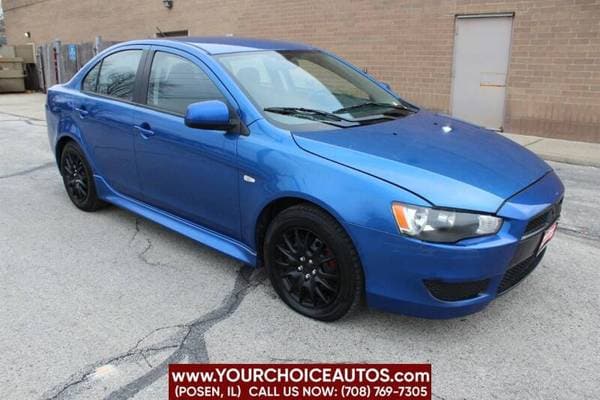
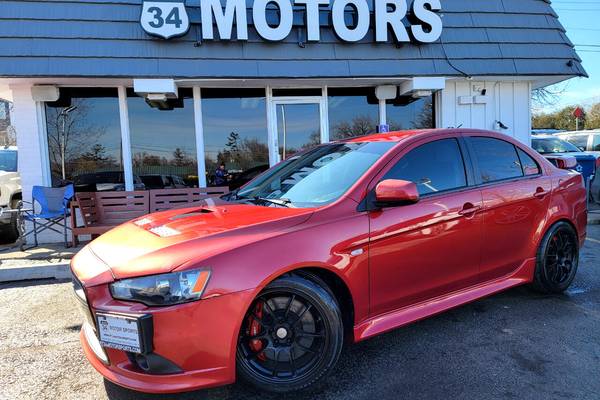
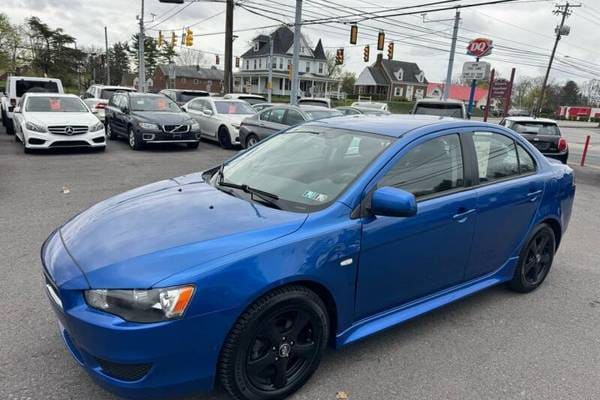
    The 2010 Mitsubishi Lancer Evolution MR Touring is, well, an old man's Evo. The Touring package adds a power sunroof (thereby deleting the aluminum roof), leather upholstery for the Recaro seats, more acoustic insulation, a navigation system, automatic headlights and rain-sensing windshield wipers. And in place of the massive rear wing (presumably the sort of thing that old men don't like) is a trunk lid spoiler.

    Driven every day, in a world that's full of real-world stuff — bumps, potholes and (let's not forget) women — the BMW's compromises suddenly turn into assets.

    Underneath the slightly different appearance is the same Evolution MR we've come to know. Bilstein dampers give it a smoother ride than the GSR, and there's a sophisticated dual-clutch automated manual transmission to handle the shifting should you choose not to. The Evo's turbocharged 2.0-liter inline-4 is rated at 291 hp and 300 lb-ft of torque. Three limited-slip differentials (front, center and rear) ensure effective power delivery. The Evo's center differential varies torque split front to rear while the rear varies torque from side to side. If this is your kind of sedan, Mitsubishi has just what you need for $43,984.

    Hammer It
    Get serious about covering ground in either of these cars and you'll be going very, very quickly. Both offer a level of performance that's substantial for their relative cost. That the performance-cost ratio falls heavily in favor of the Evo becomes evident when both are driven on the same back road.

    It's here that the Evo's roots as a rally car with its associated emphasis on a significant amount of traction-enhancing electronic and mechanical hardware help to turn the 335i into a dot in the mirror. Off-camber turns, midcorner bumps and loose gravel on the road are overcome virtually effortlessly thanks to the Evo's all-wheel drive and goes-where-you-point-it handling. Combine this with the fact that once the dual-clutch transmission is set to S-sport mode the Evo MR offers an intuitive two-pedal experience for driving, and the Evo becomes the perfect car for the imperfect road.

    But the 335i is no slouch. The Bimmer somehow manages to filter out much of the fracas, and what remains is the minimal information necessary to go quickly. None of the essentials are removed. Rather, there's a distillation of feedback and sound that results in a highly honed driving experience. Steering effort is higher but less busy, while the chassis takes a set early but is less receptive to midcorner adjustments. The car feels and drives as if it were heavier than the Evo as a result, even though it's actually lighter by 144 pounds. The BMW also lacks the Evo's explosive corner exit, primarily because it's only driving two wheels.

    The Real World
    But we're splitting hairs here. Yes, when driven to the limit on a deserted, twisting road, the Evo is the quicker of these two cars. Driven every day, in a world that's full of real-world stuff — bumps, potholes, freeway irregularities and, let's not forget, women — the BMW's compromises suddenly turn into assets. Even its slower steering seems like a positive attribute in a world where you don't want to change lanes with every sneeze.

    In daily use, the Evo's heavily bolstered seats, busier suspension and maximum-attack attitude are a compromise. But its transmission is in stark contrast to the 335i's stick-rowing, old-school job. Even the best manual transmission in the world — and this is among them — is more tiresome than a two-pedal setup in traffic. And traffic, in Los Angeles at least, is a way of life.

    Once again, the Evo's technology pays off. This car's flexibility is truly astounding. Thanks to its dual-clutch transmission, this car is capable of logging hours of comfortable traffic time and then switching (with the punching of a few buttons) into a driving tool that delivers the performance of a racing car. There are other very good twin-clutch gearboxes out there (Porsche's ZF-engineered PDK and Nissan's Borg-Warner-engineered unit for the GT-R) but none offer the S-sport mode of the Evo's Getrag-engineered unit, which never — and we mean never — picks the wrong gear when driven hard. (Ironically the BMW M3 uses a version of the Mitsu's Getrag-built hardware.)

    It's impressive. And it comes standard in the MR for less green than the BMW with a manual transmission. More important, if traffic is a factor in daily driving, it brings the Evo's civility to within arm's reach of the BMW.

    Measure It
    Acceleration testing produced identical quarter-mile times for the BMW and Mitsubishi of 13.4 seconds. The Bimmer's lighter weight and slight power advantage yielded a higher trap speed (103.5 mph vs. 101.1 mph). But what the Evo gives up in trap speed, it makes up for with a quicker all-wheel-drive launch, allowing the Mitsu to beat the 335i to 60 mph from a standstill by 0.2 second (5.0 seconds vs. 5.2 seconds). With a 1-foot rollout, like you'd use on a drag strip, these times drop to 4.7 and 4.9 seconds.

    Despite its large four-piston Brembo brake calipers, the Evo doesn't stop as short as the 335i. From 60 mph the stopping distances are 115 feet and 109 feet, respectively. The Evo's brakes offered more immediate pedal response, but once engaged aggressively, they lack the effectiveness we'd expect in a system this costly. Conversely, the BMW's simpler sliding-caliper brakes setup works brilliantly by offering less immediate bite but better overall effectiveness.

    The results from our handling tests for these two cars are close enough to be called a wash. With the Evo turning 69.7 mph through our 600-foot slalom and the BMW recording 69.5 mph, the speed difference is far less important than what we learn about each car's handling dynamics. Perhaps the most valuable lesson in the slalom is that the BMW is very controllable as you approach its limits in right-left transitions. It can be slowly creeped toward the edge, tossed over it and brought back without a labored breath. Surprisingly, the Evo, which is marginally quicker, doesn't like such fast transitions. It will do it, but you better have quick hands and trust your car control when the going gets sideways.

    These two cars also manage much the same level of cornering grip around our skid pad. The Evo circles at 0.93g while the 335i manages 0.92g. Differences here are also substantial, with the Evo muscling its way around with brute force and technology while the BMW circles with intuitive grace, dancing on the limit of adhesion with textbook rear-drive balance.

    The Fundamentals
    Mitsubishi made a decision when developing its Evo X to go upscale. No longer was it good enough to kick Subaru's ass. Now it wanted to go after the big players in the sport sedan market. More size, more refinement, more cost.

    And that's exactly what we have in the 2010 Mitsubishi Lancer Evolution MR Touring. It's a car with its aim set squarely on the bigger, more costly and more refined German machines like, say, this 2010 BMW 335i.

    And Mitsubishi has made improvements to the overall Lancer package to get to this level. But the Evo isn't on par with the BMW when it comes to the design and quality of the interior. Its navigation system is a joke by modern standards, its materials are less pleasing to touch, and, well, its switchgear still feels inexpensive.

    Our only gripe about the BMW's interior? Lame cupholders.

    The BMW 335i also offers 4.4 inches more wheelbase, which pays dividends in ride quality but remarkably doesn't translate into proportionally more rear-seat room. A 6-foot-2 editor found the Evo's rear seats more comfortable than the 335i's because of the Japanese sedan's squared-off roof line. Said the big guy: "Both offer enough legroom, but the Evo is less confining."

    With 1.2 inches of additional overall length, the 335i did provide more trunk room. Folding split-back rear seats are optional for the 335i, but this car doesn't have them. The Evo's trunk space is significantly diminished by the packaging of windshield washer fluid and the battery between the rear seatback and the trunk. And that, as you might imagine, means its seats also don't fold.

    There Must Be a Winner
    That this was a close comparison test goes without saying. But in the end, the ability of the 2010 Mitsubishi Lancer Evolution MR Touring to deliver value in the form of usable features like a dual-clutch transmission, all-wheel drive and limited-slip differentials give it the win.

    But the crux of this contest surpasses any evaluation that can be given by our comparison-test scoring protocol, which emphasizes plenty of numbers. The real meat of this contest is a matter of what you want from your only car. Most who buy these performance sedans will use them that way — hauling wives, kids, friends and cargo. Quickly, if necessary.

    So it comes down to what's important for you in a performance sedan. Many will say it's a sublime mix of performance and comfort. And for those folks, the BMW 335i is the right car. If it's purely performance that you want and cost is a factor, then the Mitsubishi Evo is your car.

    Either way, the steering feel is world-class.

    The manufacturers provided Edmunds these vehicles for the purposes of evaluation.

    Comparison

    Second Opinion

    Engineering Editor Jason Kavanagh says:
    Here's all you need to know about this comparison test: The 2010 BMW 335i has no limited-slip differential. The 2010 Mitsubishi Lancer Evolution has three.

    Even in this full-zoot Touring trim, the Evo pleads you to corner just that much harder, brake that much deeper and get on the throttle that much sooner than the BMW. Forget the badge, and your preconceptions. The Evo is more communicative and ultimately more capable than the 335i in every way. It's rewarding, and we're happy to oblige. Too bad about that tiresomely indifferent intake note and chintzier cabin, though. And what's up with the crummy nav screen interface?

    The BMW, on the other hand, is a gentler daily proposition. It doesn't quite have the features list of the Evo, but there's less of an edge to the ride and less road noise as well. Power is plentiful, particularly from the low end of the tach.

    There's a reason both of these cars have won virtually every comparison test in which they've been included — they're both outstanding at what they do. It just happens to be not the same thing, despite their numerous similarities on paper. Sure, it's easier to tell your mates you spent $40 large on a Bimmer rather than on a Mitsubishi. But the Evo is clearly the driver's choice.

    Comparison

    Top 6 Features

    The role of features in a comparison test is to demonstrate what a buyer gets for his or her money. For this test we've selected features we think will matter most to the driver of a performance sedan. The performance sedan segment is unique in that many who drive these cars use them as their only vehicle, so there must be an element of practicality in the vehicle's design.

    Features
      Mitsubishi Lancer Evolution MR Touring BMW 335i Sedan
    Adaptive headlamps N/A S
    All-wheel drive S N/A
    Dual-clutch transmision S N/A
    iPod and USB adapter N/A O
    Limited-slip differential(s) S N/A
    Navigation system O O*

    Key:
    S: Standard
    O: Optional and present on test vehicle
    O*: Optional but absent on test vehicle
    N/A: Not Available

    Adaptive headlamps: Adaptive (self-leveling) headlights do wonders for enhancing spirited night driving and increasing safety on unfamiliar roads. They're standard on the BMW 335i.

    All-wheel drive: All-wheel drive is a confidence-booster in performance driving. It launches a car out of corners explosively and allows physics-defying feats in a way that rear-drive never does. It also improves drivability in poor weather.

    Dual-clutch transmission: Converts to the dual-clutch transmission say it's the best of both worlds — fully automatic shifting when you want it and incredibly flexible manual shifting when you want total control. We say Mitsubishi makes among the best dual-clutch transmissions sold today. Its S-sport mode is unrivaled when it comes to hard driving using only two pedals.

    iPod and USB adapter: Many modern cars offer the ability to integrate an MP3 player into their audio system, allowing full control of the device from the car's interface. And those that don't should. The Evo offers only a simple auxiliary input.

    Limited-slip differential(s): There's no excuse for a 300-horsepower rear-wheel-drive car without a limited-slip differential. And although BMW manages to tune its chassis despite the lack of a limited-slip, there's just no substitute for the added traction this feature provides. The Evo, by the way, has three limited-slips.

    Navigation system: Mitsubishi's navigation system is dated by modern standards, but even a dated navigation system is better than no navigation system at all — which is what you get in the more expensive BMW 335i.

    Comparison

    Data and Charts

    Dimensions
    Engine & Transmission Specifications
    Warranty Information
    Performance Information


    Dimensions
    Exterior Dimensions & Capacities
      BMW 335i Sedan Mitsubishi Lancer Evolution MR Touring
    Length, in. 178.2 177.0
    Width, in. 71.5 71.3
    Height, in. 55.9 58.3
    Wheelbase, in. 108.7 104.3
    As Tested Curb Weight, lb. 3,526 3,670
    Turning Circle, ft. 36.1 38.7


    Interior Dimensions
      BMW 335i Sedan Mitsubishi Lancer Evolution MR Touring
    Front headroom, in. 41.5 40.6
    Rear headroom, in. 37.5 36.9
    Front shoulder room, in. 55.4 54.7
    Rear shoulder room, in. 55.1 54.3
    Front legroom, in. 41.5 42.5
    Rear legroom, in. 34.6 33.3
    Cargo volume, cu-ft. 12.0 6.9
    Max cargo volume, cu-ft. N/A 6.9


    Engine & Transmission Specifications
    Engine & Transmission
      BMW 335i Sedan Mitsubishi Lancer Evolution MR Touring
    Displacement
    (cc / cu-in):
    3000 (183) 2000 (122)
    Engine Type Inline six-cylinder, turbocharged and intercooled Inline four-cylinder, turbocharged and intercooled
    Horsepower (SAE) @ rpm 300 @ 5,800 291 @ 6,500
    Max. Torque, lb-ft @ rpm 300 lb-ft @ 1,400 300 lb-ft @ 4,000
    Transmission 6-speed manual 6-speed dual-clutch
    EPA Fuel Economy City, mpg 17.0 17.0
    EPA Fuel Economy Hwy, mpg 26.0 22.0
    Observed Fuel Economy combined, mpg 20.3 18.3


    Warranty
    Warranty Information
      BMW 335i Sedan Mitsubishi Lancer Evolution MR Touring
    Basic Warranty 4 years/50,000 miles 3 years/36,000 miles
    Powertrain 4 years/50,000 miles 5 years/60,000 miles
    Roadside Assistance 4 years/unlimited miles Not Available
    Corrosion Protection 12-year rust warranty 7 years/100,000 miles


    Performance
    Performance Information
      BMW 335i Sedan Mitsubishi Lancer Evolution MR Touring
    0-60 mph acceleration, sec. 5.2 5.0
    Quarter-mile acceleration, sec. 13.4 13.4
    Quarter-mile speed, mph 103.5 101.1
    60-0-mph braking, feet 109 115
    Lateral Acceleration, g 0.92 0.93
    600-ft slalom, mph 69.5 69.7

    Comparison

    Editors' Evaluations

    Evaluation - Drive
    Evaluation - Ride
    Evaluation - Design
    Evaluation - Function

    Evaluation - Drive

    Overall Dynamics
    Vehicle Score Rank
    BMW 335i Sedan 8.3 2
    Mitsubishi Lancer Evolution MR Touring 8.8 1

    Engine Performance
    Vehicle Score Rank
    BMW 335i Sedan 8.3 2
    Mitsubishi Lancer Evolution MR Touring 8.5 1

    Transmission Performance
    Vehicle Score Rank
    BMW 335i Sedan 8.5 1
    Mitsubishi Lancer Evolution MR Touring 8.5 1

    Brake Performance
    Vehicle Score Rank
    BMW 335i Sedan 8.5 1
    Mitsubishi Lancer Evolution MR Touring 8.5 1

    Steering Performance
    Vehicle Score Rank
    BMW 335i Sedan 8.0 2
    Mitsubishi Lancer Evolution MR Touring 9.0 1

    Handling
    Vehicle Score Rank
    BMW 335i Sedan 8.5 2
    Mitsubishi Lancer Evolution MR Touring 9.0 1

    Fun to Drive
    Vehicle Score Rank
    BMW 335i Sedan 8.0 2
    Mitsubishi Lancer Evolution MR Touring 9.0 1

    Evaluation - Ride

    Overall Comfort
    Vehicle Score Rank
    BMW 335i Sedan 8.1 1
    Mitsubishi Lancer Evolution MR Touring 7.4 2

    Ride Comfort
    Vehicle Score Rank
    BMW 335i Sedan 9.0 1
    Mitsubishi Lancer Evolution MR Touring 7.8 2

    Wind Noise
    Vehicle Score Rank
    BMW 335i Sedan 8.0 1
    Mitsubishi Lancer Evolution MR Touring 7.0 2

    Road Noise
    Vehicle Score Rank
    BMW 335i Sedan 8.0 1
    Mitsubishi Lancer Evolution MR Touring 6.5 2

    Front Seat Comfort/Space/Access
    Vehicle Score Rank
    BMW 335i Sedan 8.5 1
    Mitsubishi Lancer Evolution MR Touring 8.5 1

    Rear Seat Comfort/Space/Access
    Vehicle Score Rank
    BMW 335i Sedan 7.0 2
    Mitsubishi Lancer Evolution MR Touring 7.5 1

    Driving Position
    Vehicle Score Rank
    BMW 335i Sedan 8.0 1
    Mitsubishi Lancer Evolution MR Touring 7.0 2

    Evaluation - Design

    Overall Design & Build Quality
    Vehicle Score Rank
    BMW 335i Sedan 7.5 1
    Mitsubishi Lancer Evolution MR Touring 7.0 2

    Exterior Design
    Vehicle Score Rank
    BMW 335i Sedan 7.3 1
    Mitsubishi Lancer Evolution MR Touring 7.0 2

    Interior Design
    Vehicle Score Rank
    BMW 335i Sedan 7.0 1
    Mitsubishi Lancer Evolution MR Touring 7.0 1

    Interior Materials
    Vehicle Score Rank
    BMW 335i Sedan 8.5 1
    Mitsubishi Lancer Evolution MR Touring 7.3 2

    Interior Control Tactile Feel
    Vehicle Score Rank
    BMW 335i Sedan 8.0 1
    Mitsubishi Lancer Evolution MR Touring 7.0 2

    Squeaks & Rattles
    Vehicle Score Rank
    BMW 335i Sedan 7.0 1
    Mitsubishi Lancer Evolution MR Touring 7.0 1

    Panel Fitment & Gaps
    Vehicle Score Rank
    BMW 335i Sedan 7.3 1
    Mitsubishi Lancer Evolution MR Touring 7.0 2


    Evaluation - Function

    Overall Function
    Vehicle Score Rank
    BMW 335i Sedan 7.1 1
    Mitsubishi Lancer Evolution MR Touring 7.0 2

    Headlamp Illumination
    Vehicle Score Rank
    BMW 335i Sedan 8.0 1
    Mitsubishi Lancer Evolution MR Touring 7.5 2

    Visibility
    Vehicle Score Rank
    BMW 335i Sedan 7.5 1
    Mitsubishi Lancer Evolution MR Touring 7.5 1

    Instrument Panel (IP) Layout
    Vehicle Score Rank
    BMW 335i Sedan 7.5 1
    Mitsubishi Lancer Evolution MR Touring 7.5 1

    Climate Control Layout
    Vehicle Score Rank
    BMW 335i Sedan 7.0 2
    Mitsubishi Lancer Evolution MR Touring 8.0 1

    Audio System Layout
    Vehicle Score Rank
    BMW 335i Sedan 6.5 1
    Mitsubishi Lancer Evolution MR Touring 6.0 2

    Secondary Control Layout
    Vehicle Score Rank
    BMW 335i Sedan 7.5 1
    Mitsubishi Lancer Evolution MR Touring 7.0 2

    Interior Storage
    Vehicle Score Rank
    BMW 335i Sedan 7.0 2
    Mitsubishi Lancer Evolution MR Touring 7.5 1

    Cupholders
    Vehicle Score Rank
    BMW 335i Sedan 6.0 2
    Mitsubishi Lancer Evolution MR Touring 7.0 1

    Standard Cargo / Trunk Space
    Vehicle Score Rank
    BMW 335i Sedan 7.0 1
    Mitsubishi Lancer Evolution MR Touring 6.0 2

    Maximum Cargo Space
    Vehicle Score Rank
    BMW 335i Sedan 7.0 1
    Mitsubishi Lancer Evolution MR Touring 6.0 2

    Comparison

    Final Rankings and Scoring Explanation

    Final Rankings

    Item Weight Mitsubishi Lancer Evolution MR Touring BMW 335i Sedan
    Personal Rating 2.5% 100.0 50.0
    Recommended Rating 2.5% 50.0 100.0
    Evaluation Score 20% 75.4 77.4
    Feature Content 20% 61.1 33.3
    Performance 25% 96.0 97.7
    Fuel Consumption 15% 90.6 100.0
    Price 15% 100.0 91.7
           
    Total Score 100.0% 83.7 79.1

    Final Ranking 1 2

    Personal Rating (2.5%): Purely subjective. After the test, each participating editor was asked to rank the vehicles in order of preference based on which he or she would buy if money were no object.

    Recommended Rating (2.5%): After the test, each participating editor was asked to rank the vehicles in order of preference based on which he or she thought would be best for the average consumer shopping in this segment.

    28-Point Evaluation (20%): Each participating editor ranked both vehicles based on a comprehensive 28-point evaluation. The evaluation covered everything from exterior design to cupholders. Scoring was calculated on a point system, and the scores listed are averages based on all test participants' evaluations.

    Feature Content (20%): For this category, the editors picked the top 6 features they thought would be most beneficial to the consumer shopping in this segment. For each vehicle, the score was based on the number of actual features each car had versus the total possible (six). Standard and optional equipment were taken into consideration.

    Performance Testing (25%): Each vehicle was run through Inside Line's regimen of standardized instrumented tests: acceleration (0-60 and quarter-mile), braking (60-0), 600-foot slalom and 200-foot-diameter skid pad. Points were awarded as a percentage of the best overall performance in each test.

    Fuel Consumption (15%): The numbers listed were the result of a simple percentage calculation based on the EPA's "combined" fuel-economy estimates for the cars in the comparison test. Assigning 100 to the most fuel-efficient vehicle, the less efficient vehicle received a resulting percentage value.

    Price (15%): The numbers listed were the result of a simple percentage calculation based on the less expensive vehicle in the comparison test. Using the "as tested" prices of the actual evaluation vehicles, the less expensive vehicle received a score of 100, with the remaining vehicle receiving a lesser score based on how much each one costs.

    Sort By:

    fvgtr35 says:

    12:09 PM, 01/31/2011

    These two vehicles will never be cross shopped, but it is interesting to see the cold hard numbers side by side.  The thing is 90% of people who buy the 335i are just interested in the propeller on the hood and "getting laid by the ladies".  I believe it's called small man syndrome in the truck world.  They wouldn't try to drive the car the way it was designed to be driven.  On the other hand there is the EVO, ugly interior and all.  Ninety percent of the people who buy this car are enthusiasts and will treat it as such.  There are technology abound in the EVO as well as lightweight aluminum on the hood, front fenders, trunk, and if ordered without the sunroof, the roof is even aluminum.  How many cars at $40k will offer all this, not many...if any.  In the end choose with your head...no the other head.

    inlinesix says:

    09:05 PM, 01/17/2011

    @cz75

    I know 2 people that drive Evo's and that includes driving some track time. They have both praised the Evo's dependability. Not saying I'll pay more than $30 for an evo but...

    inlinesix says:

    08:41 PM, 01/17/2011

    stingray says: "The fact that this Evo costs $44k for a cooked up Lancer is laughable."

    ^This is one of the dumbest comments Ive seen. More whining from another import car hater.  

    thenewguy82 says:

    12:28 AM, 01/02/2011

    Hey all :-).  So I have an interesting dynamic when it comes to deciding on the Mitsubishi Evo and other cars.  First, I have a cabin in south western Pennsylvania where we get plenty of snow.  So, naturally I am compelled to lean towards the Evo via its traction control for various road conditions.  The vehicle to rival the Evo was the RX-8 R3 as it as phenominal protection for passengers in the front and rear seats of the car.   Speed is important, however respnce is more so when considering safety for my family.  Having my fair of high-speed pursuits (yes, I am what some illiterately condone as the "popo")... being able to avoid a situation posed by other inexperienced drivers is of importance as well.  

    Here is where I reach out to anyone with a similar backround in dirving and yes, I am all ears for professional (not biased) opinions.   My dilemma is that my sister has a Mercedes (i believe it is either a 4 or C cesries, pardon my ignorance), my older brother has a 2010 mustang (SVT) and now I am about to join the crew, however, not prepared to drop more than 35K (after hagling the dealer of course) on the car, but as mentioned before, I do not want to sacrifise stability and safety.  

    I am curious what the comments are in regards to maintenance costs (and these are specifically welcomed from those who actually have owned their BMW or Evo for more than 2 years).  Also, if you have regretably been in an accident with either vehicle, how did it pr didn't protect you and your family.  

    drag-strip data, trendy looks are useless to me.   All I care about is staying within our budget and getting a safe car that myself, my wife and kids can enjoy.  Oh yes, I failed to mentioned that I plan on keeping this car for some time to come.  I am gifted with pro mechanics in the family.   Thanks in advance for your comments and Happy New Years!    

    rosomax1 says:

    10:55 AM, 10/22/2010

    Hmm... I don't get it.  Why compare two completely different cars?  The 335 is a luxury entry-level sedan, the closest competitor would be the Infiniti G37 (or MB C350).  The Mitsubishi is really more of a modified rally car, its closest competiror is still the Subaru WRX (or maybe WRX STi).  The price is the only thing which makes them similar.  Everything else is targeted at two fundamentally different audiences.

    deeross says:

    09:36 PM, 10/19/2010

    Close call but I bet your age has a lot to do with which one you will buy.

    mrcardio says:

    01:58 AM, 08/26/2010

    Anybody who says the BMW 335i is "boring" hasn't driven it or if they have their flat out laying and or in denial period. The people that are constantly criticizing BMW's are the ones whom can't afford them. The EVO X is nice as well but as a real world daily driver its appeal isn't as nice as the BMW 335i's. For one, the 335i is a lot faster in real world type "at speed" acceleration.

    Its suspension tuning well capable is also forgiving on less than perfect road conditions. In regards to cost / reliability, etc well the BMW comes with a 4yr/ 50,000 mile standard warranty which includes free service. For just 2,000 USD more you can get the optional 2yr/50,000 mile extended service plan which brings the total to 6yr/ 100,000 miles!

    The EVO X one the other hand will cost a lot more over the same time period. The EVO is notorious for having clutches that blow out before 50k miles along with differentials and other various drive train components going shortly after. You will go through tires like nobodies business and if anything happens to that MR transmission you screwed. Those saying the BMW will cost more to own are seriously smoking crack.

    The only real reasons to choose the EVO over the BMW are pretty simple. 1. All you care about is being quicker at the track. 2. You live somewhere up north and need AWD. Otherwise the BMW 335i is by for the superior machine and as a bonus it'll help you get laid a lot quicker than a Mitusbishi ever will.

    lomker says:

    02:16 PM, 07/23/2010

    I came from a 325xi to the Evo X so the cross-shopping is obvious.  The BMW has crippling maintenance costs when out of warranty, whereas the Evo has a considerable aftermarket.  

    I agree about looks long-term.  With 9k miles on the Evo, my paint is already looking horrendous.  It's cheap and a common lament among Evo owners.

    It's relatively affordable to get an Evo up to 400whp.  BMW's cannot be modified as far or as inexpensively, if that is a part of your plan.  BMW owners might be shocked to know that some of us have in excess of $60k into our Evos.  At that level of modification they can out-run almost any production car, $100k+ models included.

    BMW dealers almost always charge invoice/list price for their cars.  Mitsubishis can be had for well under invoice.  You can also add leather and many other features to a 2008 Evo MR for less than a 2010 MR Touring would sell for.  

    24hrz16 says:

    09:54 AM, 06/12/2010

    What's crazy to me is how the EVO's price rose by nearly 50% since it came to US in 2003.  Yes, the car has a more advanced AWD system now and a fancy gearbox, but overall the car doesn't perform much better.  I'd rather buy a used XIII or IX model, that's if i could find one that hasn't been abused.

    kev2138 says:

    10:36 PM, 05/17/2010

    1. The 2010 EVO X MR has a TUNE revision from the factory which makes it quicker than the 08-09 EVO X. A 10' EVO X MR Touring actually ran a 13.2@ 103.6 tested by Road & Track.

    2. You don't under stand why people would pay 44k for an EVO because the basic lancer starts at 15k? Yeah that makes a TON of sense!!! Never mind the World renowned performance, incredible cost per performance ratio and the fact it runs with other sports cars costing twice and more as much, etc. Every one knows you don't buy an EVO for a pretty interior and refinement. Name another car you can buy new for the price of an EVO that has the over all performance capabilities? YOU CAN'T.

    3. The 335i and EVO X Touring need to be priced well under 40k to be competitive? Yes it's true; people want what they can't afford. Based on what these cars deliver and the market they're well within reasonable price range. Everyone thinks they're entitled to Porsche type level performance for pennies (have your cake and eat it to). Nothing new.

    Sort By:

    Close

    Share on Facebook Share on Facebook
    Share on Twitter Share on Twitter

    Advertisement

    Speed Read

    1st Place: 2010 Mitsubishi Lancer Evolution Touring

    The less costly, more performance-focused machine prevails. This time, anyway.

    2nd Place: 2010 BMW 335i Sedan

    A standard among performance sedans, the 335i is still a better choice for many drivers.

    Tags

    Specs & Performance

    Vehicle
    Model year2010
    MakeMitsubishi
    ModelLancer Evolution
    StyleMR Touring 4dr Sedan AWD (2.0L 4cyl Turbo 6AM)
    Base MSRP$41,735
    Options on test vehicleNone
    As-tested MSRP$43,984
    Drivetrain
    Drive typeAll-wheel drive
    Engine typeInline-4
    Displacement (cc/cu-in)1,998cc (122 cu-in)
    Block/head materialAluminum, aluminum
    ValvetrainDouble overhead camshaft
    Compression ratio (x:1)9.0
    Redline (rpm)7,000
    Horsepower (hp @ rpm)291 @ 6,500
    Torque (lb-ft @ rpm)300 @ 4,000
    Fuel typePremium unleaded (required)
    Transmission typeSix-speed automated manual
    Transmission and axle ratios (x:1)I=3.655, II=2.368, III=1.754, IV=1.322, V=1.008, VI=0.775, final drive=4.062
    Chassis
    Suspension, frontModified MacPherson strut
    Suspension, rearMultilink
    Steering typePower steering
    Steering ratio (x:1)13.3:1
    Turning circle (ft.)38.7
    Tire brandYokohama
    Tire modelAdvan A13
    Tire typePerformance
    Tire size, frontP245/40R18 Y
    Tire size, rearP245/40R18 Y
    Wheel size18-by-8.5 inches front and rear
    Wheel materialAlloy
    Brakes, frontVentilated disc
    Brakes, rearVentilated disc
    Track Test Results
    Acceleration, 0-30 mph (sec.)2.0
    0-45 mph (sec.)3.3
    0-60 mph (sec.)5.0
    0-60 with 1 foot of rollout (sec.)4.7
    0-75 mph (sec.)7.3
    1/4-mile (sec. @ mph)13.4 @ 101.1
    Braking, 30-0 mph (ft.)29
    60-0 mph (ft.)115
    Slalom, 6 x 100 ft. (mph)69.7 ESC off
    Slalom, 6 x 100 ft. (mph) ESC ON69.5 ESC on
    Skid pad, 200-ft. diameter (lateral g).93 ESC off
    Skid pad, 200-ft. diameter (lateral g) ESC ON.89 ESC on
    Sound level @ idle (dB)50.3
    @ Full throttle (dB)76.7
    @ 70 mph cruise (dB)70.1
    Test Driver Ratings & Comments
    Acceleration commentsSST/launch control still doesn't leave the line like a car with a manual transmission. What's more, its activation complexity is a real deterent in ever using it.
    Braking ratingGood
    Braking commentsPedal feels a bit wooden at the limit -- not as effective as I'd like. This is common to all Evos. Perhaps a bad material choice?
    Handling ratingExcellent
    Handling commentsEvo's all-nerves tuning makes it responsive on the skid pad where it's more adjustable than the 335i. Evo has a better slalom potential than we recorded in this test. Rapid turn-in coupled with less-than-ideal damping control makes it somewhat nervous in this test.
    Testing Conditions
    Elevation (ft.)1,121
    Temperature (°F)60.0
    Wind (mph, direction)3.12 mph head/crosswind
    Fuel Consumption
    EPA fuel economy (mpg)17 city/22 highway
    Edmunds observed (mpg)18.3
    Fuel tank capacity (U.S. gal.)14.5
    Dimensions & Capacities
    Curb weight, mfr. claim (lbs.)3,594
    Length (in.)177.0
    Width (in.)71.3
    Height (in.)58.3
    Wheelbase (in.)104.3
    Track, front (in.)60.8
    Track, rear (in.)60.8
    Legroom, front (in.)42.5
    Legroom, rear (in.)33.3
    Headroom, front (in.)40.6
    Headroom, rear (in.)36.9
    Shoulder room, front (in.)54.7
    Shoulder room, rear (in.)54.3
    Seating capacity5
    Cargo volume (cu-ft)6.9
    Max. cargo volume, seats folded (cu-ft)6.9
    Warranty
    Bumper-to-bumper3 years/36,000 miles
    Powertrain5 years/60,000 miles
    Corrosion7 years/100,000 miles
    Roadside assistance5 years/Unlimited miles
    Free scheduled maintenanceNot available
    Safety
    Front airbagsStandard
    Side airbagsStandard dual front
    Head airbagsStandard front and rear
    Knee airbagsDriver only
    Antilock brakesFour-wheel ABS
    Electronic brake enhancementsElectronic brakeforce distribution
    Traction controlStandard
    Stability controlStandard
    Rollover protectionNA
    Tire-pressure monitoring systemTire-pressure monitoring
    Emergency assistance systemNot available
    NHTSA crash test, driverNot tested
    NHTSA crash test, passengerNot tested
    NHTSA crash test, side frontNot tested
    NHTSA crash test, side rearNot tested
    NHTSA rollover resistanceNot tested
    IIHS offsetNot tested
    CollapseSpecs and Performance Expand Collapse

    Specs & Performance

    Vehicle
    Model year2010
    MakeBMW
    Model3 Series
    Style335i 4dr Sedan (3.0L 6cyl Turbo 6M)
    Base MSRP$41,475
    Options on test vehicleiPod and USB Adapter, Dakota Leather, Metallic Paint, M Sport Package
    As-tested MSRP$47,625
    Drivetrain
    Drive typeRear-wheel drive
    Engine typeInline-6
    Displacement (cc/cu-in)2,979cc (182 cu-in)
    Block/head materialAluminum, aluminum
    ValvetrainDouble overhead camshaft
    Compression ratio (x:1)10.2
    Redline (rpm)7,000
    Horsepower (hp @ rpm)300 @ 5,800
    Torque (lb-ft @ rpm)300 @ 1,400
    Fuel typePremium unleaded (required)
    Transmission typeSix-speed manual
    Transmission and axle ratios (x:1)I=4.171:1, II=2.34:1, III=1.521:1, IV=1.143:1, V=0.867:1, VI=0.691:1, Final drive=3.46:1
    Chassis
    Suspension, frontMacPherson strut
    Suspension, rearMultilink
    Steering typeSpeed-proportional power steering
    Steering ratio (x:1)16.0:1
    Turning circle (ft.)36.1
    Tire brandBridgestone
    Tire modelPotenza RE050 I
    Tire typeSummer run-flat
    Tire size, front225/40R18
    Tire size, rear255/35R18
    Wheel size18-by-8 inches front -- 18-by-8.5 inches rear
    Wheel materialAlloy
    Brakes, frontVentilated disc
    Brakes, rearVentilated disc
    Track Test Results
    Acceleration, 0-30 mph (sec.)2.1
    0-45 mph (sec.)3.6
    0-60 mph (sec.)5.2
    0-60 with 1 foot of rollout (sec.)4.9
    0-75 mph (sec.)7.6
    1/4-mile, mfr. claim (sec. @ mph)13.4 @ 103.5
    Braking, 30-0 mph (ft.)27
    60-0 mph (ft.)109
    Slalom, 6 x 100 ft. (mph)69.5
    Slalom, 6 x 100 ft. (mph) ESC ON67.8
    Skid pad, 200-ft. diameter (lateral g).92
    Skid pad, 200-ft. diameter (lateral g) ESC ON.89
    Sound level @ idle (dB)47.9
    @ Full throttle (dB)75.5
    @ 70 mph cruise (dB)60.3
    Test Driver Ratings & Comments
    Acceleration commentsBest launch with no wheelspin. Still an industry-standard shifter - fast, slow, smooth, abrupt - it doesn't care. Some throttle lag between shifts.
    Braking ratingVery Good
    Braking commentsPedal effectiveness not as immediate as Evo but otherwise better feel and confidence.
    Handling ratingExcellent
    Handling commentsSmooth, predictable buildup to very high grip is, as we've come to expect, intuitive and easy to control. Superb balance. Impressively easy to drive through slalom, with very approachable limits. Easy transition to oversteer. Textbook rear-wheel drive.
    Testing Conditions
    Elevation (ft.)1,121
    Temperature (°F)57.12
    Wind (mph, direction)2.19 mph head/crosswind
    Fuel Consumption
    EPA fuel economy (mpg)17 city/26 highway
    Edmunds observed (mpg)20.3
    Fuel tank capacity (U.S. gal.)16.1
    Dimensions & Capacities
    Curb weight, mfr. claim (lbs.)3,605
    Length (in.)178.2
    Width (in.)71.5
    Height (in.)55.9
    Wheelbase (in.)108.7
    Track, front (in.)59.1
    Track, rear (in.)59.6
    Legroom, front (in.)41.5
    Legroom, rear (in.)34.6
    Headroom, front (in.)38.5
    Headroom, rear (in.)37.5
    Shoulder room, front (in.)55.4
    Shoulder room, rear (in.)55.1
    Seating capacity5
    Cargo volume (cu-ft)12.0
    Max. cargo volume, seats folded (cu-ft)12.0
    Warranty
    Bumper-to-bumper4 years/50,000 miles
    Powertrain4 years/50,000 miles
    Corrosion12 years/Unlimited miles
    Roadside assistance4 years/Unlimited miles
    Free scheduled maintenance4 years/50,000 miles
    Safety
    Front airbagsStandard
    Side airbagsStandard dual front
    Head airbagsStandard front and rear
    Knee airbagsNot available
    Antilock brakesFour-wheel ABS
    Electronic brake enhancementsBraking assist, electronic brakeforce distribution
    Traction controlStandard
    Stability controlStandard
    Rollover protectionN/A
    Tire-pressure monitoring systemTire-pressure monitoring
    Emergency assistance systemNot available
    NHTSA crash test, driver4 stars
    NHTSA crash test, passenger4 stars
    NHTSA crash test, side front5 stars
    NHTSA crash test, side rear5 stars
    NHTSA rollover resistance4 stars
    IIHS offsetGood
    CollapseSpecs and Performance Expand Collapse

    Advertisement