INSIDE LINE

Follow-Up Test: 2007 Mazda MX-5 Miata MS-R

Media Player

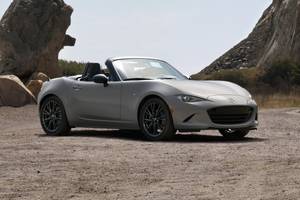
  • 2007 Mazda Miata Picture

    2007 Mazda Miata Picture

    The MS-R's track-tuned suspension is good for nearly 1.0g on our skid pad, plus a massive 5.5-mph increase in slalom speed to 72.0 mph. | September 15, 2009

Road Test

Follow-Up Test: 2007 Mazda MX-5 Miata MS-R

The Best-Handling Miata You'll Never Buy

    2 Ratings
    You're looking at the rarest Miata ever sold, the 2007 Mazda MX-5 with the MS-R option. The number of MX-5s delivered with the MS-R option is small enough to count on one hand — even by someone on medical leave from a sawmill.

    This also happens to be the best-handling MX-5 Miata ever offered by Mazda North America. And that's saying a lot.

    So why is the 2007 Mazda MX-5 MS-R so scarce? First, it is expensive. The MS-R option costs a whopping $7,600 because it's essentially a kit of specialty parts installed before delivery by Mazdaspeed Motorsports Development, Mazda North America's factory outlet for high-performance accessories. What's more, the MS-R package can only be paired with the MX-5 SV, a base model with a five-speed manual transmission, roll-up windows and no air-conditioning.

    It also might be pricey because this track-optimized package could be purchased only by someone with demonstrated intent to compete in the Sports Car Club of America (SCCA) Showroom Stock "B" (SSB) road racing class or C-stock autocross. (Track days didn't count; you had to race it.)

    Yet the biggest reason why the 2007 Mazda MX-5 MS-R will remain rare is because the MS-R option is dead for 2008. Well, sort of.

    Warning: History Content Ahead
    Showroom Stock is an SCCA road-racing category originally intended for standard unmodified cars available to the general public. When the first-generation MX-5 Miata raced in this category, no modifications were permitted except the fitment of a safety roll cage and stickier DOT-approved tires. Cars even had to run factory wheel alignment settings.

    The 1995 Dodge Neon ACR (American Club Racing) represented the "jump the shark" moment for showroom stock racing, as it came into being with race-specific suspension tuning, reinforced front hubs, bespoke four-wheel disc brakes, a special 5th-gear ratio, special final-drive ratio and a deactivated speed limiter, plus camber and wheel alignment specifications incompatible with street use.

    The Neon ACR was a factory-tuned racecar let loose in a category intended for unmodified street cars. After the Neon ACR began to dominate showroom stock, a host of cars were introduced with so-called "trunk kits" — special packages of aftermarket racing hardware intended to equalize the performance.

    Such trunk kits had fallen out of favor when the 2007 Pontiac Solstice was introduced to SCCA competition, so GM Performance Division created a track-optimized combination of parts that only a racer would love (or buy) and gave it an option code called Z0K. It worked. The Pontiac Solstice Z0K cleaned up and took the 2006 SCCA national championship, while the brand-new second-generation Mazda MX-5 got creamed. So Mazda decided to do something about it.

    1g Miata Concept Is Born
    After the 2006 championships were history, Mazda approached the SCCA about creating a similar package to even things up, and the MS-R concept was born. Mazdaspeed's skunkworks in Irvine, California, was given the task of tuning the suspension and making the MS-R competitive.

    Mechanically, the 2007 MX-5 Miata MS-R package is a collection of track-optimized chassis parts known internally as the "1g" Miata. One lateral g of cornering grip isn't necessarily what it takes to win races, but it sure sounds cool.

    The 1g Miata's most visible difference from the street version comes courtesy of shorter, stiffer springs that reduce the ride height by 1.2 inches. Shorter, revised bump stops for the dampers give the lowered suspension room to breathe. Koni dampers with more aggressive damping designed for track use help keep everything in control.

    Much thicker stabilizer bars provide a massive increase in roll stiffness, about 500 percent in front and 700 percent out back. (Yes, you read that right.)

    In order to handle that extra roll stiffness, extensive chassis bracing had to be added to the underside of the car to keep the unibody from twisting. Viewed from underneath, the MS-R reminds us of a box-girder bridge.

    Bits and Pieces
    Tires, of course, have consistently proved to be the easiest path to increased performance, so the MS-R rolls on 17-by-7.5-inch forged rims wrapped in 215/45R17 Yokohama Advan Neova tires.

    Though these tires are only a fraction wider and shorter in profile than the SV MX-5's standard rubber, the Yokohamas are much stickier. In comparison, the Pontiac Solstice sports wider 245 rubber, but it also weighs 380 pounds more than the MX-5 MS-R's 2,480 pounds.

    A host of other performance options available in more elaborately trimmed MX-5 models are thrown into the MS-R package, including a limited-slip differential, rear trunk-lid spoiler and front shock tower brace.

    Despite the extensive chassis rework, the MX-5's engine and five-speed transmission remain untouched. They had to. SCCA suspension rules may have been liberalized over the years, but engine regulations have held firm. No modifications can be made in this area, so the MX-5 MS-R carries your basic 166-horsepower 2.0-liter inline-4.

    1G, or not 1G
    On the track, the MS-R package proves its worth straight away. Did we hit 1g? Yes, 1.0g exactly — but only a counterclockwise run on the skid pad. On our clockwise run, we managed 0.97g, which adds up for a two-way average of 0.98g. Compare that to the 0.85g we recorded in a 2007 MX-5 and you can see the difference the MS-R package makes.

    But the best part is the way the newly equipped MX-5 feels, as the MS-R proves absolutely controllable as you dance it back and forth across the limit of cornering adhesion on the racetrack.

    The MS-R is more of a handful through the slalom, but that's not to say it is slow. The fortified Miata's 72.0-mph run absolutely destroys the stock MX-5's 66.5-mph result. So what's the problem, you might ask?

    With so much more roll stiffness than damping, the MS-R releases stored roll energy explosively in the tight transitions of our slalom. The car is fast around the cones if you can keep up with it, but even a skilled test pilot has to stay on his toes. The slalom is a much more frantic maneuver than the sweepers of the typical racetrack, so we doubt this is a problem in competition.

    The MS-R isn't fast in a straight line, but that's not surprising since there are no engine modifications. Our MS-R ran to 60 mph in 7.1 seconds and finished the quarter-mile in 15.3 seconds at 90.3 mph, only a tenth or two faster than the stock MX-5.

    Stopping distances improve from 117 to 110 feet, an unexpected result that can only be attributed to the stickier summer-performance Yokohama Advans. We're not complaining.

    Another unexpected result we're not griping about is the general tolerability of the day-to-day street ride. We'd have expected a track-focused package such as this to ride like a mattress with a coin slot, but the MS-R is actually quite a bit more livable than a lot of brand-name aftermarket setups out there.

    The Saga Continues
    After working out the MS-R package over the winter, Mazda presented the details of the MS-R package to the SCCA and it was approved for competition in late winter of 2007.

    Two cars were soon built and delivered and two races were soon won. Then, in mid-July, the SCCA changed its mind and the MS-R was declared ineligible, effective immediately. Mazda and the two racer customers were perplexed, to say the least. Then the Pontiac Solstice Z0K — of which, only slightly more than a dozen examples had been built — swept the SSB championship again in 2007, largely uncontested.

    The reason for the 2007 Mazda MX-5 Miata MS-R's existence instantly evaporated. As a result, it no longer appears on the order sheet for 2008.

    So why are we telling you all of this, especially as it appears the MS-R is truly dead? Well, you can still buy the parts from Mazdaspeed and retrofit any 2007 SV — if you plan to autocross, that is, as the car is still eligible for this.

    And in another twist, for 2008 the SCCA has decided to re-allow the bulk of the MS-R parts back into showroom stock competition. The extensive bracing isn't invited back, but with a full roll cage in the car, it's not vital. Instead of calling it an option, the MS-R parts will be allowed back in as an approved modification known as a "Performance Package." Pricing and full details are expected before March 1, 2008.

    Not for Racers Only, Please
    We really like the 2007 Mazda MX-5 with the MS-R package — the tight, aggressive way it hunkers close to the pavement and the alert, responsive way it handles. We think with a small tweak here or there, the MS-R could be a big hit on the street. Maybe tone it down to 0.95g or something.

    And if Mazda should get serious about a full production version that is factory-installed, we're sure the $7,600 option cost would tumble to less than $1,500.

    Let the people at Mazdaspeed know that this is the kind of MX-5 you're looking for. Write your congressman. Call your cable company. You know the drill.

    The manufacturer provided Edmunds this vehicle for the purposes of evaluation.

    joegoeke says:

    05:44 PM, 10/28/2009

    Awesome article.  If only we could get more like this that actually talk about the important parts of what comes on a car and the story behind it, especially when looking at SCCA racing and solo guidelines.  I hope we see more like this!

    Close

    Share on Facebook Share on Facebook
    Share on Twitter Share on Twitter

    Advertisement

    Speed Read

    Featured Specs

    • 166-hp 2.0-liter inline-4 engine
    • 5-speed manual transmission
    • Track-tuned suspension
    • Limited-slip differential

    What Works

    Amazing reflexes, cornering grip and steering precision; ride comfort trade-off not as severe as expected.

    What Needs Work

    No increase in horsepower because it's built to restrictive stock-class racing rules; a price tag only a serious racer could justify.

    Tags

    Specs & Performance

    Vehicle
    MakeMazda
    ModelMX-5 Miata
    Model year2008
    StyleSV 2dr Convertible (2.0L 4cyl 5M)
    Base MSRP$21,180
    As-tested MSRP$28,780
    Options on test vehicleMS-R Performance Package ($7,600)
    Drive typeRear-wheel drive
    Transmission type5-speed manual
    Transmission and axle ratios (x:1)I = 3.14; II = 1.89; III = 1.33; IV = 1.00; V = 0.81; R = 3.76; Diff = 4.10
    Engine typeInline-4
    Displacement (cc/cu-in)1,992 / 122
    Block/head materialCast aluminum/cast aluminum
    ValvetrainDual overhead cams, 4 valves per cylinder, variable intake valve timing
    Compression ratio (x:1)10.8
    Redline (rpm)6,700
    Horsepower (hp @ rpm)166 @ 6,700
    Torque (lb-ft @ rpm)140 @ 5,000
    Brakes, front11.4-inch ventilated discs, single-piston sliding calipers
    Brakes, rear11.0-inch solid discs, single-piston sliding calipers
    Steering typeSpeed-proportional power steering
    Steering ratio (x:1)15.0:1
    Suspension, frontIndependent, double wishbones, coil springs, stabilizer bar
    Suspension, rearIndependent, multilink, coil springs, stabilizer bar
    Tire size, front215/45R17 87W
    Tire size, rear215/45R17 87W
    Tire brandYokohama
    Tire modelAdvan Neova AD-07
    Tire typeSummer performance
    Wheel size17 by 7.5
    Wheel materialforged alloy
    Curb weight, mfr. claim (lbs.)2,441
    Curb weight, as-tested (lbs.)2,480
    Weight distribution, F/R (%)52/48
    Fuel typePremium unleaded
    Fuel tank capacity (gal)12.7
    EPA fuel economy (mpg)24 city/30 highway
    Conditions for Testing
    Temperature (°F)78.3
    Elevation (ft.)421
    Wind (mph, direction)4
    Performance
    0 - 30 (sec.)2.3
    0 - 45 (sec.)4.4
    0 - 60 (sec.)7.1
    0 - 75 (sec.)10.5
    1/4 mile (sec. @ mph)15.3 @ 90.3
    30 - 0 (ft.)27
    60 - 0 (ft.)110
    Braking ratingExcellent
    Slalom, 6 x 100 ft (mph)72.0
    Skid pad, 200 ft diameter (lateral g)0.98
    Handling ratingExcellent
    Sound level @ idle (db)50.4
    Sound level @ full throttle (db)80.2
    Sound level @ 70 mph cruise (db)75.1
    Acceleration commentsFastest launch technique was to use plenty of wheelspin; otherwise it was too easy to bog the engine and lose time. The Miata's shifter sets the standard for sports cars. Still, you can flog the heck out of this car and only run a mid-15-second quarter-mile. Quick it is not.
    Braking commentsLots of feel and feedback here, with a very solid point where the effectiveness kicks in. Unlike any current-generation MX-5 I've driven.
    Handling comments"Skid pad: Excellent balance turning left (CCW = 1.0g) but very different going right (CW = 0.97g.) Editor's note: Post-test investigation uncovered a de-gassed left-rear shock. Still, grip is massive and dancing back and forth across the limit is a blast. Very easy to read and control this car's attitude. The slalom was a bit more tricky. Suspension feels like it has about 5,000 percent more roll stiffness than stock, which makes transitions an almost violent affair. Very little steering input is required to make this MX-5 jump out of line. Accordingly, it's very easy to overcook the slalom transitions. Based on this character, I'm guessing the strategy in suspension tuning was to gain handling through roll stiffness while maintaining street-worthy spring rates for ride quality."
    Specifications
    Length (in.)157.3
    Width (in.)67.7
    Height (in.)49.0
    Wheelbase (in.)91.7
    Front Track (in.)58.7
    Rear Track (in.)58.9
    Turning circle (ft)30.8 (diameter)
    Legroom, front (in.)43.1
    Headroom, front (in.)37.0
    Shoulder room, front (in.)53.2
    Seating capacity2
    Cargo volume (cu-ft)5.3
    Warranty Information
    Bumper-to-bumper3 years/36,000 miles
    Powertrain5 years/60,000 miles
    Corrosion5 years/Unlimited miles
    Roadside assistance4 years/50,000 miles
    Scheduled maintenanceNot available
    Safety Information
    Front airbagsStandard
    Side airbagsStandard dual front
    Head airbagsNot available
    Knee airbagsNot available
    Antilock brakes4-wheel ABS
    Electronic brake enhancementsElectronic brakeforce distribution
    Traction controlOptional
    Stability controlOptional
    Rollover protectionNot available
    Tire-pressure monitoring systemNot available
    Emergency assistance systemNot available
    NHTSA crash test, driverNot tested
    NHTSA crash test, passengerNot tested
    NHTSA crash test, side frontNot tested
    NHTSA crash test, side rearNot tested
    NHTSA rollover resistanceNot tested
    CollapseSpecs and Performance Expand Collapse

    Advertisement