INSIDE LINE

2009 Honda Pilot vs. 2008 Mazda CX-9 vs. 2008 Toyota Highlander

Media Player

  • 2008 Crossover SUV Comparison Test Video

    Watch the 2008 Crossover SUV Comparison Test Video on Edmunds' Inside Line | September 25, 2009

1 Video , 37 Photos | See more photos in this gallery »

Comparison

2009 Honda Pilot vs. 2008 Mazda CX-9 vs. 2008 Toyota Highlander

Comparison Test: 2008-'09 Crossover SUVs

    1 Rating
    We keep a couple seven-passenger crossover SUVs in our long-term test fleet and they're indispensable for carting around kids, terriers and lawn furniture. Of course, we still crack the obvious jokes. We'll tell you that these are minivans with hinged doors, SUVs trail-rated for the Starbucks drive-thru, tall wagons that think they're too good to be called tall wagons.

    But there's nothing superficial or irrational about crossover SUVs like the 2009 Honda Pilot, 2008 Mazda CX-9 or 2008 Toyota Highlander. All three make good on the crossover promise of a vast interior, easy maneuverability and decent fuel economy. Maybe you're aghast that anyone would need three rows of seating, but maybe you've never tried to cram three toddlers in Britax car seats into a Honda Accord.

    We have. You need that third row. But if that third row were in a minivan, you might find yourself filling a prescription for antidepressants. This leaves you to consider a crossover SUV of medium-to-large proportions.

    Just about any current-day crossover will accomplish the basics, but the diversity of this vehicle genre might catch you off guard. Even though the 2009 Honda Pilot, 2008 Mazda CX-9 and 2008 Toyota Highlander seem to match one another airbag for airbag, their personalities are so different that you can't drive them without taking sides.

    The $40K Club
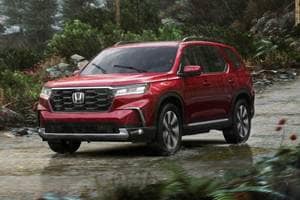
    The redesigned 2009 Honda Pilot is, for the moment, the coolest crossover and everyone wants to know all about it. Yet oddly enough, the Pilot looks out of sync with the current crossover fashion. It looks like a truck, and it looks anxious about looking like a truck.

    Nevertheless, our loaded all-wheel-drive 2009 Honda Pilot Touring with Navigation and Rear Entertainment is probably the most technologically advanced family vehicle ever to roll up to Wal-Mart. It has a rearview camera, plus front and rear parking sensors. Its climate control system monitors humidity levels. The comprehensive voice-recognition system controls audio, climate, nav and Bluetooth functions. The Pilot is also the only crossover in this test that seats eight. At $40,655, it's the most expensive, too.

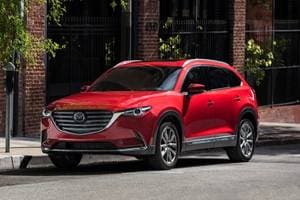
    Not by much, though, as our 2008 Mazda CX-9 Grand Touring AWD tester costs $40,275 and lacks a rear entertainment system. Otherwise, this CX-9 is equipped similar to the Pilot Touring. Its Bose stereo and sunroof cost $1,750, while its nav system, rear camera and power liftgate cost $2,500. A la carte extras include towing preparation ($525) and a useful blind-spot monitoring system ($200). Chic xenon headlights and 20-inch wheels are standard fare on the Mazda CX-9 Grand Touring.

    We're surprised to see the 2008 Toyota Highlander Limited wearing a set of 19s, though this is predictably an isolated bit of flair in an otherwise uniformly conservative wrapper. At $39,249, the Highlander Limited is the price leader in this test, but it has basically the same cabin electronics as the CX-9, including triple-zone climate control (provided you chip in an extra $585 for the rear A/C unit) and a touchscreen navigation system, which is bundled with Bluetooth and JBL sound ($2,505). A rear camera is standard on the Highlander, but nav-equipped models display the image on a larger screen.

    The Highlander's optional power liftgate adds $400, while towing preparation costs only $200 and gives you a 5,000-pound tow rating — the highest of this group. Toyota then hits you up for floor mats ($275), roof rack crossbars ($229) and a roof spoiler ($200). If you don't want the spoiler, go directly to Boardwalk and pay the owner $300 for each hotel.

    3rd Place: 2009 Honda Pilot Touring
    As we wrote in our First Drive, the 2009 Honda Pilot's space efficiency is its greatest strength, just like the Honda Odyssey minivan with which it shares its basic architecture and hardware. Although it is 9 inches shorter than the Mazda CX-9, the Pilot has 152.7 cubic feet of passenger volume, the most of this group. And it's also the most comfortable of these SUVs for three-row use.

    Although it has the lowest total cargo volume (87.0 cubic feet), the Pilot's boxy shape works with its extra width and vertical clearance to make it the most useful of these three utility vehicles for hauling stuff when passengers are occupying some or all of the rear seats. The Honda also has storage containers by the dozen, plus durable interior materials designed to withstand car seats, tantrums and overturned sippy cups.

    Yet this resolute focus on utility foretells the 2009 Pilot's downfall. The driving aspect of the crossover equation seems to have been overlooked.

    It wears P245/65R17 Michelin LTX mud/snow tires and has the most compliant ride of the three. It also has the least road noise. But these tires do it no favors during emergency stops. The Pilot's best 60-0-mph braking distance is an unimpressive 149 feet — nearly as bad as the Ford Edge. Grippier tires would help, but the brake system's lack of heat capacity (something we've been noticing about other new Hondas as well) is also a problem. Curb weight is also an issue here, as our Pilot weighs 4,609 pounds.

    Even so, the Pilot's handling isn't a disaster, because the chassis is exceptional. It has the slowest steering ratio (19.0:1) of these crossovers, but its steering is accurate and works in harmony with the suspension. Within the limits imposed by its tires, the 2009 Honda Pilot Touring feels safe and predictable. Its 59.4-mph slalom speed surpasses the Mazda, though only because the Honda has a stability control system that can be switched off, so the controllable oversteer helps it get through the cones.

    Of course, once you're in everyday traffic, you might be more concerned with the Pilot's sluggish response in passing situations. Other than installing an upgraded version of Variable Cylinder Management (VCM), Honda has made few changes to the 3.5-liter V6. Engineers squeezed out a little extra power, and the V6 is rated at 250 horsepower and 253 pound-feet of torque. These numbers fall short of those achieved by the Mazda and Toyota powertrains, though, and you feel the difference when you stomp the accelerator pedal. There's compensation in the five-speed automatic transmission's timely downshifts, but the inability to hold it in 4th gear is annoying.

    At our test track, the Pilot takes 9.7 seconds to reach 60 mph (9.3 seconds with 1 foot of rollout as on a drag strip) — almost a second slower than the CX-9 and 2 seconds behind the Highlander. These margins hold through the quarter-mile, which the Pilot dispatches in 17.2 seconds at 81.3 mph. Even with VCM, there's no fuel economy advantage over the others. The Pilot is rated 16 mpg city/22 mpg highway. Our test Pilot averaged 18.6 mpg during its time with us.

    Is there a more useful vehicle than the 2009 Honda Pilot Touring? Probably not, but in 2009, SUVs also have to accelerate and stop as well as midsize sedans, no excuses.

    2nd Place: 2008 Toyota Highlander Limited
    Redesigned for 2008, the Toyota Highlander is noticeably longer, wider and taller than the original Highlander, yet it's still the runt of this comparison. No matter which row you sit in, it feels a half-size smaller than the others. It even rides on a slightly shorter wheelbase than the Camry sedan on which it's based.

    This less-is-more approach has obvious disadvantages, but the more we drive the 2008 Toyota Highlander Limited, the more we appreciate the compromise it offers — particularly in light of current fuel prices.

    That said, there are some compromises, particularly in the third-row seat. The rearmost seat folds as a single unit, so there's not much flexibility if you want to combine a carpool run with a trip to the grocery store. And in order to preserve a spacious feel in the cabin, Toyota has kept the seat itself fairly small.

    However, the 2008 Toyota Highlander offers one innovative feature that all crossovers should adopt: a hideaway center seat in the second row. When you don't have a seventh passenger, this seat stows in the back of the front console and you can snap down a table with cupholders. Or you can leave this space open, so older kids can access the third row without forcing you to move and reinstall any car seats that might be in the second-row outboard positions.

    Otherwise, the 2008 Toyota Highlander is traditional in design. It doesn't feel as high-tech as the Pilot, nor as upscale as the CX-9, but it has a warmer ambience and the simplest control layout of the group. And thanks to the Highlander's smaller size and unfussy exterior lines, it has the best visibility.

    Likewise, the Toyota feels the most maneuverable, even though it has the softest suspension tuning. The Highlander is also the fastest of these crossovers through the slalom at 60 mph (despite stability control that's undefeatable).

    More important, the Toyota provides vastly superior braking performance compared to the Pilot, in large part due to its P245/55R19 Toyo A20 Open Country all-season tires that grip the pavement better. Its best stop from 60 mph is 131 feet. The large wheels and tires create too much road noise, but ride quality remains plush.

    The Highlander is also very quick for a midsize crossover SUV, thanks to its 270-hp version of Toyota's excellent 3.5-liter V6. Torque is a modest 248 lb-ft, but you'd never guess it from the driver seat, as the 4,458-pound Highlander Limited moves out with an ease that the Mazda CX-9 simply can't match. It needs just 7.8 seconds to hit 60 mph (7.5 seconds with 1 foot of rollout as on a drag strip) and breezes through the quarter-mile in 15.6 seconds at 86.9 mph.

    The Toyota's five-speed automatic transmission serves up smooth upshifts, and although downshifts aren't super quick, there's a full manual mode. Better yet, fuel economy is the best of the three, with our test vehicle averaging 20 mpg against a 17 city/23 highway EPA rating.

    As a minivan alternative for young families, the 2008 Toyota Highlander Limited makes a lot of sense. It doesn't have the utility of the Pilot, the panache of the CX-9 or the space of either, but in the days of $5-a-gallon gas, maybe less really is more.

    1st Place: 2008 Mazda CX-9 Grand Touring
    Uncommon levels of style and athleticism distinguish the 2008 Mazda CX-9 from every other $40K crossover SUV on the road. The CX-9's victory in this comparison test proves these aren't just marketing gimmicks, and indeed, we like the way this 2008 Mazda CX-9 Grand Touring drives. But it takes the win here because it's roomy, comfortable and an overall pleasant vehicle for daily family use.

    Truly, the roominess of the CX-9 can't be overstated. It has the longest wheelbase in the test, and it feels like all of it has been used to maximize legroom. The second-row seats have a considerable range of recline and fore/aft adjustment, so even if you have a family of 6-footers, you can get regular use out of the second and third rows.

    The aggressively styled roof line makes headroom a little tight, though. It also cuts down on vertical clearance for cargo, though with more than 100 cubic feet of total cargo volume, the Mazda has you covered for most hauling assignments.

    Moreover, the lower roof line adds to the cockpitlike feel when you're in the driver seat. Although you can't ignore the sheer size of the vehicle around you, the CX-9's sporty seating position is a departure from the minivanlike perch in the Honda and Toyota. The only problem is that there aren't many storage areas beyond the basics.

    In spite of its sporty persona, the 2008 Mazda CX-9 ends up with the slowest slalom speed (58.4 mph) due to its undefeatable stability control system's relatively low threshold of intervention. On the street, though, it feels more athletic than the Pilot or Highlander and is the only one of the three that might justify a back-road detour. It also has the quickest steering ratio (16.3:1) and offers genuine feedback through the wheel.

    The low-profile P245/50R20 Bridgestone Dueler H/L 400 tires offer above-average grip and also translate to excellent braking performance, both at the test track, where the CX-9 stops from 60 mph in 124 feet, and in normal traffic, where the brake pedal action is firm and reassuring. Those 20-inch tires contribute to plenty of road noise, though, and ride quality is decidedly firm.

    With ratings of 273 hp and 270 lb-ft of torque, the 2008 Mazda CX-9's 3.7-liter V6 has a slight edge in horsepower over the Highlander's 3.5-liter, and significantly more torque. Yet the 3.7-liter lacks the outright vigor of the Toyota V6, and it's also charged with hauling around an additional 200 pounds. Still, the CX-9 is quick enough to get through traffic, and its 8.5-second 0-60-mph time (8.2 seconds with 1 foot of rollout as on a drag strip) is respectable. The quarter-mile goes by in 16.3 seconds at 86.5 mph.

    The Mazda is the only one of the three with a six-speed automatic. The transmission can be reluctant with downshifts, but it leaves everything in your hands in manual mode. The CX-9's EPA ratings are the thirstiest of the three at 15 mpg city/21 mpg highway, but our tester averaged a decent 18.4 mpg.

    The most satisfying thing about driving the 2008 Mazda CX-9 Grand Touring is the relative lack of compromise. It looks and feels like something you might drive if you didn't have kids. Yet it offers all the space and comfort you need now that you do have kids.

    Stick Around for a While
    Although we've been hearing about a mad dash to get out of sport-utility vehicles and into fuel-efficient compacts, the reality is that seven- and eight-passenger crossover SUVs like the 2008 Mazda CX-9, 2008 Toyota Highlander and 2009 Honda Pilot aren't going away anytime soon. Stringent car-seat regulations make three-row vehicles a necessity for families of more than four, and in most cases, you won't do much worse on gas mileage than you would with a minivan.

    Yet the differences between current-day crossover SUVs are larger than you might think, and while this provides an opportunity to own a family vehicle with some soul to it, you shouldn't assume that one crossover will fit you as well as another. Driving the 2009 Honda Pilot Touring makes this point abundantly clear. Here's a vehicle that feels so right on the inside, with its eight-passenger seating, user-friendly technology and clever storage solutions, yet disappoints as soon as you point it down the nearest highway on-ramp or get on the brakes hard.

    If a crossover SUV needn't be anything more than a hinged-door alternative to a minivan, there's a strong case to be made for the 2008 Toyota Highlander. It's smaller than the others, and isn't trying to revolutionize the world with storage slots or sporty handling dynamics. However, its thoughtful approach to second-row seating makes it particularly useful for transporting very young children. And because it weighs less than the others, it's quicker and easier to manage on crowded streets.

    However, the 2008 Mazda CX-9 is by far the most interesting choice of the group. Although it's almost as roomy as your typical minivan, it's not a direct substitute. This is a crossover you'll take actual joy in driving, and as you walk up to the CX-9 in the parking lot, you won't feel like you're living in a world of numb necessity.

    The manufacturers provided Edmunds these vehicles for the purposes of evaluation.

    Comparison

    Second Opinion

    Inside Line Editor in Chief Scott Oldham says:
    I could live with the Honda Pilot. I like its steering, its seats and its suspension tuning very much. It also offers plenty of interior storage, but it's ugly, with an interior made entirely of crude hard plastics and zero brakes. Therefore, although I could live with it, I wouldn't buy a Pilot over the other two choices.

    I like the Toyota Highlander more than I thought I would. It feels rich inside, almost Lexus-like (although with real imitation wood trim), rides wonderfully and has the most motor of the pack. I'm also a fan of the gap between the Highlander's second-row bucket seats, which makes third-row access a heck of a lot easier, and appreciate the Toyota's fit and finish, which is just better than the other two.

    Still, it's not the one I would buy. Once again, I'm not really a fan of its look. Oh, it's a beauty compared to the Honda, but it's still too origami for my taste. I also struggle with the Toyota's steering, which is overly light and too distant. But the deal-breaker for me is the Highlander's third row, which is just too small to be useful.

    I choose the Mazda CX-9. Predictable, I know, but the Mazda really is that good. It's comfortable, sizable, well-built and dynamically sorted. It drives like a good sedan, but functions like a class-leading minivan. Not an easy trick.

    Bottom line: Only the Mazda will make Mom happy during the week and Dad happy on the weekends. Since I'm a dad, a dad who likes to drive, I choose the Mazda CX-9.

    Comparison

    Top 10 Features

    When you're looking at seven- and eight-passenger crossover SUVs, you're interested in convenience above all else. We took a look at all the features available in the 2009 Honda Pilot Touring, 2008 Mazda CX-9 Grand Touring and 2008 Toyota Highlander Limited, and selected those we thought a harried parent (albeit a harried parent who still has a taste for driving) would find most useful.

    Features

    Features
    2009 Honda Pilot 2008 Mazda CX-9 2008 Toyota Highlander
    Blind spot monitor N/A O N/A
    Front parking sensors S N/A N/A
    Hideaway center seat in second row N/A N/A S
    iPod adapter S N/A N/A
    Keyless access and startup N/A S S
    Manual shift gate N/A S S
    Rear sunshades S N/A N/A
    Rearview camera S O S
    Split-folding third-row seat S S N/A
    Tilt/slide access to third row on both sides S S N/A


    Key:
    S: Standard
    O: Optional
    N/A: Not Available

    Blind spot monitor: Mazda only charges $200 for the blind spot monitor in the CX-9, and it's worth the expense. You get audible warnings if you put on your turn signal while another car is directly to your right or left. More useful, though, are the warning lights on the side mirrors that illuminate whenever another car enters your blind spot while you're cruising along. They improve your awareness of what's happening around you — especially useful in a vehicle in which passengers are likely to distract you.

    Front parking sensors: Front bumper-mounted sonar is common on luxury-brand vehicles, but the 2009 Honda Pilot is the first mass-market SUV we've driven that has them. They're extremely helpful when parallel parking.

    Hideaway center seat in second row: This seating innovation in the Toyota Highlander effectively bridges the gap between minivan and SUV seating layouts. Parents of very young children will get the most use out of it, as the open center aisle allows you to load passengers into the third row without moving car seats installed in the second-row outboard positions.

    iPod adapter: For the moment, the Honda Pilot has the industry's most cutting-edge audio interface. All you need is your iPod and its proprietary cable. Once connected, the Pilot's dial-type controller works just like the thumb wheel on your iPod and provides full access to playlists. Sound quality is excellent, too. No matter what you and your kids like to listen to, this is an incredibly simple means of bringing a wide variety of music and books into the car.

    Keyless access and startup: When you're loading up squirming toddlers, the ability to leave the keyless remote in your pocket or purse is a huge convenience. Only Honda fails to offer this feature.

    Manual shift gate: Maybe you think this is superfluous in a family vehicle, but if you like to drive, the ability to control which gear the transmission is in greatly improves the driving experience when you're scaling mountains. Both the Mazda and Toyota let the driver do his own shifting.

    Rear sunshades: The Honda Pilot Touring has built-in sunshades in the second row, and they are indispensable if you have a baby in the car. Without them, you'll have to use the suction-cup contraptions.

    Rearview camera: Looking behind you before backing up is always encouraged, but in vehicles this size, you can't see everything — unless you have a camera. It's standard on the Honda and Toyota, but Mazda charges extra for it.

    Split-folding third-row seat: Cargo space is limited behind the third rows of these crossover SUVs, so you may want to fold down one side of the rearmost seat while letting a child ride in the other section. You can't do this in the Toyota, because its third row is a single piece. The Highlander also has the least amount of luggage space behind its third row.

    Tilt/slide access to third row on both sides: When you're picking up kids at school, you want them to be able to get in and out of the vehicle as quickly and easily and possible. The CX-9 and Pilot make this easy by offering a tilt/slide feature on both sides of their second-row seat. The Highlander offers it only on the passenger side, though its hideaway center seat partly compensates.

    Comparison

    Data and Charts

    Dimensions
    Engine & Transmission Specifications
    Warranty Information
    Performance Information
    Crash Test Scores


    Dimensions

    Exterior Dimensions & Capacities
    2009 Honda Pilot 2008 Mazda CX-9 2008 Toyota Highlander
    Length, in. 190.9 199.8 188.4
    Width, in. 78.5 76.2 75.2
    Height, in. 72.7 68.0 69.3
    Wheelbase, in. 109.2 113.2 109.8
    Front/rear track, in. 67.7/67.5 65.1/64.7 64.0/64.2
    As-tested Curb Weight, lb. 4,609 4,631 4,458
    Turning Circle, ft. 38.6 37.4 38.7
    Interior Dimensions
    2009 Honda Pilot 2008 Mazda CX-9 2008 Toyota Highlander
    Front headroom, in.* 39.3 38.4 40.6
    2nd-row headroom, in.* 39.8 39.0 40.1
    3rd-row headroom, in. 38.2 35.4 36.3
    Front shoulder room, in. 61.5 59.4 59.7
    2nd-row shoulder room, in. 62.2 58.7 59.5
    3rd-row shoulder room, in. 58.9 56.9 55.0
    Front hiproom, in. 58.6 56.5 56.7
    2nd-row hiproom, in. 56.9 56.0 56.5
    3rd-row hiproom, in. 48.4 43.7 42.3
    Front legroom, in. 41.4 40.9 43.2
    2nd-row legroom, in. 38.5 39.8 38.3
    3rd-row legroom, in. 32.1 32.4 29.9
    Cargo capacity behind 3rd row, cu-ft. 18.0 17.2 10.3
    Cargo capacity behind 2nd row, cu-ft. 47.7 48.4 42.3
    Cargo capacity behind 1st row, cu-ft. 87.0 100.7 95.4
    *These headroom specs account for the sunroof installed on our 2009 Honda Pilot Touring (standard) and 2008 Mazda CX-9 Grand Touring (optional) test vehicles. Our 2008 Toyota Highlander Limited did not have the optional sunroof, so headroom specs are given for a vehicle without a sunroof.

    Engine & Transmission Specifications

    Engine & Transmission
    2009 Honda Pilot 2008 Mazda CX-9 2008 Toyota Highlander
    Displacement
    (cc / cu-in):
    3,471/212 3,726/227 3,456/211
    Engine Type SOHC V6 DOHC V6 DOHC V6
    Horsepower (SAE) @ rpm 250 @ 5,700 273 @ 6,250 270 @ 6,200
    Max. Torque, lb-ft @ rpm 253 @ 4,800 270 @ 4,500 248 @ 4,700
    Transmission 5-speed automatic 6-speed automatic 5-speed automatic
    Tow Rating, lbs* 4,500 3,500 5,000
    EPA Fuel Economy City, mpg 16.0 15.0 17.0
    EPA Fuel Economy Hwy, mpg 22.0 21.0 23.0
    Observed Fuel Economy combined, mpg 18.6 18.4 20.0
    *This figure assumes a 2008 Mazda CX-9 Grand Touring and a 2008 Toyota Highlander Limited are equipped with the optional tow package. Trailer prep is standard on the 2009 Honda Pilot Touring.

    Warranty

    Warranty Information
    2009 Honda Pilot 2008 Mazda CX-9 2008 Toyota Highlander
    Basic Warranty 3 years/36,000 miles 3 years/36,000 miles 3 years/36,000 miles
    Powertrain 5 years/60,000 miles 5 years/60,000 miles 5 years/60,000 miles
    Roadside Assistance Not offered 3 years/36,000 miles Not offered
    Corrosion Protection 5 years/Unlimited mileage 5 years/Unlimited mileage 5 years/Unlimited mileage

    Performance

    Performance Information
    2009 Honda Pilot 2008 Mazda CX-9 2008 Toyota Highlander
    0-60 mph acceleration, sec. 9.7 8.5 7.8
    Quarter-mile acceleration, sec. 17.2 16.3 15.6
    Quarter-mile speed, mph 81.3 86.5 86.9
    60-0-mph braking, feet 149 124 131
    Lateral Acceleration, g 0.76 0.78 0.75
    600-ft slalom, mph 59.4 58.4 60.0
    Sound level at idle, dB 42.7 41.4 41.8
    Sound level at full throttle, dB 74.8 73.8 72.1
    Sound level at 70-mph cruise, dB 68.0 64.5 68.0

    Crash Test Scores

    Crash Test Scores
    2009 Honda Pilot 2008 Mazda CX-9 2008 Toyota Highlander
    NHTSA frontal-impact crash -- driver* 5 stars 5 stars 5 stars
    NHTSA frontal-impact crash -- passenger 5 stars 5 stars 4 stars
    NHTSA side-impact crash -- front 5 stars 5 stars 5 stars
    NHTSA side-impact crash -- rear 5 stars 5 stars 5 stars
    IIHS frontal-offset crash** Not tested Good Good
    IIHS side-impact crash Not tested Good Good
    *NHTSA = National Highway Traffic Safety Administration http://www.safercar.gov/
    **IIHS = Insurance Institute for Highway Safety http://www.iihs.org/

    Comparison

    Final Rankings and Scoring Explanation

    Final Rankings

    Final Rankings
    Item Weight 2008 Mazda CX-9 2008 Toyota Highlander 2009 Honda Pilot
    Personal Rating 5% 83.3 50.0 66.7
    Recommended Rating 5% 83.3 75.0 41.7
    Evaluation Score 25% 79.3 74.9 77.8
    Feature Content 20% 53.3 40.0 60.0
    Performance 20% 89.5 95.2 63.1
    Price 25% 97.4 100.0 96.4
    Total Score 100.0% 81.1 77.0 73.6
    Final Ranking 1 2 3

    Personal rating (5%): Purely subjective. After the test, each participating editor was asked to rank the vehicles in order of preference based on which he or she would buy if money were no object.

    Recommended rating (5%): After the test, each participating editor was asked to rank the vehicles in order of preference based on which he or she thought would be best for the average consumer shopping in this segment.

    29-point evaluation (25%): Each participating editor ranked every vehicle based on a comprehensive 29-point evaluation. The evaluation covered everything from exterior design to cupholders. Scoring was calculated on a point system, and the scores listed are averages based on all test participants' evaluations.

    Feature content (20%): For this category, the editors picked the top 10 features they thought would be most beneficial to consumers shopping for a seven-to-eight-passenger crossover SUV. For each vehicle, the score was based on the amount of actual features it had versus the total possible (10). Standard and optional equipment were taken into consideration.

    Performance testing (20%): All three crossover SUVs were put through a comprehensive battery of instrumented tests, including 0-60-mph acceleration, quarter-mile runs and panic stops from 60 mph. They were also run through a 600-foot slalom course to test transitional handling, and around a skid pad to determine ultimate grip. The vehicles were awarded points based on how close they came to the best-performing vehicle's score in each category.

    Price (25%): The numbers listed were the result of a simple percentage calculation based on the least expensive vehicle in the comparison test. Using the "as-tested" prices of the actual evaluation vehicles, the least expensive vehicle received a score of 100, with the remaining vehicles receiving lesser scores based on how much each one costs.

    Sort By:

    Sort By:

    Close

    Share on Facebook Share on Facebook
    Share on Twitter Share on Twitter

    Advertisement

    Tags

    Advertisement