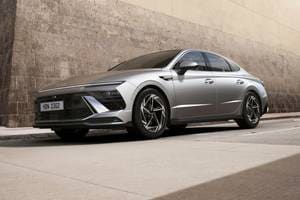
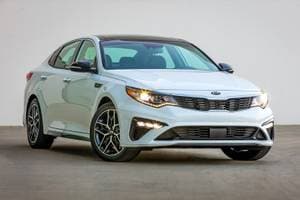
When the 2011 Kia Optima EX wearing Spicy Red paint arrived at our offices, it happened to park next to our long-term 2011 Hyundai Sonata GLS coated in a suspiciously similar Venetian Red paint. This similarity was no coincidence since the cars in question are, in ways far more significant than their exterior color, essentially the same.
They share a 2.4-liter four-cylinder engine, six-speed automatic transmission, electric-assist power steering hardware, a 110-inch wheelbase and four-wheel disc brakes with ABS, EBD and other assorted TLAs (three-letter acronyms). What's more, they look an awful lot alike. But there are differences — some small, some significant.
Our quest is to find out if those differences actually matter. The devil, as they say, is in the details. Here are a few: The location of final assembly for each is different, as are North American parts content, interior trimmings, wheel/tire fitment and, of course, price. Perhaps more significant are the subtle but effective changes made to give each car its identity — a suspension tweak here or an additional feature there. It's these changes that either bond a customer with a car or break the deal altogether.
We knew from the first time we selected Reverse in the 2011 Kia Optima and discovered a back-up camera that it had a number of features our beloved Hyundai Sonata GLS did not. And when we started tabulating features we realized precisely how much better equipped the new Kia is than the Hyundai.
Base Versus Midlevel Models
The Optima EX loaner we received is a mid-tier model (starting at $23,190) and our Sonata GLS is a base model (starting at $20,915). So before beginning this Korean confrontation, we knew it wouldn't be a strictly a SaGwa-to-SaGwa comparison. Even accounting for our Sonata's $2,585 in options, the GLS's $23,500 as-tested price proved $4,070 lower than the Optima EX's $27,570 as-tested price (including $4,380 in options) — a substantial difference, which we couldn't ignore.
Still, we had to admit to liking Kia's approach: Using Hyundai's strategy of offering a lot of car for little money against a Hyundai is, after all, poetic.
Will the 2011 Kia Optima be the 2011 Hyundai Sonata's fiercest competitor? Perhaps the Sonata's lowball price will still outweigh the Optima's various features and the Hyundai would win yet another comparison test.
Same but Different
The 2011 Kia Optima is assembled in Hwasung, South Korea, and contains but 1 percent North American parts. The 2011 Hyundai Sonata is built in Montgomery, Alabama, and 41 percent of its parts originate in North America. They both feature optional satellite radio and navigation systems with real-time traffic, but Kia uses Sirius services, while Hyundai favors XM. Both satellite services are complimentary for the first 90 days of ownership, and both sedans are optionally equipped with premium audio systems: Kia's from Infinity and Hyundai's from Dimension. The Infinity system is available in the Sonata Limited at a higher price point.
The Optima EX rides on standard 17-inch aluminum wheels shod with Nexen CP671 all-season tires (P215/55R17 front and rear) whereas the Sonata has P205/65R16 all-season Kumho Solus KH25 tires wrapped around optional 16-inch aluminum wheels, yet the tires' relative rolling circumferences are within fractions of an inch. Weight differed between our two test cars by only 165 pounds (3,407 Optima, 3,242 Sonata).
The Drag Strip
With the same six-speed automatic transmission and final-drive ratios, the two cars leave the starting line in a dead heat, but by 30 mph, the lighter Sonata begins to eke out a lead. At 60 mph, the Sonata is 0.6 second ahead (8.3 seconds vs. 8.9 seconds), and by the end of the quarter-mile, the Hyundai is a half-second quicker with a 2-mph advantage (16.2 seconds at 88.0 mph vs. 16.7 seconds at 85.7 mph). Have a look at the graph in the photo gallery showing the two cars' best acceleration runs to see the divergent curves, but there's no question the Optima is either encumbered by its additional weight or it's down on power.
Our comparison became a rather significant victory for one and a bit of a black eye for the other.
Turns out, it's probably both. Despite sharing the same displacement, direct fuel-injection and 87-octane fuel requirement, our 2011 Kia Optima EX carries a California SULEV (super ultralow-emissions vehicle) rating. This regional engine knocks down the output slightly relative to the ULEV II-rated Sonata. With 198 horsepower and 184 pound-feet of torque, the Sonata offers a small bump in power over the Optima's 192 hp and 181 lb-ft.
Incidentally, we measured a very slight fuel efficiency advantage in the Sonata. Covering the same 1,000 miles or so, we recorded 23 mpg in the Sonata versus the Optima's 22 mpg. Contrary to our typical mixed-driving results, it was curious that neither one achieved its EPA "Combined" target (27 mpg Optima, 26 mpg Sonata).
The tables turned slightly in the Kia's favor when we stood on the brake pedals. The Optima required 121 feet to stop from 60 mph while the Sonata (with 5,600 more miles on its brake pads) ate up 127 feet — that's a foot better than when it was new.
The Wiggly Bits
Despite sharing the same electric-assisted power steering hardware and steering ratios, Kia tuned the boost/resistance of the Optima EX's steering system to offer more feel and heft, lending it far more substantial and intuitive responses. Compared to the excessively light/numb feedback in the Sonata, the Optima feels as if it has traditional hydraulic-assisted steering. There's also more rubber contacting the ground beneath the Optima EX so it came as little surprise when we recorded a higher level of grip — and confidence — for the Kia (0.82g on the skid pad to the Hyundai's 0.77g orbit). We observed similar results in our 600-foot slalom test, where the Optima managed a 62.1-mph best pass to the Sonata's 61.6-mph best.
The test driver noted that in a previous test of the very same Sonata — when its odometer read 1,113 miles — it slithered between the cones faster because it then exhibited an Optima-like ability to shun understeer with an aptitude to rotate in the slalom. The Sonata no longer dances, but plows through the slalom. Our driver suspected the Sonata's front tires' capacity to bite the pavement had degraded enough to alter this slalom-friendly aptitude.
Time out
At this point, the running results of this comparison are looking rather ambiguous. To get a better handle on these two midsizers' qualities and differences, we needed to spend some evaluation time driving in everyday conditions, poking buttons, measuring things and observing variations in presentation, quality and content — with scorecard in hand.
True, it's been a veritable five-month love fest with our long-term Sonata GLS. We appreciate its segment-leading styling, its relaxed and generously sized interior, its many useful features, plus its long-haul comfort and affordability. Then we drove the 2011 Kia Optima. It made us realize for the first time that the Sonata's ride qualities border on floaty and that the Sonata's light-colored cloth seating was neither all that supportive, nor resilient to the grime that comes with everyday use. And if we didn't have an aversion to the Sonata's steering before, we certainly do now that we know it can be tuned like the Optima's.
The Optima EX manages to possess a ride as compliant as the Sonata in addition to a sportier feel and a more confident demeanor. Its more supportive leather seating lends a sense of solidity and there's a sturdiness and poise when piloting the Optima down the freeway or on a twisting road that we never have observed in our Sonata. Some of this is owed to the steering and some to suspension, but we like it all together.
In contrast, the 2011 Hyundai Sonata feels as if its primary goal is to carry its passengers with as little sensation of traveling as possible — which is not a bad thing, just a different approach to tuning the chassis. Lexus has found success with this ideal. Then again, Mercedes-Benz has recently earned more acclaim sloughing off the old ways and offering a more connected, more engaging dynamic without sacrificing comfort, too.
Widening the Gap
Where the Optima really put its brother in a headlock, though, is with its overpowering list of features. What began as a trickle with a few editors noticing a couple Optima-unique conveniences, snowballed into a sizable avalanche of small-but-meaningful items.
We found 16 features which best demonstrate the $4,070 difference in as-tested prices. It began with little things: foglamps, leather-wrapped steering wheel and a little vent in the glovebox to cool its contents. Then we started noticing bigger things: 17-inch alloy wheels, an intelligent key with push-button ignition, dual-zone automatic climate control up front, and HVAC vents in the rear, heated and ventilated leather front seats (with two-position memory for the driver), heated leather rear seats, a heated steering wheel, and of course, the blacked-out two-pane "panoramic" sunroof. In all, the Optima outscored the Sonata by 83 points (as 20 percent of the test's total weight) on features alone.
We recognize that many — though not all — of the Optima EX's features that we chose to highlight are available in higher trim levels of the 2011 Hyundai Sonata. But in this case — because these are fundamentally the same car — we chose to score only features that are distinct to each vehicle. Consult the "Features" page for details, but the as-tested prices of the as-tested models are what we compare.
Furthermore, we purposely weight the Price category the same as Features (at 20 percent of the total) to balance what you get against what you pay for. The Sonata, as equipped, undercuts the Optima in price by 17 points.
Finally, we used our 28-item evaluation rubric to score everything from front/rear seat comfort and driving position to cupholders and infotainment systems. The results were, not surprisingly, very close. However, the Optima again held a narrow advantage.
Same Game, Different Winner
We often see comparison tests like this one produce point spreads in the five-to-10-point range. With a commanding 16.3-point margin of victory over the reigning champ, the Kia Optima EX beat the 2011 Hyundai Sonata GLS at its own game; proving that it is a truly a car worth your consideration — just like the 2011 Hyundai Sonata did when it was introduced.
Our clever scheme to compare the same car with different wrappers became a rather significant victory for one and a bit of a black eye for the other. It turns out there are enough differences in content, execution and dynamics to declare the Optima EX a completely different — and better — car than the Sonata GLS.
The manufacturers provided Edmunds these vehicles for the purposes of evaluation.

Add A Comment »
alex142 says:
04:16 PM, 12/31/2011
According to some information, the Kia doesn't have rear window heaters and the Hyundai does. That's a pretty big deal for us here in the Northeast. I don't understand why Kia would not have this available on its cars.
macsaan says:
03:45 PM, 11/30/2011
love both
markchurch1 says:
04:45 AM, 11/18/2011
The one thing it seems you missed is that per the Hyundai and Kia websites, the Kia comes with self leveling HID headlights and HID is no even offered on the Hyundai.
nrbears says:
12:50 PM, 06/18/2011
i have a sonata and an optima. They both have everything in them. i have an sx optima and a limited sonata. i like the optima because it has more features like the sonata doesn't have automatic passenger seats and the kia does. Also the kia has cooled seats. Those feel cool. the kia also has a panoramic moonroof. although i do like the sonatas navigation system a little better. overall i like the kia better if thats what your deciding inbetween.
ford91 says:
03:15 PM, 04/01/2011
That was interesting considering their both mad by the same company.
adukes_007 says:
11:24 AM, 04/01/2011
Either car is a winner. The Optima almost liiks like a hatchback from certain angles. The Sonata is more lady like and the Optima is more of a robot looking thing.
www.turbosonata.com
maximoose says:
08:08 PM, 03/24/2011
Test drove the kia optima turbo tonight immediately after driving the hyundai 2.0T SE.
It is clear that the kia's options package is more extensive for the price with nice touches such as rear seat vents and heated/cooled seats on many trim levels as well as the avialability of a panoramic sunroof.
That said, the optima in sporty guise looks ridiculous. It's too pointy and a little too angular. With the KIA grill, it looks more like a toy next to the decidedly grown-up sonata.
And if you're comparing the interiors, the KIA has WAY TOO MUCH in the way of black plastics. On the flipside, the lower trim levels of the kia get the INFINITY stereo while the SE trim even with nav has you stuck with the DIMENSION stereo in the sonata (the limited offers the infinity). Overall, the interior of the Sonata is far more cohesive and interesting. Someone nailed it when they said the interior was Saab 9-5ish in the sonata (which is a BAD thing). The interior of the Hyundai feels more spacious as well.
Ultimately, the KIA felt more planted/glued to the road during my test drive, and the throttle felt more responsive to me. However, the tight suspension also transmitted more road noise and vibration into the cabin.
Ultimately, these two cars come down to preference. It's clear that Hyundai/KIA deliberately made the hyundai a little more luxurious in feel and the kia more sporty. However, I think that tomorrow I will buy a Sonata SE 2.0T and forego the KIA nameplate and cheapo side air vents (really, kia).
/ramble
buc_em_down says:
04:05 PM, 03/21/2011
When I had a chance to look at all the data of this comparison, I am left with more questions! Why when the sonata got better fuel economy for city/hwy/combined, did the optima win for fuel economy? The Huge diffrence in this scoring system used was the "features" which I guess when you compare a base model to a Loaded model, yeah there might be a diffrence in features. I think they missed the mark not comparing apples to apples, that is a comparison I would like to see!
buc_em_down says:
02:07 PM, 03/21/2011
I think both these are very nice cars. What I don't understand is why would you compare a Base model Sonata to a EX Optima? Makes no sense! This comparison should have been a Limited Sonata vs. EX Optima! You could buy a Limited Sonata Turbo for just about the same price as the Ex Optima with the two packages on this vehicle tested. I was excited to see the comparison until I started to read and saw it was Base model vs. Loaded top of the line. what a waste of time inside line!
wallymc says:
01:10 PM, 02/14/2011
I have read the article on comparisons, and I think they did a pretty good job. They noted all of the differences in trim as well as results. The one thing I did not notice is, in all of the comments on this article no one mentioned the 10 year 100,000 mile warranty. When the other brands come up to that standard, we will have a horse race in the automobile market place.