Comparison
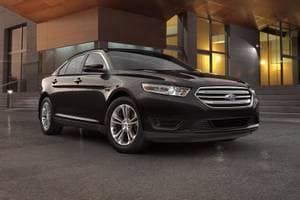
Comparison Test: 2010 Ford Taurus SHO vs. 2009 Infiniti G37 Journey
It Seemed Like a Good Idea at the Time
The twin-turbo Taurus wouldn't have it easy, seeing how the Infiniti G35 sedan had dethroned the BMW 335i sedan in our five-car comparison last year. More recently a G37 devoured Acura's high-tech TL SH-AWD without so much as a by-your-leave in a head-to-head comparison.
But perhaps the reanimated Super High Output (SHO) Taurus will once again have a few sleeper sedan tricks for the establishment.
The Same?
Put the spec charts of the 2010 Ford Taurus SHO and 2009 Infiniti G37 Journey next to one another, and there are good reasons to believe these two sport sedans are peers — on paper, at least.
The 3.7-liter V6 in the Infiniti produces 328 horsepower, but that's outdone by the twin-turbo 3.5-liter EcoBoost V6 in the Ford that generates 365 hp. Both cars can accelerate to 60 mph in less than 6 seconds. Wheelbase measurements of the two five-passenger sedans are separated by less than an inch. The EPA's estimate for combined fuel economy for each car shows a 1 mpg difference — 21 mpg for the G37 and 20 mpg for the Taurus SHO.
Sadly, that's pretty much where the similarities end.
Or Different?
The base price of the all-wheel-drive 2010 Ford Taurus SHO is $37,995. Our test car carried $7,480 in options for an as-tested total of $45,475. Gulp.
The rear-wheel-drive 2009 Infiniti G37 Journey starts at $34,565. Ours was equipped with $7,620 in options for a total of $42,185. In our protocol for scoring comparison tests, this $3,300 price gap between the two might be difficult to overcome in the final scoring.
Overall length, width and height of the Taurus SHO dwarfs the G37's, and therefore so does the interior passenger volume and cargo capacity. It might surprise you to learn, however, that most of the size advantage the SHO enjoys over the G37 is found in the dimensions of the backseat and the trunk (the Taurus' trunk measures 20 cubic feet, some 7 cubic feet more than the G37), and the front-seat accommodations are remarkably similar.
But you would also be correct in assuming the inevitable result of this sizable disparity is that the SHO's as-tested weight proves to be greater — in this case 684 pounds greater. That's like loading up the G37 with two NFL linemen.
But if NFL greats Lawrence Taylor, Emmitt Smith, Warren Sapp and Jerry Rice can compete — and win — on Dancing With the Stars, then maybe Ford's 2-ton flagship sedan has some latent dynamic abilities we might be missing in a simple comparison of scale.
Something's Missing
Then we drove the two cars.
We quickly determined the appropriately equipped SHO for this test would've been the one with the $995 Performance package. Though there were test mules lurking in Detroit, Ford unfortunately wasn't able to make this car available to us yet. Then again, the package would've pumped up the as-tested price of this SHO to $46,470.
So what's missing? It includes more aggressive gearing (to improve acceleration); quicker steering (to improve transitional responses); upgraded brake pads (to improve feel and fade resistance); summer tires (to improve grip, reduce stopping distances and increase heat capacity); and the ability to shut off the conservatively tuned stability control system (to enable us to test the limits of the car, not those set by an engineer and a corporate lawyer).
It would've been nice had Ford included all these performance features on its "premium performance sedan," especially one headed for a track test.
The Track Results
Even without the performance gearing, the heavyweight SHO still makes the G37 glance over its shoulder at the track.
With its 5.8-second acceleration to 60 mph from a standstill (5.5 seconds with 1 foot of rollout like on a drag strip), the Ford is only 0.2 second behind the Infiniti, which does the task in 5.6 seconds (5.3 seconds with 1 foot of rollout). In the remainder of the quarter-mile, the G37 opens up a lead of 0.4 second and finishes with a significant 2.3-mph advantage, recording 13.8 seconds at 101.4 mph against the Ford's 14.2 seconds at 99.1 mph.
The difference in trap speed is significant because this measure is strongly influenced by horsepower. The Taurus SHO doesn't seem to exploit its 37-hp advantage, and we think the parasitic losses of the car's all-wheel drive play a role here, as do its size and weight.
Damned Physics
With such a large frontal area, the big-boned and not-so-slippery SHO (0.32 Cd) obviously tries to punch a bigger hole through the atmosphere than the smaller, more slippery (0.29 Cd) G37. And at 4,404 pounds, each of the Ford's 365 horses has to haul around 12 pounds while the Infiniti has an easier task with 11 pounds/hp. Indeed we noted that the SHO feels as if it lies down at the end of the quarter-mile even as the G37 is still accelerating.
When we hit the brakes from 60 mph, the SHO fares poorly against the G37, requiring 127 feet to stop compared to the G37's 110-foot best. What's more, the SHO's pedal grew progressively softer from the first to fifth (and final) stop and the pads smoked after several acceleration runs. The Infiniti's brakes showed no such signs of nearing their limits — ever. No doubt the G37's $2,100 Sport package helped here with, among other things, upgraded brakes and summer tires. Oh, and it wasn't saddled with those two invisible NFL players either.
Things got worse for the Ford when the handling portion of the tests began. Without the ability to shut off Ford's electronic stability system, the SHO was artificially relegated to 0.80g and a 63-mph slalom pass. While these numbers aren't embarrassing for a 4,400-pound car, the steering is vague while the chassis feel reluctant to change direction. Once the understeer began in earnest, the stability control started to rein in things. There might not have been more grip from the all-season tires in any case.
No such complaints from behind the wheel of the Infiniti. The steering is so quick and precise that it's effortless to catch any slides by the G37's lively rear end. We also like the car's knife-edge balance on the skid pad, which we can adjust delicately with steering, throttle or brake. The result is 0.87g in lateral acceleration and a 66.4-mph slalom speed. It's also worth pointing out that when we ran the same tests with the Infiniti's stability control system fully engaged, the performance changed little: 0.86g and 65.1 mph.
So What Does the SHO Do Well?
Freeways and two-lane on-ramps to freeways, and that's where the original SHO's sleeper-sedan directive lives on. Sure, the SHO comes up short compared to a G37 at a drag strip on a slalom course, but compared to other cars of its size and mass (or smaller), it's quick and it sticks. You should've seen the look on the guy's face in the Dale Earnhardt Signature Edition Monte Carlo when we went around him on the outside while merging onto the freeway.
The SHO's suspension works on an assortment of less-than-ideal surfaces, even with its 20-inch tires. The SHO is isolated without feeling floaty; it's sure-footed without beating you over the head about it. And it is remarkably quiet. Aside from the congenitally numb and springy electric-assisted power steering with its unnatural return-to-center, the SHO is the model for the way every Taurus should ride and handle. Nevertheless, a Taurus SHO should behave with a sharper and more dedicated attitude, just like the G37 with a sport package does.
Standards, Options and Gizmos
For around $40,000, you'd expect to find some pretty nice equipment on these cars, and you'd be right. Besides 300-plus-hp V6 engines, both the SHO and G37 arrived with xenon headlamps (those on the Infiniti articulate with the steering), dual-zone climate control, intelligent key with push-button start, and navigation systems.
When you select key sport sedan features — as we did in our scoring protocol — the Ford backs up such expected sporting options as shift paddles and all-wheel drive with some genuine innovations, like the Cross Traffic Warning (it should be renamed "Parking Lot Idiot Detector"). The device repurposes the existing blind-spot sensors to alert a driver backing out of a parking stall if another car is barreling down the aisle, and from which direction.
Also, the SHO is available with radar-based adaptive cruise control, but it's been engineered to also provide a collision warning system that not only flashes and sounds a warning but also pre-charges the brakes to give you an extra edge when coming to a halt quickly. At the same time, the threshold of safety intervention by the SHO's electronics is set to Chicken Little's standards — a little too vigilant and occasionally alarmist.
If you note the Top 10 Features, you'll see how the SHO claws back more points with its features than it loses in its price premium.
Alternative Realities
Sure, the more obvious all-American branded comparison might've been the one we featured over here: the 2010 Ford Taurus SHO versus our 2008 Pontiac G8 GT. It's a valid point, but the Pontiac G8 GT is an endangered species. Maybe a Cadillac CTS V6 DI would've been a better competitor, but that's supposedly where the 2010 Lincoln MKS EcoBoost is intending to hunt, isn't it?
So here's where we've landed.
The Infiniti G37 has improved much from its introduction as the Infiniti G35 sedan. A larger engine with more power, a multimode seven-speed automatic transmission with available shift paddles, a growing list of standard and available equipment, and improved interior materials content have made the 2009 Infiniti G37 Sport Sedan a genuine benchmark in its category. That it doesn't break the $43,000 mark when you add Premium, Sport and Navigation packages is simply icing on the cake.
The 2010 Ford Taurus has undoubtedly picked up right where the last 1999 Ford Taurus SHO left off. The problem is, this is not the year 2000. We agree that the thoroughly efficient, twin-turbo direct-injected 3.5-liter V6 is a very good engine that's loaded with brilliant engineering and probably even more potential than Ford is willing to admit at this point, especially as revised CAFE mpg requirements loom large on the horizon.
We agree that the SHO's styling is bold, forward-looking and tough all at the same time. While the SHO's interior is attractive, it still doesn't feel all that special or premium to us, though. And that strange theatre seating arrangement and the resulting convoluted headliner is just off-putting to us.
Finally, the subtle but necessary improvements made to the already top-notch Sync infotainment system didn't go unnoticed (thank you), and most of the new gizmos are both cool and useful, but there's a right way to execute parts-bin sharing of controls and a less right way. You must first start with a bin chock full o' high-quality parts, you see. Take, for instance, the G37's magnesium paddle shifters, which are the same ones found in a Nissan GT-R. And this makes us wonder when Ford is finally going to get rid of that cruise control interface on the steering wheel, the one that we've grown to dislike on our long-term 2009 Ford Flex? No "cancel" button, no telltale for on/off, etc., and now it's more complex with the adjustable cruise control?
In the end, the 2010 Ford Taurus SHO feels like an excellent all-new Taurus with a muscular engine, period. It's not quite up to the sport sedan badge. Once we finally get a chance to test an SHO with the Performance package, we're hoping it transforms the dynamic experience. Until then, the 2009 Infiniti G37 (and the crowd in which it is typically found) has nothing to worry about from the Taurus SHO. That is, unless someone starts changing the G37's list of standard equipment to include two NFL players.
The manufacturers provided Edmunds these vehicles for the purposes of evaluation.
Add A Comment »
dieseltc says:
03:18 PM, 10/29/2009
I'm all for Ford and think they're on their way up. But walk into an Infiniti dealership and then into a Ford dealership. That's where the comparison stops.
When will the domestics start thinking about the ownership experience? That's what I'm looking for. I don't just buy what would be the second largest investment after a house and walk away.
ducbil01 says:
10:02 AM, 10/29/2009
Every time I read about the SHO, I can't resist the idea of a Fusion SHO. That motor and all wheel drive in a car the Fusion's size just sounds ideal to me. The Taurus is way too big.
cowbell says:
06:40 PM, 10/26/2009
To sum up why this was a ridculous test in one letter: M. There's this car that Infiniti makes that is much more the type of car the Taurus SHO is designed to compete against. Closer in size, closer in power, closer in weight.... No, that would have made too much sense.
Just out of curiosity, when is the G37 coupe vs. Elise comparo coming out? I mean there both performance coupes.
draw007 says:
04:06 PM, 10/26/2009
joihan777, are you serious? Four-door, self proclaimed performance sedans is a direct comparison, whereas, your analogy is not.
acqui says:
10:15 AM, 10/26/2009
I don't understand why you wouldn't wait and get the cars with the packages you want before doing a comparison test. It makes no sense to test these cars against each other, especially given the fact that a great bit of your testing is based on overall performance. That said, I am not sure if Ford is going to succeed with this plan. I test drove one with the performance pack and if the roads are straight, it's pretty good, but personally, I would never pay the 46k I saw on the window sticker.......or anywhere close if I were in the market for a sports sedan. I am not sure why everyone is making a stink about comparing the SHO to the Infiniti because when I spoke to a couple of Ford executives at the NAAS, they specifically listed the G37 as one of their target competitors for the car, along with the Lexus GS and Audi A6. The fact of the matter is Ford is fighting a perception problem and the way to overcome that isn't by charging 46k for a "sports sedan" that many in the public still believe will devalue at a much faster rate than it's Japanese or German competition. Regardless of where you come down on the argument, the fact is that the majority of the public will still choose a car with an Infiniti, Mercedes, BMW, Lexus, Acura badge on it over a Ford....as evidenced by auto sales in the 40-50k price range over the last decade. People seem to forget, this particular model is aimed at enthusiasts and as a driving enthusiasts, it just doesn't cut it as a sports sedan for me, midsize or large.
jays83gsl says:
04:49 AM, 10/24/2009
These are neat, but we've seen your rehashed SHO numbers before. I happen to have an SHO10 with the Track Pack, and it's WORLDS of difference from without.
I first drove the SHO without, and was NOT impressed. When the dealer took me around back to the one with the track pack, I decided to give it ONE more shot, and it was well worth it.
Please test the SHO with the track pack. Most people (publications) are getting around a 13.7, with a 118 60-0 with them.
SOBELLA says:
02:19 AM, 10/24/2009
Twin turbo for nothing! G37 forever!!
Better performance
Better brand image
Better resale value
Better reliability
Who wouldn't want an Infiniti over a Ford???
cbrandi says:
02:36 PM, 10/23/2009
I owned a 1992 SHO, 5-speed manual. I loved that car, raw fun. Unfortunately, its poor build quality soured the ownership experience. No sooner had the warranty period ended when all sorts of expensive stuff started to break. I traded it in. I also note, that this new SHO cost nearly as much as I paid for my new 2009 Jaguar XF. No comparison implied. The Jag is a gentleman's car, fast, comfortable and beautiful. The SHO was one of the bad boys. I also had an Infiniti J30T, a nice car, Jaguarish lines, tremendous quality, nothing broke even after 10 years of ownership. It made a lovely sound when in the higher rpms. Gas milage was terrible 23-25 mpg highway. My new jaguar has been giving 25-28 highway. Better technology I guess. Good luck to Ford and SHO, but its too heavy.
pitchman99 says:
11:25 AM, 10/23/2009
I agree...this is a stupid comparison. A full size car should be compared to a full size car. Don't compare a full size to a mid size and then be surprised and outraged when the full size weighs more. The author is an idiot.
Two suggestions:
1. Since you like the G37 as a gold standard, get one with AWD compete it against the Taurus SHO you have. Or, be a little more patient and get the Taurus without AWD (at least one of your NFL linemen) and put the performance package on it. I'll bet those numbers would be a hell of a lot closer.
2. How about a Taurus SHO v. Mercedes E-class, Cadillac STS, BMW 5 series, Jaguar XF, etc. That $3,000 price difference starts to look like toll booth change huh?
Let's be real for a moment. The fact that Ford, a company many of us thought should be bankrupt, now produces a sedan competitive with Infiniti (who has spent millions of dollars and many years trying to compete with BMW) is nothing short of a miracle.
BTW: I own a 2009 Ford Flex and it is not that hard to operate the cruise control buttons. The author is an idiot.
matt310 says:
07:36 AM, 10/23/2009
I think if you actually read the article and look at the performance numbers these two cars put out, they're closer than anyone would have thought. And honestly, just because you wouldn't cross-shop the two vehicles doesn't mean others feel the same way. I wish Edmunds would have had the performance package-equipped SHO since that one is supposed to be a bit faster and more nimble.
By the way, I love the "Data and Charts" portion of this comparison test. This is something that has definitely been missing from Edmunds' tests - the ability to easily compare numbers side by side (instead of top-to-bottom like what's on the right side of this page). The data panel is much appreciated.