Just when you thought you've seen every permutation of hybrid, Hyundai goes and tweaks the formula a bit. You know, just a bit.
Fundamentally, the hybrid powertrain in the 2011 Hyundai Sonata Hybrid — Hyundai's first — can deliver that golden moment of silence made possible via electric-only propulsion, which is not so unusual. And during other driving conditions the electric motor's twist can be blended with the gasoline engine or disabled entirely. Again, not unusual.
In ideal conditions — a fully charged battery, no accessories, the right ambient conditions and driven by a totally committed eco-weenie — engineers report that the Sonata Hybrid can briefly touch 62 mph in electric-only mode.
OK, that's a bit unusual. It's also not something that's likely to be replicated in the real world. That's the difficult part.
Mixing the Cutting-Edge and the Familiar
Really, though, Hyundai's hybrid strategy deviates from the norm in its deliberate and strategic combination of the cutting-edge and the familiar.
There's a familiar power plant under the hood of the 2011 Hyundai Sonata Hybrid. You'll find a port-injected version of the 2.4-liter inline-4 from the base-model Sonata, although in hybrid form it's been changed over to the Atkinson cycle in order to boost its efficiency. The engine all by itself generates 169 horsepower at 6,000 rpm and 156 pound-feet of torque at 4,250 rpm. A 30-kilowatt (40 hp) electric motor is sandwiched between the engine and transmission, and when this unit is in play, combined output goes to 209 hp and 195 lb-ft of torque.
The divergence from the typical hybrid path is also where we see more familiarity. Hyundai's hybrid system employs a conventional six-speed automatic transmission rather than a continuously variable transmission (CVT). Using an existing transmission simplifies the system, which both boosts efficiency and lowers cost. Hyundai also reckons that consumers prefer the familiar experience of stepped gearchanges. "A CVT feels like something is slipping," a Hyundai engineer told us.
The Sonata Hybrid does indeed deliver its power in a more natural manner than many hybrids.
Because the 2011 Hyundai Sonata Hybrid has fixed gear ratios in the transmission, the speed of the engine and the electric motor must be precisely synchronized when the power of the two devices is being blended. A clutch pack between the engine and the electric motor accomplishes this, acting as a mediator in place of a torque converter. A sophisticated electronic controller manages the activity of the engine and motor to ensure a scrum doesn't ensue.
A 96-pound lithium-polymer (Li-po) battery pack sits just aft of the Sonata's backseat. The primary difference between Li-po and lithium-ion (Li-ion) is the manner in which the lithium electrolyte is suspended — Li-po uses a thin but rugged polymer rather than the organic solvent of Li-ion batteries. This allows for a smaller size and a bit more flexibility in the shape of Li-po batteries, as well as higher power density. It's a technology in which Hyundai is making a large investment and it will find its way into other Hyundai vehicles, like an upcoming hybrid with a dedicated platform and a plug-in hybrid variant.
Today the batteries are sourced from LG, which adds a layer of cost and removes a degree of control. It is this situation that has Hyundai engineers considering taking battery development in-house.
What Say You, Electrons?
Said to accelerate to 100 km/h (62 mph) in 9.2 seconds, the 2011 Hyundai Sonata Hybrid won't be fast, but Hyundai figures it will pip both of its primary competitors, the Ford Fusion Hybrid and Toyota Camry Hybrid. The last examples of the Fusion Hybrid and Camry Hybrid we tested, however, both beat Hyundai's estimate of the Sonata Hybrid's performance by a half-second, and they're both a couple hundred pounds heavier than the grinning Hyundai. So at this point it's probably only safe to say that the Sonata Hybrid at least will be in the same ballpark as those cars.
We briefly drove a preproduction Sonata Hybrid at Hyundai's Namyang Proving Ground in South Korea. Very briefly, as in a few hundred yards in primarily a straight line on flat ground. Still, it was possible to discern what the Hyundai boffins were talking about with that transmission talk. The 2011 Hyundai Sonata Hybrid does indeed deliver its power in a more natural manner than many hybrids thanks to its use of discrete gear ratios. Simply put, the human brain is happy when the engine speed rises in relation to road speed.
The hybrid's zest off the line was about what you'd expect, and the powertrain integrated the activity of the electric motors with the gas engine with less of the abruptness we've observed in other hybrids. The steering and the brakes in particular feel synthetic in the way that the regenerative brakes and electric tillers of most hybrids sometimes are, and are not as refined as they ought to be in production. To be fair, we were not driving the final product.
The Dark Side of Green
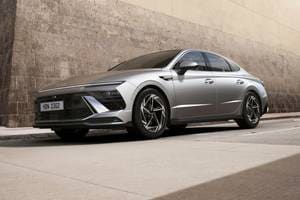
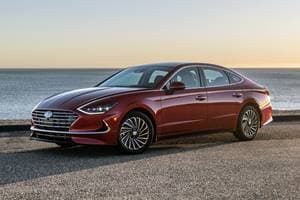
Hyundai stylists went to some lengths to visually differentiate the Sonata Hybrid from its non-hybrid brethren.
The hybrid's headlights, rocker sills and wheels are new. Front and rear fascias have been altered to improve the hybrid's ability to slip unfettered through the farts of navel-gazing hybrid-owning tree huggers, improving its drag coefficient from 0.29 to 0.25. The resulting huge gaping maw in the front of this vehicle only needs a few rows of baleen and it could strain the oceans for plankton (better opt for a dark hue to hide it).
The cabin, thankfully, escaped relatively unmolested. There will be a few custom touches like seat fabrics and colors, while the instrument cluster is tweaked to include the de rigueur graphic that depicts where energy is flowing at any given moment.
Fuzzy Future
None of this technological hoop-jumping would be worthwhile if it didn't produce relevant benefits. To hybrid customers, this really boils down to fuel economy and price point.
Unfortunately, there are no official numbers for the 2011 Hyundai Sonata Hybrid on either count. EPA fuel economy figures are yet to be finalized, and Hyundai brass are mum on MSRP. Hyundai's latest preliminary estimates — subject to change slightly, of course — peg the Sonata Hybrid at 37 city/40 highway mpg, or 38 mpg combined. These numbers are better than those of every other midsize hybrid sedan we can think of, save the Ford Fusion Hybrid.
If the past is any indication, Hyundai aims to outperform and out-value Toyota. It's like some kind of corporate mission. So if we had to guess — and we do — we'd say that the 2011 Hyundai Sonata Hybrid will undercut the Toyota Camry Hybrid's base price of $26,400. Say, a nice round number like $24,900.
Sound good to you? It'll hit showrooms just before the turn of the year.
Edmunds attended a manufacturer-sponsored event, to which selected members of the press were invited, to facilitate this report.

Add A Comment »
r_l_r says:
07:28 PM, 07/03/2011
I have driven my Sonata hybrid for about 1000 miles and like it alot. My impressions are
Appearance - the striking lines and sleek contours evoked completments from my friends and family. The car even turned the heads of parking attendants and co-workers in the parking lot.
Ride - The ride is very smooth, yet controlled. The car absorbs road bumps, which are aplenty in Cleveland, yet maintains excellent control and feel in curves and during avoidance maneuvers. Braking is very sure and controlled - the regenerative braking system that recharges the battery does not compromise function. In an emergency braking situation the car braked without pulling to either side and I felt in full control of the car. I had read prior owner comments that earlier Sonatas tended to pull to the left. I have not experienced any tendency for the car to pull to one side during driving or braking. I have driven about 1,000 miles. So far the tires have good gripping and are quiet.
Interior - The interior is very well appointed. The switches are where they should be and they are easily accessable. The car is designed to enable the driver to keep an eye on the road at all times. The standard Bluetooth enables the driver to keep vision on the road while receiving and making calls, The voice interface enables you to utilize the phonebook from your phone to conveniently make calls. The head, leg, hip and shoulder room are excellent. The access for entering and leaving the care are also excellent - this was particularly important for me because with knees that do not bend well, I need a car to have a large entry profile. The motorized driver seat is extremely comfortable and its controls are intuitive.
FueL economy - I am getting 40-42 mpg in city driving and 45+ on the highway. The car will cruise using the electric motor up to about 60 mph, albeit for about a mile or so before engaging the gas engine to run the car and recharge the battery. The instrument display enables one to learn how to drive more economically.
zacchaeus says:
08:36 PM, 03/21/2011
Why can't we have a hybrid that does three things? 1. That looks cool? This looks like an ugly fish out of water, and, as such, it will never swim. Pictures of the new Kia Optima hybrid blow this one away for styling! 2. That performs well? Zero-to-sixty should be FASTER than the regular model so it doesn't become a detrimental factor for those making a purchase decision. 3. Find a place, other than the trunk, to put the battery so you don't sacrifice trunk space. 15.4 cu. ft. is merely adequate in a family sedan, so chopping it down to 11 cu. ft. is suicidal for marketers! Only commuters will opt for this car, as 11 cu. ft. is woefully deficient for a family on vacation. Add to that the absence of a fold-down rear seat, and the car's utility becomes further hamstrung.
As it stands, this is a one-trick pony with too many compromises in too many areas to be irresistible to family type buyers.
Fix this please, Hyundai! Make this sedan so that it gets 32mpg city, and 36mpg highway, while not losing any trunk space and we'll be as pleased as punch. When you go to extremes, you only attract the extremists, and the amount of those people who have money are very few and far between.
indyking says:
05:42 AM, 07/28/2010
Disclaimer: I use to have a Prius (last generation - 2010 model), which I got rid because I could not stand it and now I own a 2010 Sonata (old model). Let me just start by saying this. The drag coefficient in the Sonata hybrid is the same as the last-generation Prius, the difference being that Toyota accomplished this by creating a bizarre ugly-looking car, whereas Hyundai did so by creating a cool, sporty-looking beauty. Not sure about the Camry hybrid, but the interior quality and overall quality of my old model Sonata blows the Prius quality out of the water.... it is like comparing a luxury car to cheap economical one. My Sonata MPG is 33.3MPG with roughly 75/25 HWY/CITY driving, which is way above EPA figures. My combined figures in the Prius were 46, which is bellow EPA because the Prius MPG drops significantly during winter. So, I'm pretty confident that the Sonata hybrid will do combined figures in the mid to upper 40's beating EPA estimates. Maintenance in my Sonata is about 3 times cheaper than it was with the Prius, so I believe the Sonata hybrid will have that advantage over competitors as well. Well done again, Hyundai!
bluberrypi says:
07:10 AM, 07/25/2010
The back end is very nice - with those fancy brake-lights and all. The front is a bit too Peugeot for me...
ryrybugatti22 says:
03:40 AM, 07/21/2010
is this a pre-production model? cuz the tail lights and wheels are different on the tested car and the auto show car....
ryrybugatti22 says:
03:38 AM, 07/21/2010
i absolutely LOVE those tail lights!!!! as for the head lights, the LEDs are cool but the shape is not
tenta20 says:
12:05 AM, 07/21/2010
This is a nice piece of auto! Hyundai is really doing well for themselves! However, a thorough comparison between this and the Fusion Hybrid MUST be in order.
n2guru says:
10:01 PM, 07/20/2010
Those lights are just AWESOME!!!.....Now what I want to know is....will there be a Kia Hybrid as well?...Can't wait for the OPTIMA to come out. Way to go Hyundai/Kia!!!
alpine6speed says:
09:42 AM, 07/20/2010
Its amazing how things change in in a year or two. This car and the Ford Fusion are the best cars in the class and offer the best hybrids in the class as well. If I were getting hybrid sedan it would be between this and the Fusion and I would NOT even consider the camry. This still blows my mind. Great job with sonata as usual. All the 3 flovors are at the top or near the top in the class.
cnauta says:
09:16 PM, 07/19/2010
I have been waiting on this vehicle for years now. I can hardly wait. I am gunning to be one of the first owners here in Canada of this vehicle. With the provincial and federal rebates I am getting on this car, it won't be much more than the regular gas version of it. The Ford Fusion is just that...another FORD with the same old paint/rust problems that Ford has become synonymous with. A relative of mine has the Fusion, a 2008 model and it is starting to rust out already....sheez !! And go to Toyota if you want to have your gas pedal stick while driving at highway speed (a thought I don't relish at all). Hyundai will make the move from the 6th largest car manufacturer to number 4 or 5 spot within 2 years for sure.