INSIDE LINE

2011 Honda CR-Z Full Test and Video

Media Player

  • 2011 Honda CR-Z Full Test Video

    Inside Line's Mike Magrath takes a look at the 2011 Honda CR-Z hybrid sport coupe and discusses its performance, fuel economy and handling. | June 29, 2010

1 Video , 22 Photos | See more photos in this gallery »

Road Test

2011 Honda CR-Z Full Test and Video

Almost a CRa-Zy Honda

    78 Ratings

    For the generation of Honda freaks that grew up reading Super Street and Sport Compact Car and worshipping at the Temple of VTEC, the new 2011 Honda CR-Z will represent another blown chance for Honda to return to its tuner-friendly roots. This "sport hybrid" is not a cousin to the old Acura Integra or a high-tech hybrid reimagination of the Honda CRX. But at the same time it's something fun out of the same company that's put a trowel on the front of every Acura and let the Accord swell up into a dirigible.

    The CR-Z is a car that finally shows us that Honda is trying to figure out what a Honda should be. It's a car that feels like it has been built by engineers, not dictated by product planners juggling contradictory data from focus groups. Sure, there's a bit too much soulless Asimo robot in the CR-Z's personality and not enough Integra Type R boiling in its blood, but if this is the future, there's hope for Honda.

    There's even hope for hybrids.

    Cuts Like a Butter Knife
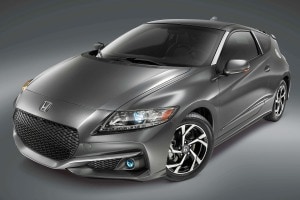
    In profile the 2011 Honda CR-Z has a nearly flat tail and a steeply raked windshield that leads to a blunt nose. It looks like a knife all right, but one that's used for spreading butter and jam over an English muffin. Not the sort of sharp blade that one takes to a knife fight. It might be that the new regulations for pedestrian protection in Europe will mean that all cars sold there (like the CR-Z) are doomed to have high, flat hoods like that of the CR-Z (take a look at the new BMW 5 Series, too).

    At an overall length of 160.6 inches, the CR-Z looks short, but with its long doors and relatively long 95.9-inch wheelbase (4.2 inches longer than that of a Mazda MX-5), this little coupe is exceptionally easy to get in and out of. The big doors are thick and heavy, so they produce a satisfying thud when you close them, which makes you feel safe and secure. But they also swing out with a lot of inertia, and if you put a little too much shoulder into opening one at the Target parking lot there's a chance that you might put a good-size dent into the side of a Dodge Caravan. (Not that we have any personal experience.)

    Command Central
    Every control in the CR-Z is angled toward the driver. It's almost as if the engineers were tempted to build the CR-Z as a one-seater, but chickened out.

    A large circular tachometer lies within its own shrouded pod, and floating in its center is a digital speedometer. To each side are various ancillary gauges, including a battery charge meter and a status meter for the electric motor assist to the left, plus a fuel gauge and multipage instrument display to the right. There's a bit too much going on, and the objective here seems to be lots of style with a scientific spin.

    The seats are nicely shaped, full of airbags and covered in a silvery fabric that feels like a Kevlar mesh. Behind the two seats are indentations that look like they might be seats themselves, but function as bins for the usual flotsam. Close the cover and you get secure storage plus a nice, flat load floor all the way back to the tail. Honda says that 25.1 cubic feet of storage space can be found here, and it's all usable and easily accessible.

    For many CR-Z drivers, it will become a ritual after starting the car to hit that Sport button.

    While the interior looks great, it's hard to see out to the rear. The long rear window acts like a prism, so reflections toward the edges can get funky. Instead you look through the vertical glass panel at the trailing edge of the hatch and there's a lot that gets hidden, like the grilles of Dodge Chargers, Ford Crown Victorias and other assorted vehicles preferred by our friends in law enforcement.

    Three-in-One Motoring
    In general specification, the drivetrain of the CR-Z is identical to that of the current Honda Insight. There's a SOHC 1.5-liter inline-4 with i-VTEC variable valve timing making 113 horsepower at 6,000 rpm and 107 pound-feet of torque at 4,800 rpm. It's supplemented by a small electric motor that produces 13 hp and 58 lb-ft of torque. The combined parallel hybrid system is making 122 hp at 6,000 rpm and 128 lb-ft of torque between 1,000 and 1,750 rpm when the car is equipped (as this one is) with a six-speed manual transmission. (If you choose the continuously variable transmission, CVT, the torque rating is 123 lb-ft.)

    To the left of the steering wheel are three buttons marked "Sport," "Normal" and "Econ." The default mode is Normal and the CR-Z performs, eh, OK that way, plus the tachometer glows blue. There's no crispness to the throttle response in this mode, but the car isn't significantly more sluggish than, say, a heavily laden Honda Fit.

    In Econ the CR-Z feels as if it is dragging an anchor at anything less than full throttle, plus the tach gets a virtuous green aura. Honda says the Econ mode limits power and torque by about 4 percent, but provides "full responsiveness" at full throttle. Since it's misery at anything less than full throttle, what's the point?

    The Sport mode pumps in extra electrical power during acceleration, firms up the steering effort and changes the electronic throttle's responsiveness, plus it has the tach burning a bright evil red as if you were actually strangling a Spotted Owl instead of driving a small car. At part throttle in Sport, the CR-Z actually feels pretty neat, with the unique sensation of low-end torque being the most prominent element in that neatness. For many CR-Z drivers, it will become a ritual after starting the car to hit that Sport button.

    Almost Sort of Fast
    Since we perform our acceleration testing at wide-open throttle, the CR-Z records the same test numbers in any mode, even Econ. And with its stability control disengaged, the CR-Z gets to 60 mph from a standstill in 8.8 seconds (8.5 seconds with 1 foot of rollout like on a drag strip), and the quarter-mile comes up in 16.5 seconds at 84.1 mph. That's better than the Honda Fit we last tested, which did 9.5 seconds to 60 mph (9.4 seconds with rollout) and 16.9 seconds at 81.1 mph in the quarter-mile.

    According to the EPA, the CR-Z with its six-speed manual transmission will achieve 31 mpg in the city and 37 mpg on the highway. That's pretty good. And yet because it's a hybrid, we found ourselves expecting somewhat better than that from this 2,635-pound car. In our real-world driving, we achieved 30 mpg, ranging from a best of 38.7 mpg while driving so frugally it nearly killed us to a worst of 26.6 mpg while driving like a complete idiot on mountain roads.

    The thing with a Sport Hybrid is, we also expected great performance, and the electric motor did provide some kind of edge, as this car would give us a little scratch between 1st and 2nd gear. We've never heard of anyone ever running the battery in Honda's Integrated Motor Assist (IMA) system out of juice, but we managed on some steep canyon roads while driving far too quickly, and the lack of the electric motor's useful power assist left the car surprisingly lifeless.

    Perhaps all this shows you that the presence of the electric motor in this car is about more than just corporate public relations; it really makes a difference in the way the car drives, whether you're trying to get mpg or mph.

    Chassis Schmassis
    In a hybrid like the CR-Z, handling often seems to be an afterthought. But the CR-Z has a sweet feel to it that's not part of many other hybrids. The electric power steering is direct and responsive, and the suspension is both supple over road zits and dignified in corners.

    This, however, doesn't mean the CR-Z is a corner-carving rocket. Its 195/55R16 all-season tires are designed for low rolling resistance, and the nose pushes through corners determinedly. Our 0.83g orbit around the skid pad is pretty respectable, though, while it also achieves 0.82g with the stability control engaged, which shows you that the electronic nanny is pretty permissive.

    There's more car here than tire, an impression confirmed by the CR-Z's 61.4-mph run through the slalom.

    The CR-Z We All Want
    The pricing for the 2011 Honda CR-Z starts at $19,950 and peaks at the CR-Z EX with Navigation and the CVT at $23,960. Our test car, the CR-Z EX with Navigation and a six-speed manual, runs $23,310, which seems maybe too much for a car that's not so quick and for a hybrid that's not so economical. It's also just a few hundred bucks short of the Honda Civic Si coupe with nav that performs much better, or the Honda Civic Hybrid Sedan with Navi that gets better mileage.

    Right now, the 2011 Honda CR-Z tantalizingly straddles the territory between what Honda once was and what it is going to be. There's a better, more engaging car waiting to burst out of the CR-Z, and here's hoping the Honda engineers start channeling the solid-state soul of Soichiro Honda himself and find a way to make this sport hybrid thing work better for us.

    The manufacturer provided Edmunds this vehicle for the purposes of evaluation.

    Road Test

    Second Opinion

    Vehicle Testing Assistant Mike Magrath says:
    The first thing you have to come to terms with when driving the new 2011 Honda CR-Z is the stalling. Well, it's not really stalling, but you come to a stop and the engine turns off. For those of us used to driving traditional stick-shift cars, that's a bad thing. But in the CR-Z the engine stays off until you depress the clutch pedal fully (there's a big warning light if it's not) and slide the shift lever into 1st, at which point the engine comes to life again. This is part of its hybrid thing. The first few dozen times, I panicked and over-revved the motor, thinking it wasn't going to go. It went, so I spun the tires. It was kind of fun.

    Solution: Deal with it.

    And there's a second thing you have to sort of wrestle with here. Ignore the lure of green in Econ mode, turn the gauges red with Sport mode and then you can really drive the CR-Z. There's understeer, sure, but there's also lift-throttle oversteer (thanks to all those heavy batteries in the back). And for maybe the first time ever in a little Honda, you can also get torque, and from like, zero rpm! It's a blast, really. Small car with torque? Cool in my book. Happens to be a hybrid? Neat. And 26 mpg is way better than you get hustling a Miata.

    Solution: You think this is a problem?

    But this is where the third thing about the CR-Z shows up. If you've somehow managed to drain the battery pack (even if there's still a bar of charge left on the battery indicator), and there are hills around and you're going up them quickly (like a maniac, maybe), then be prepared for the Integrated Motor Assist to turn into an anchor. When fully charged, the CR-Z will scratch its tires on a hard shift from 1st gear to 2nd. After you've run three-quarters up a mountain, the same engine bogs and chokes like a gear or five was missed. This drop-off in performance necessitates careful battery minding. "I'd love to pass this pack of cyclists, dear, but we'll have to wait for a good long downhill to power up again."

    Solution: Ditch the weak-sauce Fit motor in this car and dump in the Civic Si motor. It'll pull when there's electricity and it'll pull when there isn't. Make IMA a bonus, not a necessity.

    Sort By:

    jrhoglund1 says:

    06:09 PM, 11/18/2010

    WHY COULDN'T THEY HAVE JUST SHOVED A 2.0 IN IT AND CALLED IT A ROCKET OH THEN IT WOULD BE A CRX DAH.

    carlos20 says:

    05:34 AM, 07/09/2010

    The veloster is back to the drawing board because Hyundai is working in a Sonata Hybrid
    engine detuned to 140 HP so they can compete with the CR-Z.
    Honda take the automakers off guard with the CR-Z. Nobody compare the CR-Z with another hybrid because nobody want to admit the CR-Z superiority.
    The CR-Z is compare wih SUVS, Sedans, Minivans even wih a 1987 model, all with the
    hope to make the CR-Z a loser.

    bb49 says:

    09:55 PM, 07/02/2010

    I think this article points out another reason not to buy the CR-Z if you're buying it for sporty performance.   The CR-Z's best acceleration is with the assist from the electric motor which supplies the additional hp and torque (even with the assist the car is slow) so when the battery is depleted the driver is left with an electric motor  and batteries that just act as a boat anchor and leave the CR-Z to flounder on its extremely weak gasoline motor.   I suspect when forced to run on its gasoline engine the modicum of performance that the CR-Z has disappears completely and the driver's is left to ponder the question--where is the Sport?

    rsxs says:

    12:44 PM, 07/02/2010

    Pointless. A normal civic is either quicker or the same from 0 to 60. Handle .83g same also. MPG? pretty much the same. Like the seats but thats about it. Shame on you Honda. I had some high hopes for his car but after delivering these poor numbers just seems pointless. $23 000 plus, ugh... good luck. I'll take an SI.

    alex38 says:

    07:33 AM, 07/02/2010

    @ igo 1

    "So is Ferrari which I though you were passionate about.  All Ferrari are that way.  All true Ferrari fan know."

    You do bring up a good point and it is the one thing I DO NOT like about Ferrari's.  I'm a big fan of the F430 but if the front overhang was shortened by a couple of inches, would look better to me...

    I guess I've been drawn to Ferrari for the racing history, the overall beauty of their designs (sans the longish front overhangs), and supposed fun to drive factor.  The engine sound second to none.

    So, back on point, the Ferrari, with all that, is forgiven for it's long front overhang.

    The CR-Z?  Well, from the original CRX, it's heavier, more expensive, more complicated, arguably less fun to drive?, and much worse looking imo.  The fuel efficiency numbers are good in its own right (39 MPGs?) but the upcoming Hyundai Veloster, or whatever it's called, is supposed to have better fuel efficiency, WITHOUT A HYBRID SYSTEM (40 MPGs speculated).   The CR-Z almost as bad as the Aztec and is ugly as sin..

    igo1 says:

    06:39 AM, 07/02/2010

    THE FRONT OVERHANG IS LONGER THAN THE REAR OVERHANG!!!

    So is Ferrari which I though you were passionate about.  All Ferrari are that way.  All true Ferrari fan know.

    xoquixxoqafxo says:

    05:27 PM, 07/01/2010

    @ ctpax

    oh yeah... and if you want an automaker that is targeting the generation Y customers... look at SCION! thats the whole reason toyota created the brand.

    fuhteng says:

    01:58 PM, 07/01/2010

    eldaino2 - when the whole point of a new car is to be fun, I don't think 8.8 s 0-60 cuts it. And by the way, a Fusion hybrid is 0.1 s faster to 60.

    A Civic is indeed slower and heavier, but it also seats four, which is more than can be said of this.

    Comparing this thing to the only car I can come up with that is close (two seater only, small, tiny engine) it is indeed heavier as a Miata weighs 150 lbs less. Which admittedly isn't much. I guess I read the number wrong before (I thought it was 3,600, not 2,600). However, am I supposed to be impressed that this thing weighs 2635 lbs and handles like a truck?

    Tell me again why someone would buy this? Oh wait, suckers are born every minute. Honda-philes will buy anything with an H on it (but then, all fanboys are that way). I think my objections are the lack of purpose for this thing, and that instead of making sure the next Civic would be on time and up to par, money and time was devoted to a vaccuum cleaner.

    05redrex says:

    11:50 AM, 07/01/2010

    "Really? its the fastest hybrid on the market. its faster than most 'ecnoboxes' too."

    Thats like saying you're the smartest idiot.  PS - It isn't the "fastest hybrid on the market."  You're making stuff up.  If that were true it would be faster than an LS600h.

    autoboy16 says:

    11:40 AM, 07/01/2010

    Honestly, why not get a regular civic coupe? Its gets about the same MPG, its easier to drive, more powerful, and no hybrid batter woes to worry about. Plus it gets a rear seat and nicer interior quality?

    Whats with honda knocking themselves in almost every category? Don't even get me started on having 4 similarly sized sedans that cost the same coin!

    Sort By:

    Close

    Share on Facebook Share on Facebook
    Share on Twitter Share on Twitter

    Advertisement

    Speed Read

    Vehicle Tested:

    2011 Honda CR-Z EX

    Base Price:

    $19,950

    Price as Tested:

    $23,310

    Engine:

    1.5-liter inline-4 gas-electric hybrid

    Gearbox:

    Six-speed manual

    Power:

    122 hp @ 6,000 rpm (combined); 128 lb-ft of torque @ 1,000-1,750 rpm (combined)

    0-60 mph:

    8.8 seconds

    Fuel Mileage:

    30.0 mpg (observed)

    What Works (pros):

    Great interior; rides well; nice low-end torque in Sport mode.

    What Needs Work (cons):

    Poor rearward vision; pushes nose in corners; tedious to drive in Econ mode.

    Tags

    Specs & Performance

    Vehicle
    Year Make Model2011 Honda CR-Z EX 2dr Hatchback With Navigation (1.5L 4cyl gas/electric hybrid 6M)
    Vehicle TypeFWD two-door, two-passenger hatchback
    Base MSRP$19,950
    Options on test vehicleNone
    As-tested MSRP$23,310
    Assembly locationSuzuka, Japan
    Drivetrain
    ConfigurationTransverse, front-engine combined with electric motor(s), front-wheel drive
    Engine typeNaturally aspirated, port-injected gasoline inline-4 with auto-stop/start
    Displacement (cc/cu-in)1,497cc (91 cu-in)
    Block/head materialAluminum/aluminum
    ValvetrainSOHC, four valves per cylinder, variable intake-valve timing
    Compression ratio (x:1)10.4
    Redline, indicated (rpm)6,500
    Fuel typeRegular unleaded
    Hybrid typeParallel
    Combined horsepower (hp @ rpm)122 @ 6,000 (includes electric motor assist of 13 hp @ 1,500 rpm)
    Combined torque (lb-ft @ rpm)128 @ 1,000 (includes electric motor assist of 58 lb-ft @ 1,000 rpm)
    Transmission typeSix-speed manual with console shifter
    Transmission ratios (x:1)I=3.143; II=1.870; III=1.303; IV=1.054; V=0.854; VI=0.639; Reverse=3.307
    Final-drive ratio (x:1)4.11
    Chassis
    Suspension, frontIndependent MacPherson struts, coil springs, stabilizer bar
    Suspension, rearSemi-independent twist-beam axle, coil springs, stabilizer bar
    Steering typeElectric speed-proportional power steering
    Steering ratio (x:1)12.8
    Turning circle (ft.)35.4
    Tire make and modelDunlop SP Sport 7000 M&S
    Tire typeAll-season, low-rolling resistance (30 psi cold front; 30 psi cold rear)
    Tire sizeP195/55R16 86V
    Wheel size16-by-6 inches
    Wheel materialCast aluminum
    Brakes, front10.3-inch ventilated steel discs with single-piston sliding calipers
    Brakes, rear10.2-inch solid steel discs with single-piston sliding calipers
    Track Test Results
    Acceleration, 0-30 mph (sec.)3.1
    0-45 mph (sec.)5.6
    0-60 mph (sec.)8.8
    0-60 with 1 foot of rollout (sec.)8.5
    0-75 mph (sec.)13.2
    1/4-mile (sec. @ mph)16.5 @ 84.1
    0-30 mph, trac ON (sec.)3.7
    0-45 mph, trac ON (sec.)6.1
    0-60 mph, trac ON (sec.)9.4
    0-60, trac ON with 1 foot of rollout (sec.)9.1
    0-75 mph, trac ON (sec.)14.0
    1/4-mile, trac ON (sec. @ mph)17.1 @ 82.9
    Braking, 30-0 mph (ft.)31
    60-0 mph (ft.)126
    Slalom, 6 x 100 ft. (mph)61.4
    Slalom, 6 x 100 ft. (mph) ESC ON59.9
    Skid pad, 200-ft. diameter (lateral g)0.83
    Skid pad, 200-ft. diameter (lateral g) ESC ON0.82
    Sound level @ idle (dB)40.0
    @ Full throttle (dB)78.2
    @ 70 mph cruise (dB)68.6
    Engine speed @ 70 mph (rpm)2,800
    Test Driver Ratings & Comments
    Acceleration commentsNo measurable difference between Econ/Normal/Sport modes at wide-open throttle with batteries fully charged. Easy to hit rev limiter before shifting up with such a free-revving engine. Traction control punished exuberant launch.
    Braking commentsNothing out of the ordinary to report here, just the usual ABS buzz and some moderate dive under panic stop conditions. Adequate fade resistance, as best stop from 60 mph came on fourth attempt.
    Handling commentsSkid pad: Steering remains light and delicate as the limit approaches with stability control disengaged. Very slight understeer with more neutral cornering atitude than a typical front-wheel-drive car. With stability control engaged, throttle closes to retard speed; Slalom: With stability control disengaged, the rear of the car walks/moves around quite a lot, limiting the CR-Z's speed because of oversteer. Fun for test-driver, but not recommended for a civilian. With stability control engaged, the self-correcting brake applications keep the car on track well within its limits.
    Testing Conditions
    Test date6/22/2010
    Temperature (°F)67.2
    Relative humidity (%)58.1
    Barometric pressure (in. Hg)28.88
    Wind (mph, direction)2.9 head/crosswind
    Odometer (mi.)1,732
    Fuel used for test87 octane
    As-tested tire pressures, f/r (psi)30/30
    Fuel Consumption
    EPA fuel economy (mpg)31 city/37 highway/34 combined
    Edmunds observed (mpg)30.2
    Fuel tank capacity (U.S. gal.)10.6
    Driving range (mi.)392.2
    Audio and Advanced Technology
    Stereo description360-watt AM/FM/CD with 7 speakers
    iPod/digital media compatibilityStandard generic aux jack USB stick
    Satellite radioOptional XM
    Bluetooth phone connectivityStandard
    Navigation systemStandard
    Dimensions & Capacities
    Curb weight, mfr. claim (lbs.)2,654
    Curb weight, as tested (lbs.)2,635
    Weight distribution, as tested, f/r (%)59.1/40.9
    Length (in.)160.6
    Width (in.)68.5
    Height (in.)54.9
    Wheelbase (in.)95.9
    Track, front (in.)59.6
    Track, rear (in.)59.1
    Legroom, front (in.)42.7
    Headroom, front (in.)36.9
    Shoulder room, front (in.)53.8
    Seating capacity2
    Max cargo volume behind 1st row (cu-ft)25.1
    GVWR (lbs.)3,131
    Tow capacity, mfr. claim (lbs.)Not Published
    Warranty
    Bumper-to-bumper3 years/36,000 miles
    Powertrain5 years/60,000 miles
    Corrosion5 years/Unlimited miles
    CollapseSpecs and Performance Expand Collapse

    Advertisement