INSIDE LINE

Comparison Test: 2012 Ford Focus Titanium vs. 2011 Hyundai Elantra Limited

Media Player

  • 2012 Ford Focus vs. 2011 Hyundai Elantra Comparison Test Video

    The two best compact cars in North America meet head-to-head. Can the 2011 Hyundai Elantra pull ahead and best the all-new 2012 Ford Focus? | August 12, 2011

1 Video , 56 Photos | See more photos in this gallery »

Comparison

Comparison Test: 2012 Ford Focus Titanium vs. 2011 Hyundai Elantra Limited

We Pick the Best Compact Sedan on the Road Today

    60 Ratings

    Yes, this is another comparison of inexpensive compact sedans. We know you want to see yet another Burnout Supertest, but this is no less important. Especially when you consider that the winner of this comparison will be crowned nothing less than the best compact car you can buy in America.

    It's a story that's been in the making for months, as the 2012 Ford Focus Titanium and 2011 Hyundai Elantra Limited are both previous comparison test champions. So what we have here is the best of the best.

    Without question both Ford and Hyundai have raised their games. Whether it's styling, features or performance, both of these sedans are stacked with plenty of everything. And sure enough, both Ford and Hyundai claim that their respective entries set the standard for the segment.

    But only one of these sedans can lay claim as the new standard-bearer of the class. Let's settle it right now.

    From the Outside In
    One look at the new 2011 Hyundai Elantra and it's obvious that Hyundai gave the art degree types at its North American Design Center in Irvine, California, free rein. The Elantra looks like a shrunken Sonata, but with a friendlier face and more bulbous fenders. It's what Hyundai calls "Fluidic Sculpture" design and it's one of the more eye-catching designs in the class.

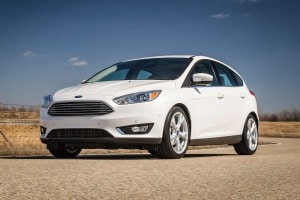
    The new 2012 Ford Focus, with its more purposeful lines, is a welcome change from the dreadfully awkward model that preceded it. It may not have the flair of the Elantra, but its "kinetic design form language" seems more of one piece. Since styling is so subjective there's no real winner here, but we're impressed with the sheer design-per-inch of both sedans.

    Although the materials may be soft-touch-look, the hard plastics point to Hyundai's cost-cutting.

    Some Power for the People
    Compact cars always face the dilemma of power versus fuel economy, especially these days when it seems a requirement to advertise 40 mpg on the highway.

    The Focus' all-aluminum direct-injected 2.0-liter four-cylinder is the power champ of the two, grinding out 160 horsepower and 146 pound-feet of torque. The Elantra counters with 148 hp and 131 lb-ft from its 1.8-liter multiport fuel-injected four. Continuing its high-techery, the Focus Titanium comes with a dual-clutch six-speed transmission dubbed PowerShift, while Hyundai uses a traditional six-speed automatic.

    Out in the real world, the Focus doesn't feel like it has a significant power advantage over the Elantra. That's partly because its twin-clutch transmission is reluctant to downshift more than one gear for passing. The other factor is its resistant throttle pedal, which tricks you into thinking you've given it more boot than you really have. Further, the PowerShift's Sport mode only holds revs slightly higher and does a pretty poor job of "learning" your driving habits.

    The Elantra's transmission is what we'd call shifty, but we mean that in a good way. It tries to get into 6th as soon as possible for better fuel economy, but prod the throttle pedal even a little and it immediately downshifts, sometimes two or even three gears. The downside here is that because it's so eager to please, even if you just want a bit of extra power, the little engine is suddenly revving way up into its thrashy region. On the contrary, the Focus four sounds better the more you rev it and is always smooth. It even has a sporty-sounding rasp from its exhaust.

    You can manually shift the Elantra via the console lever but there's no rev-matching, so downshifts are slow and a bit jerky. The Focus' PowerShift transmission uses a ridiculous rocker switch on the console shifter for manual operation. It's hard to find quickly, and doesn't really work all that well once you do. On the bright side, it does nice throttle blips on downshifts in Manual and Sport modes.

    Against the Clock
    Despite weighing 268 pounds more than the Elantra (3,091 vs. 2,823), the Focus proved about a half-second quicker from zero to 60 mph. Its best run took 8.9 seconds compared to the Elantra's 9.5-second time (they run 8.6 and 9.2 seconds, respectively, with a 1-foot rollout like at a drag strip). The Focus was aided by quicker shifts from its twin-clutch gearbox along with a 2,800-rpm "launch control" mode that's good for two-tenths.

    When it comes to stopping, the Focus' optional 18-inch cast-aluminum wheels/summer tire option helped it to an exemplary stopping distance of 111 feet from 60 mph. The all-season-tire-equipped Elantra could only manage a 126-foot stop from 60 mph, although its pedal was nice and firm. Although the Ford's pedal felt a bit spongy during panic stops at the track, on the road it was much more reassuring. The Elantra's pedal remained nice and firm throughout testing.

    Besides the tires, the Focus has the benefit of a well-sorted suspension and one of the best electric-assist steering systems on the road. It snaked through our slalom at 67.7 mph, almost 2 mph quicker than the Elantra that proved to be surprisingly agile as well. The Focus might have even gone faster if not hampered by its nondefeat stability system, the intervention of which is thankfully quite high. The Focus also had its way with the Elantra around the skid pad, generating 0.88g versus the Elantra's 0.81g.

    Back in the Real World
    Given its strong performance at the track, we weren't surprised to find that the 2012 Ford Focus is more enjoyable on the street, too. The well-weighted steering, sticky tires and composed suspension give it a substantial feel that's missing from most sedans in this class. Go ahead, attack a corner if you want; the Focus can handle it.

    The Elantra slides around more on its slippy tires, and its wonky electric steering offers near-zero feedback. It also has a cruder suspension that skitters over bumps much more so than the Focus. Ride quality and interior noise were similar between the two, despite the Focus using what should be noisier performance tires. Chalk it up to good sound-deadening on the Ford.

    Both of these cars claim to deliver exceptional mileage, but our testing loop was clearly more aggressive than the EPA test, as neither car came close to its official ratings. The Focus delivered an overall average of 27 mpg, with EPA ratings of 27 city/37 highway/31 combined. The Elantra fared even worse, with an overall average of 23.6 mpg on ratings of 29 city/40 highway/33 combined. Clearly, both cars would do better under more conventional driving, but the Elantra doesn't appear to have a significant advantage despite its higher ratings.

    The Inside Dirt
    After considerable seat time in both sedans, we preferred the look of the 2011 Hyundai Elantra's interior. The controls are far simpler and the layout in general is more pleasing to the eye. The biggest issue with the Elantra is the quality of the materials. They look soft, but when you actually touch them they're hard plastic that doesn't feel expensive.

    In contrast, the Focus has some of the finest materials ever to swath a compact car's cabin. It makes you feel as if you're in a different class of car. Sure, there are huge vents jutting out in odd directions and it feels a bit more cramped than the Hyundai, but the overall impression is one of quality.

    Plus, the front seats positively envelop you with their plushness and lateral support, putting the flat-as-a-board Elantra buckets to shame. The only real letdown in the Focus is the unnecessarily confusing/overwhelming MyFord Touch infotainment display screen, a standard feature of the Focus Titanium model. There's no doubt it offers some nice features. Unfortunately, ease of use isn't one of them.

    Speaking of the seats, the Elantra's dramatic roof line seriously cramps rear headroom, although the large and wide-opening doors make exit/entry easier than the Focus. Both cars come with split-folding seats and small trunk pass-throughs, but the Focus' cargo area is abysmal because of the full-size spare that comes with the 18-inch summer tire option. Ford estimates the spare steals 3 cubic feet of cargo capacity, dropping it to 10.2 compared with the Elantra's generous 14.8 cubic feet.

    Adding It Up
    So after thoroughly evaluating both sedans in every type of driving situation, here's where they stand. The Focus cleaned up in every performance category, including observed fuel mileage. To some, that's enough right there. These are not sport sedans, or even pseudo sport sedans, but when you combine top-notch performance with great fuel mileage it's a pretty hard combination to beat.

    When it comes to interior comfort, the Focus is our pick, too. Between the seats and the materials, you never feel as if you settled for an inexpensive car. The Hyundai isn't far behind in this respect. There's plenty of room and features galore, but it doesn't have the same level of refinement as the Focus.

    Of course, price is a major factor when you're talking about cars in this category. Not surprisingly, the Focus is more expensive. Quite a bit more expensive, actually. Its as-tested price is $26,375 or $3,545 more than the $22,830 Elantra.

    A closer look at the options list revealed plenty of features on the Focus that could be deleted without changing our impression of the car. The $1,100 automated parking package is largely pointless. Learn to park on your own. It's free. The $1,490 Premium package is debatable. The six-way power driver seat is nice, but the rear parking sensors and rain-sensing wipers certainly aren't necessary. Ditch those two packages and it would bring the Focus within $955 of the Elantra.

    So is the 2012 Ford Focus $1,000 better than the 2011 Hyundai Elantra? Our unanimous decision was yes, it's well worth the extra cost. From the interior materials to the solid feel of its chassis, the Focus feels like it costs $5,000 more than the Elantra, it's really that good.

    The manufacturers provided Edmunds these vehicles for the purposes of evaluation.

    Sort By:

    macsaan says:

    12:40 PM, 02/09/2012

    *elantra rules

    lol i accidentally typed acccent

    love both but my friend got elantra and he really loves it

    btw focus... many people hate it (i believe there is a reason)

    macsaan says:

    12:36 PM, 02/09/2012

    accent rules

    ne1butu2 says:

    08:43 PM, 02/04/2012

    For people nickel and diming on price.... BMW has no problem selling a $40k mini cooper, and it ranks near last in reliability. Or a $30k GTI. I like the idea of premium small cars. To me the Ford is a real premium small car. It comes from European DNA where they've had many different premium variations of the Focus for years, including a Volvo C70 based hardtop convertible. Finally, with this model, the US gets the good stuff. A Hyundai is an economy car. Which isn't bad, but it shows. I'll take the Focus. ST please.

    runnerguy45 says:

    08:11 PM, 01/22/2012

    I bought a new 2011 VW Sportwagen TDI for less then $25,000. I can't see spending that much on the two cars reviewed.

    wizard_ says:

    07:18 AM, 12/02/2011

    Dang, Edmunds only averaged mid 20s for the Elantra.  And on premium fuel.

    http://www.leftlanenews.com/consumer-watchdog-asks-epa-to-evaluate-hyundai-elantra-fuel-economy-claims.html

    "Consumer Watchdog requests that the EPA re-test the 2011 and 2012 Elantra models in its own facility, to seek an explanation for the MPG disappointments of so many Elantra buyers,"

    timmm55 says:

    01:15 PM, 08/30/2011

    Warranty? Please, I remember when the Chevy Vega HAD to have a 100K mile warranty just to sell them because of the engine block/head issues.

    Hyundai's long term reputation has not been proven, otherwise they wouldn't need the longer warranty.

    hako says:

    06:15 PM, 08/25/2011

    The Focus does seem very nice, if a bit over-priced, but there is the (often ignored) 500 lbs gorilla in the middle of this review.   Warranty.   They didn't really talk about it, and it matters, because it speaks directly to value.   The Hyundai warranty covers the car for the entire payment schedule, not just 36 months.  

    paulvincent1 says:

    06:28 PM, 08/19/2011

    I bought the 5 door Titanium Focus as it was the model that my wife wanted, and I got an excellent deal. It is a wonderful car that is really road worthy. The best mpg I've gotten (hypermiling) was a bit over 47 mpg. If I stand on the throttle, I get 29-31 mpg. Ford really outdid themselves on this car. Previous two cars were a 2007 MS3 and a 2008 WRX STI. The Focus is the best of the three by far (the others are not even close). Subaru made me a very strong offer, but I wasn't even interested after having driven the Focus.

    bsegalis says:

    07:08 AM, 08/18/2011

    I just don't understand paying 26K for a Ford Focus.  This is the cost of a two-year old Audi A4 Quattro or Mercedes C300, among other cars.  I don't understand where the Focus fits in terms of pricing, market.  I failed to mention that a brand new, de-contented Jetta is less expensive... You could get a TDI for 26K.

    itm1221 says:

    07:50 PM, 08/17/2011

    for that kind of money id buy myself a mazdaspeed 3!

    Sort By:

    Close

    Share on Facebook Share on Facebook
    Share on Twitter Share on Twitter

    Advertisement

    Speed Read

    1st Place: 2012 Ford Focus Titanium

    Precise chassis dynamics and fantastic interior materials set the Focus apart in the compact segment.

    2nd Place: 2011 Hyundai Elantra Limited

    The Hyundai Elantra sports flashy styling and boasts 40 mpg highway, but its driving dynamics leave us cold.

    Tags

    Specs & Performance

    Vehicle
    Year Make Model2012 Ford Focus Titanium 4dr Sedan (2.0L 4cyl 6AM)
    Vehicle TypeFWD 4dr 5-passenger Sedan
    Base MSRP$22,995
    Options on test vehicleKona Blue Metallic; Rapid Spec 401A ($1,490 -- includes Titanium Premium package: leather-trimmed seats, six-way power driver seat with manual lumbar, rear parking aid sensor, rain-sensing wipers, auto-dimming (electrochromic) rearview mirror and rear armrest with storage); Parking Technology Package ($1,100 -- includes Active park assist; front parking sensors; rearview camera); Voice-Activated Navigation ($795); Titanium Handling Package ($595 -- includes 18-inch alloy wheels, optimized sport suspension components, low-profile summer performance tires, full-size spare tire); PZEV Emissions ($0); Parking Technology Package Discount (-$405); Rapid Spec 401A discount (-$195)
    As-tested MSRP$26,375
    Assembly locationWayne, Michigan
    North American parts content (%)55
    Drivetrain
    ConfigurationTransverse, front-engine, front-wheel drive
    Engine typeNaturally aspirated, direct-injected, inline-4, gasoline
    Displacement (cc/cu-in)1,999/122
    Block/head materialAluminum/aluminum
    ValvetrainDOHC, four valves per cylinder, variable intake + exhaust-valve timing
    Compression ratio (x:1)12.0
    Redline, indicated (rpm)6,500
    Horsepower (hp @ rpm)160 @ 6,500
    Torque (lb-ft @ rpm)146 @ 4,450
    Fuel typeRegular unleaded
    Transmission typeSix-speed dual-clutch automated manual with console shifter and lever-mounted shift button; sport mode
    Transmission ratios (x:1)I = 3.92; II = 2.43; III = 1.44; IV = 1.02; V = 0.87; VI = 0.70; R = 3.51
    Final-drive ratio (x:1)3.85 (gears I, II, V, VI) and 4.28 (gears III, IV, R)
    Differential(s)Open differential with brake-induced torque vectoring
    Chassis
    Suspension, frontIndependent MacPherson struts, coil springs, monotube dampers, stabilizer bar
    Suspension, rearIndependent multilink, coil springs, monotube dampers, stabilizer bar
    Steering typeElectric-assist, speed-proportional, rack-and-pinion power steering
    Steering ratio (x:1)14.7
    Turning circle (ft.)36.0
    Tire make and modelMichelin Pilot Sport 3
    Tire typeSummer, performance
    Tire sizeP235/40ZR18 (95W) front and rear
    Wheel size18-by-8 inches front and rear
    Wheel materialCast aluminum
    Brakes, front10.9-inch ventilated cast-iron discs with single-piston sliding calipers
    Brakes, rear10.7-inch solid cast-iron discs with single-piston sliding calipers
    Track Test Results
    Acceleration, 0-30 mph (sec.)3.5
    0-45 mph (sec.)5.7
    0-60 mph (sec.)8.9
    0-60 with 1 foot of rollout (sec.)8.6
    0-75 mph (sec.)13.1
    1/4-mile (sec. @ mph)16.5 @ 85.4
    0-30 mph, trac ON (sec.)3.6
    0-45 mph, trac ON (sec.)6.0
    0-60 mph, trac ON (sec.)9.2
    0-60, trac ON with 1 foot of rollout (sec.)8.8
    0-75 mph, trac ON (sec.)13.3
    1/4-mile, trac ON (sec. @ mph)16.7 @ 84.6
    Braking, 30-0 mph (ft.)28
    60-0 mph (ft.)111
    Slalom, 6 x 100 ft. (mph)67.7
    Slalom, 6 x 100 ft. (mph) ESC ON67.3
    Skid pad, 200-ft. diameter (lateral g)0.88
    Skid pad, 200-ft. diameter (lateral g) ESC ON0.85
    Sound level @ idle (dB)41.6
    @ Full throttle (dB)73.1
    @ 70 mph cruise (dB)65.6
    Engine speed @ 70 mph (rpm)2,550
    Test Driver Ratings & Comments
    Acceleration commentsThe Focus is sluggish off the line, but has a nice surge of power at about 4,000 rpm. It will go into a "launch" mode if you power brake with TC off and the transmission console lever switched to Sport. Then it "bounces" the revs off a 2,800-rpm limiter and lazily drops the clutch. It's good for two-tenths. Manual shifting is done via the completely lame rocker switch on the console lever. Will not hold gears at redline. Does blip the throttle on downshifts.
    Braking commentsFirst run, the pedal went almost to the floor, but still stopped quite short. By the third stop the pedal felt perfectly firm, then regressed to lengthier travel again on subsequent stops. Distances were consistently short; summer tires probably helped. Strong brake odor by the sixth and final stop.
    Handling commentsSkid pad: For whatever reason, possibly the extremely hot temps, we could not reproduce quite the levels of grip as the last '12 Focus we tested. Still pretty good, though. What's interesting here is how much the ESC system cuts the throttle with TC on, while it hardly cuts the throttle at all with TC off. Interesting, because it was more intrusive in the slalom. Slalom: The Focus has nondefeatable ESC. Traction control can be turned off, but ESC is always there, watching and waiting for you to go over the limit, at which point it starts to dab the brakes. The Focus could definitely go a bit quicker if not for the ESC, although thankfully the system isn't overly aggressive. Still, it pays to drive smoothly. TC on/TC off runs proved basically identical, with the same level of ESC intervention. Steering has good feel and weighting for an electric setup.
    Testing Conditions
    Test date7/6/2011
    Test locationCalifornia Speedway
    Elevation (ft.)1,121
    Temperature (°F)92.9
    Relative humidity (%)35.8
    Barometric pressure (in. Hg)28.8
    Wind (mph, direction)4.56, Headwind
    Odometer (mi.)1,222
    Fuel used for test91-octane gasoline
    As-tested tire pressures, f/r (psi)39, 39
    Fuel Consumption
    EPA fuel economy (mpg)27 city/37 highway/31 combined
    Edmunds observed (mpg)33.2 best, 24.2 worst, 27 average (over 717 miles)
    Fuel tank capacity (U.S. gal.)12.4
    Driving range (mi.)458.8
    Audio and Advanced Technology
    Stereo description10-speaker premium audio system with subwoofer, HD radio with iTunes tagging
    iPod/digital media compatibilityStandard USB port, iPod integration, Bluetooth audio, aux jack
    Satellite radioStandard Sirius with six-month pre-paid subscription
    Hard-drive music storage capacity (Gb)Not available
    Rear seat video and entertainmentNot available
    Bluetooth phone connectivityStandard Sync hands-free with voice control
    Navigation systemOptional
    Telematics (OnStar, etc.)Standard 911 assist (if paired Bluetooth phone is present)
    Smart entry/StartStandard ignition doors
    Parking aidsOptional parking sonar front and rear, back-up camera, automated self-parking system
    Blind-spot detectionNot available
    Adaptive cruise controlNot available
    Lane-departure monitoringNot available
    Collision warning/avoidanceNot available
    Night VisionNot available
    Driver coaching displayNot available
    Dimensions & Capacities
    Curb weight, mfr. claim (lbs.)2,935
    Curb weight, as tested (lbs.)3,091
    Weight distribution, as tested, f/r (%)59/41
    Length (in.)178.5
    Width (in.)71.8
    Height (in.)57.7
    Wheelbase (in.)104.3
    Track, front (in.)61.2
    Track, rear (in.)60.4
    Legroom, front (in.)41.9
    Legroom, rear (in.)33.2
    Headroom, front (in.)38.3
    Headroom, rear (in.)38.0
    Shoulder room, front (in.)55.6
    Shoulder room, rear (in.)53.7
    Seating capacity5
    Step-in height, measured (in.)14.3
    Trunk volume (cu-ft)10.2 (est.)
    Cargo loading height, measured (in.)28.1
    GVWR (lbs.)3,990
    Payload, mfr. max claim (lbs.)827
    Tow capacity, mfr. claim (lbs.)Not recommended
    Warranty
    Bumper-to-bumper3 years/36,000 miles
    Powertrain5 years/60,000 miles
    Corrosion5 years/Unlimited miles
    Roadside assistance5 years/60,000 miles
    CollapseSpecs and Performance Expand Collapse

    Specs & Performance

    Vehicle
    Year Make Model2011 Hyundai Elantra Limited 4dr Sedan (1.8L 4cyl 6A)
    Vehicle TypeFWD 4dr 5-passenger Sedan
    Base MSRP$20,700
    Options on test vehiclePhantom Black Metallic; Premium Package ($2,000 -- includes navigation system with 7-inch screen, rearview camera, 360-watt premium audio with external amplifier, automatic headlamps, proximity key entry with electronic push-button start, engine immobilizer); Carpeted Floor Mats ($95); iPod Cable ($35)
    As-tested MSRP$22,830
    Assembly locationMontgomery, Alabama
    North American parts content (%)34
    Drivetrain
    ConfigurationTransverse, front-engine, front-wheel drive
    Engine typeNaturally aspirated, port-injected inline-4, gasoline
    Displacement (cc/cu-in)1,797/110
    Block/head materialAluminum/aluminum
    ValvetrainDOHC, four valves per cylinder, variable intake + exhaust-valve timing
    Compression ratio (x:1)10.3
    Redline, indicated (rpm)6,750
    Horsepower (hp @ rpm)148 @ 6,500
    Torque (lb-ft @ rpm)131 @ 4,700
    Fuel typeRegular unleaded
    Transmission typeSix-speed automatic with console shifter
    Transmission ratios (x:1)I = 4.40; II = 2.73; III = 1.83; IV = 1.39; V = 1.00; VI = 0.77; R = 3.44
    Final-drive ratio (x:1)3.07
    Chassis
    Suspension, frontIndependent MacPherson struts, coil springs, twin-tube dampers, stabilizer bar
    Suspension, rearSemi-independent twist beam-axle, coil springs, monotube dampers
    Steering typeElectric-assist, speed-proportional rack-and-pinion power steering
    Steering ratio (x:1)14,.2
    Turning circle (ft.)34.8
    Tire make and modelContinental ContiProContact
    Tire typeAll-season front and rear
    Tire sizeP215/45R17 (87H) M+S
    Wheel size17-by-7 inches
    Wheel materialCast aluminum
    Brakes, front11-inch ventilated cast-iron discs with single-piston sliding calipers
    Brakes, rear10.3-inch solid cast-iron discs with single-piston sliding calipers
    Track Test Results
    Acceleration, 0-30 mph (sec.)3.3
    0-45 mph (sec.)5.9
    0-60 mph (sec.)9.5
    0-60 with 1 foot of rollout (sec.)9.2
    0-75 mph (sec.)14.1
    1/4-mile (sec. @ mph)16.9 @ 82.7
    0-30 mph, trac ON (sec.)3.4
    0-45 mph, trac ON (sec.)6.1
    0-60 mph, trac ON (sec.)9.7
    0-60, trac ON with 1 foot of rollout (sec.)9.3
    0-75 mph, trac ON (sec.)14.3
    1/4-mile, trac ON (sec. @ mph)17.0 @ 82.6
    Braking, 30-0 mph (ft.)31
    60-0 mph (ft.)126
    Slalom, 6 x 100 ft. (mph)66.0
    Slalom, 6 x 100 ft. (mph) ESC ON64.6
    Skid pad, 200-ft. diameter (lateral g)0.81
    Skid pad, 200-ft. diameter (lateral g) ESC ON0.79
    Sound level @ idle (dB)39.7
    @ Full throttle (dB)74.0
    @ 70 mph cruise (dB)65.6
    Engine speed @ 70 mph (rpm)2,250
    Test Driver Ratings & Comments
    Acceleration commentsDecent squirt off the line, but still not enough power to break the front tires loose. Shifts at 5,750 rpm for the 1-2, 6,250 for the 2-3 and 6,400 for the 3-4, regardless of whether in Drive or Manual modes. Quickest run was with some power braking, but that only netted an extra tenth. Manual shifting is via console lever (pull back for downshifts). Will not hold gears to redline and does not blip throttle on downshifts.
    Braking commentsVery solid pedal, from first stop to last. The Elantra's on-road pedal touchiness not a hindrance here. But it doesn't stop particularly quickly, largely due to the lack of grip from its tires. Lots of ABS noise and pumping.
    Handling commentsSkid pad: Steering is kinda syrupy and lacks much in the way of feel around the skid pad. Although there isn't much grip, the car's attitude can be adjusted nicely with drop-throttle. In other words, the Elantra doesn't just go into a plow-fest, terminal understeer mode, a nice trait. With ESC on, system aggressively cuts throttle, but it keeps the car perfectly on the arc with no need to adjust steering or throttle, never overshooting like the Focus. Slalom: Very composed around the cones. Steering is reasonably quick, if not overly precise. What's impressive is that the Elantra went this quickly with all-season tires. The tail only gets loose when you really start throwing it around, or using drop-throttle, with ESC off. But even then, it remains composed and catchable.
    Testing Conditions
    Test date7/6/2011
    Test locationCalifornia Speedway
    Elevation (ft.)1,121
    Temperature (°F)91.3
    Relative humidity (%)36.9
    Barometric pressure (in. Hg)28.8
    Wind (mph, direction)5.31, Crosswind
    Odometer (mi.)4,774
    Fuel used for test91-octane gasoline
    As-tested tire pressures, f/r (psi)32, 32
    Fuel Consumption
    EPA fuel economy (mpg)29 city/40 highway/33 combined
    Edmunds observed (mpg)31.1 best, 20.2 worst, 23.6 average mpg (over 762 miles)
    Fuel tank capacity (U.S. gal.)12.8
    Driving range (mi.)512
    Audio and Advanced Technology
    Stereo description360-watt AM/FM/CD/MP3/XM satellite radio audio system with six speakers and external amplifier.
    iPod/digital media compatibilityStandard iPod via USB and Aux input jacks
    Satellite radioStandard XM with 90-day trial subscription
    Hard-drive music storage capacity (Gb)Optional 16GB music storage capacity
    Rear seat video and entertainmentNot available
    Bluetooth phone connectivityStandard
    Navigation systemOptional with 7-inch display screen
    Telematics (OnStar, etc.)Optional traffic, weather, sports and stocks with 90-day trial subscription
    Smart entry/StartOptional ignition and doors
    Parking aidsOptional back-up camera
    Blind-spot detectionNot available
    Adaptive cruise controlNot available
    Lane-departure monitoringNot available
    Collision warning/avoidanceNot available
    Night VisionNot available
    Driver coaching displayStandard
    Dimensions & Capacities
    Curb weight, mfr. claim (lbs.)2,877
    Curb weight, as tested (lbs.)2,823
    Weight distribution, as tested, f/r (%)62/38
    Length (in.)178.3
    Width (in.)69.9
    Height (in.)56.5
    Wheelbase (in.)106.3
    Track, front (in.)61.1
    Track, rear (in.)61.6
    Legroom, front (in.)43.6
    Legroom, rear (in.)33.1
    Headroom, front (in.)40.0
    Headroom, rear (in.)37.1
    Shoulder room, front (in.)55.9
    Shoulder room, rear (in.)54.8
    Seating capacity5
    Step-in height, measured (in.)13.6
    Trunk volume (cu-ft)14.8
    Cargo loading height, measured (in.)27.1
    GVWR (lbs.)3,792
    Ground clearance (in.)5.5
    Warranty
    Bumper-to-bumper5 years/60,000 miles
    Powertrain10 years/100,000 miles
    Corrosion7 years/Unlimited miles
    Roadside assistance5 years/Unlimited miles
    CollapseSpecs and Performance Expand Collapse

    Advertisement