INSIDE LINE

2011 Dodge Durango Crew AWD vs. 2011 Ford Explorer XLT 4WD

Media Player

  • 2011 Dodge Durango Crew AWD vs. 2011 Ford Explorer XLT 4WD Picture

    2011 Dodge Durango Crew AWD vs. 2011 Ford Explorer XLT 4WD Picture

    The Explorer and Durango are crossovers now. But they're still among the most upright vehicles around. | January 21, 2011

Comparison

2011 Dodge Durango Crew AWD vs. 2011 Ford Explorer XLT 4WD

Once Trucks, Now Crossovers

    80 Ratings

    Not long ago the Ford Explorer and Dodge Durango were engineering throwbacks, midsize SUVs with full ladder frames under their blunt steel bodies, powered by drivetrains swiped from pickups. "They can tow!" their defenders would shout as if that justified their position in the marketplace. "And they can go off-road!" they'd add, as if that mattered.

    Both the Explorer and Durango are back for 2011 and now, like virtually every other mainstream crossover SUV against which they compete, they're built around unibody structures covered by sleek sheet metal. Throw your eyes out of focus and there's still some tough truck in their styling, but the engineering now is all car — from multivalve V6s to all-independent suspensions.

    And these days such modernity starts just shy of $40,000. Our Durango Crew tester, fitted with the entry navigation/commuter group and the optional Pearl paint cost $37,035. The Explorer XLT including its Driver Connect package, voice-activated navigation, blind spot information system and Trailer Tow package totaled $38,750.

    But let's not be coy; these are minivans disguised for 21st-century consumption. They both carry most of the functionality of a minivan — three rows of fold-flat seats and an arcade's worth of available onboard entertainment options — while avoiding the Mom Mobile stigma. These are state-of-the-art breeder buggies optimized for the cut, thrust and commuting of suburban kid toting. But they're coated with just enough ego-soothing plausible deniability.

    Still, in suburbia, no one tows anything and all the roads are paved. And one of these crossovers is better than the other.

    Different Directions
    Both the Durango and Explorer have turned their backs on their truckish engineering heritage, but they aren't exactly alike now.

    The Explorer is built atop Ford's "D4" platform, which is itself an evolved version of the "D3" structure that underpins Ford's Taurus sedan, Flex wagon and assorted Lincolns. Considering that this architecture was originally developed by Volvo for the front-drive 1999 S80 sedan — before Ford bought the Swedish company — it's fair to call it well-proven by now.

    So, like all the other Ford crossovers and most of the competition, the Explorer positions its engine transversely in the nose with the six-speed transaxle alongside it. Order a two-wheel-drive Explorer and it's a front-driver.

    In contrast, the new Durango rides on a stretched version of the same Mercedes-derived SUV platform that makes up the substance of the new 2011 Jeep Grand Cherokee. Like its American and German brothers, the Durango has its power plant mounted longitudinally in the engine bay with the Mercedes five-speed automatic bolted behind. Order a two-wheel-drive Durango and it's a rear-driver.

    But once past that, the two have a lot in common. Both are powered by all-aluminum DOHC 24-valve V6 engines. The Durango's "Pentastar" V6 displaces 3.6 liters, has a 10.2:1 compression ratio and delivers 290 horsepower and a peak 260 pound-feet of torque at 4,800 rpm.

    The Explorer's V6, on the other hand, displaces 3.5 liters, has 10.8:1 compression ratio and includes independent variable valve timing on both the intake and exhaust cams. Ford also rates its V6 at 290 hp, with the peak 255 lb-ft of torque at just 4,000 rpm.

    It's like picking between Peyton Manning and Tom Brady. It's Mantle vs. Mays, Magic vs. Bird or Gurney vs. Foyt.

    Although neither SUV is equipped with a low-range transfer case, the Explorer's all-wheel-drive system offers more adjustability. Ford's Terrain Management System changes the throttle map, stability control and transmission calibrations to accommodate four kinds of terrain (Normal, Mud/Ruts, Sand or Snow), plus there's hill descent control. The Durango's system simply provides a full-time 50/50 front/rear torque split with no adjustable electronics.

    Beasts of Burden
    In everyday driving neither V6 feels strained and both remain relatively quiet, even when accelerating to join freeway traffic. But the Explorer enjoys the significant advantage of the six-speed automatic transmission. Compared to the Durango's five-speed, the Explorer's shifts are crisper and the gears do a better job of keeping the V6 in the thickest part of its power band. The Durango's drivetrain is fine, but the Explorer's is sweeter and more flexible.

    Throw in the fact that the Durango weighs in at a thunder thigh-high 5,022 pounds, while the Explorer comes in at a still corpulent 4,707 pounds, and it's no shock that the Ford is the quicker machine. The Explorer will get to 60 mph in 8.1 seconds (7.7 seconds with 1 foot of rollout like on a drag strip) and slip through the quarter-mile in 15.9 seconds at 89.4 mph. It takes the Durango 9.0 seconds (8.7 seconds with rollout) to hit 60 and 16.6 seconds to complete the quarter-mile at 85.8 mph.

    On the other side of the ledger, the Explorer is also slightly better on fuel. Its EPA mileage ratings are 17 mpg in the city and 23 on the highway. The Durango is a nip behind at 16 mpg city and 22 mpg highway. In combined driving we averaged 16.2 mpg in the Durango and 18.1 mpg in the Explorer.

    The Smother Brothers
    Both the new Durango and Explorer ride fantastically well on-road using double-wishbone front suspensions and multilink independent systems in back. With their luxury car-spec tires, they both quietly smother road imperfections and transmit very little motion into their bodies. Compared to previous Explorers and Durangos, it's astonishing.

    Still, it's not as if these big wagons are nimble road rockets. After all, the Durango stretches out 199.8 inches long overall and rides on a 119.8-inch wheelbase. The original 1998 Durango was just 193.3 inches long and had a 116.2-inch wheelbase. At 197.1 inches long, the 2011 Ford Explorer is fully 12.8 inches longer than the first Explorer five-door that appeared 20 years ago and longer than any Explorer that's come before it. These two may not have full frames, but they're hardly downsized in either physical breadth or weight.

    Fortunately, both have steering that belies their size. The Durango's hydraulic power rack-and-pinion steering has better on-center feel than the electrically assisted rack-and-pinion system in the Ford. And the Explorer's steering is a little bit quicker than the Dodge's. Both have surprisingly good initial turn-in when cornering and remain relatively neutral within their modest limits. Beyond those limits, the story is all about understeer.

    Slalom speeds and skid pad adhesion don't matter much for vehicles like these, but we generated those numbers anyhow. The Durango charged through the slalom at an average 59.5 mph with stability control on and 59.6 mph with it off. It can feel top-heavy, but it actually stays well planted while pushing its nose through the cones. On the skid pad it orbited at 0.75g with stability control on and 0.76g with it off.

    We averaged 16.2 mpg in the Durango and 18.1 mpg in the Explorer.

    The Explorer generated similar numbers. There's no way to turn off the stability control system in the Ford, but turning the traction control off improved the slalom performance from 59.6 mph to 60.1 mph. On the skid pad it stuck to 0.77g regardless of how we set the electronic measures.

    Braking always matters, however, and both these jumbo-size haulers acquitted themselves well. The Durango needed 119 feet to stop from 60 mph, while the Explorer beat that number by a foot, achieving the same task in 118 feet.

    Creature Features
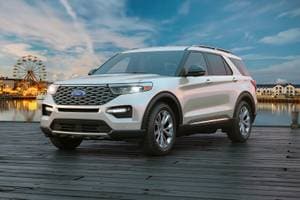
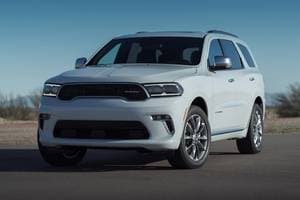
    Considering how dynamically similar these two are and how closely priced they are to each other, many — if not most — purchase decisions will boil down to aesthetics. Do you want to drive around in something that looks muscular like the Dodge? Or would you prefer a Ford that looks like a scaled-up Remington F5790 electric shaver? They're both handsome in their own way and destined to become anonymous, taken-for-granted presences on America's roads for decades.

    It's inside where the two differ most. The Durango has traditional instrumentation and real buttons to operate its various technologies. The Explorer, on the other hand, has progressed beyond that, with a single conventional speedometer flanked on either side by reconfigurable LED displays. And many of the Explorer's switches are soft-touch buttons — a touch-sensitive membrane over a printed circuit board.

    The Durango interior is, by far, the highest quality yet seen in a Chrysler product. It's a huge step forward for a company that's known for hard surfaces and haphazard interior fit. But overall, the Ford feels slightly higher quality and has better-shaped front seats.

    That aside, the Durango has slightly more room for cargo, there's something delightful in its unpretentious interior design and its third-row rear seat was easier for our 9-year-old child to access.

    Finally, the Explorer wins the electronic gizmo award hands down. There's simply more to Ford's Sync system than there is to the Dodge's UConnect. The learning curve for both — including navigation and entertainment elements — is fairly steep. But learning the Sync system seems to pay off better.

    The Winner
    It's early in their product lives, but already it's obvious that the new Durango and new Explorer are all-timers — vastly better than the trucklets they replace, and among the very best crossovers available at any price. So picking a winner here is like picking between Peyton Manning and Tom Brady, Mickey Mantle and Willie Mays, Magic and Bird, Gurney and Foyt. Pick whichever one fits the peculiarities of your life best and you can feel confident you did well.

    But the numbers crunch down to a slight victory for the Explorer over the Durango. Some of us prefer the Durango over the Explorer as new vehicles, but feel more confident recommending a Ford over a Dodge based solely on their respective reputations for long-term quality — and that counts in the scoring.

    So the Explorer racked up 82.7 points to the Durango's 80.3. That's eyelash close. And maybe the Hemi V8-powered Durango R/T would yank our hearts out with its 360 hp and deep well of torque. Then again, maybe it will prove so thirsty that we'd hurry back to the Explorer.

    The Explorer is a well-executed consumer product: the Starbucks vanilla latte of crossover SUVs. It does virtually everything well, does nothing badly, has enough room for most people most of the time, is pretty quick for its size, and smooth and creamy in every aspect of its operation. After all, even if everyone is drinking vanilla lattes, vanilla lattes are still really good.

    The manufacturers provided Edmunds these vehicles for the purposes of evaluation.

    Comparison

    Top 12 Features

    You'd think any luxury/sport sedan starting at around $60,000 would come with a plethora of the latest features to both coddle you and make your driving experience more fun. But as the list below shows, BMW and Infiniti have widely differing views on what should come standard and what the customer should have to cough up extra coin for. A critical miscue by Infiniti is the lack of a limited-slip differential, even as an option. Here's our list of features that we think a sport sedan in this category should have.

    Features
      Dodge Durango Crew AWD Ford Explorer XLT 4WD
    110- or 115-volt plug outlet O O
    Back-up camera O O
    Blind-spot warning system N/A O
    Bluetooth connectivity O O
    Dual-zone climate control O O
    Power-folding third-row seat N/A N/A
    Power liftgate O O
    Rear air-conditioner and heater O N/A
    Reverse-sensing system O O
    Satellite navigation O O
    Third-row remote fold-down headrest O O
    USB port O O


    Key:
    S: Standard
    O: Optional
    N/A: Not Available

    110- or 115-volt plug outlet: This allows the vehicle to power such items as laptop computers, personal electronics and lamps using a conventional plug. A great thing to have when camping or traveling.

    Back-up camera: These are big vehicles that are often loaded with driver distractions and/or vision-obstructing equipment. A rearview camera makes backing up much safer and easier.

    Blind-spot warning system: Using the same radar elements as the reverse-sensing system, the Explorer's blind-spot warning system lets you know when there's a vehicle alongside in the adjacent lane. Another way to fight on-road distraction.

    Bluetooth connectivity: Hands-free is a law in many states already. Plus, it's the only smart way to drive while talking on the phone. Bluetooth should be standard on every new car. Both test cars have it.

    Dual-zone climate control: Driver and front passenger seldom agree on the ideal temperature. Dual-zone climate controls ensure harmony during long drives. May save your marriage.

    Power-folding third-row seat: Just like a power-operated liftgate, power-folding third-row seats are a parent's best friend. They keep your hands free to hold onto a toddler or a grocery bag.

    Power liftgate: Coming out of Costco with three kids and enough groceries to feed them for a month is a logistics challenge in itself. A remote-operated power liftgate means the vehicle is ready to accept cargo before you get there with the cargo. And it means not having to set down packages or let go of a toddler's hand to get the rear door open.

    Rear air-conditioner and heater: The Durango offers a separate heating and air-conditioning system for rear-seat passengers, while the Explorer uses only one system with separate controls for the passengers. So the kids can be toasty back there while the adults up front enjoy an easygoing chill.

    Reverse-sensing system: Radar-based proximity detection systems give an audible warning that the vehicle is approaching a collision. Great for avoiding toys left in the driveway or low-lying pets and moppets.

    Satellite navigation: Onboard GPS systems end all arguments about exactly where you're headed. This helps harmonize familial happiness and ensure marital bliss.

    Third-row seat remote fold-down headrest: The third-row seats in both the Durango and Explorer are most easily accessed and most comfortably used by children. But when the kids aren't back there, the head restraints severely restrict rearward vision. A remote down feature allows the headrests to be stowed out of the driver's line of vision without him or her having to crawl into the back of the vehicle.

    USB port: There's no easier way to plumb personal electronics into a vehicle.

    Comparison

    Data and Charts

    Dimensions
    Engine & Transmission Specifications
    Warranty Information
    Performance Information


    Dimensions
    Exterior Dimensions & Capacities
      Dodge Durango Crew AWD Ford Explorer XLT 4WD
    Length, in. 199.8 197.1
    Width, in. 85.5 90.2
    Height, in. 71.6 71.0
    Wheelbase, in. 119.8 112.6
    As Tested Curb Weight, lb. 5,022 4,707
    Turning Circle, ft. 37.1 N/A


    Interior Dimensions
      Dodge Durango Crew AWD Ford Explorer XLT 4WD
    Front headroom, in. 39.9 39.1
    Rear headroom, in. 39.8 38.3
    Front shoulder room, in. 58.5 61.3
    Rear shoulder room, in. 58.3 61.3
    Front legroom, in. 40.3 40.6
    Rear legroom, in. 38.6 39.8
    Cargo volume, cu-ft. 47.7 44.0
    Max cargo volume, cu-ft. 84.5 81.0


    Engine & Transmission Specifications
    Engine & Transmission
      Dodge Durango Crew AWD Ford Explorer XLT 4WD
    Displacement
    (cc / cu-in):
    3600 (220) 3500 (214)
    Engine Type DOHC V6 DOHC V6
    Horsepower (SAE) @ rpm 290 @ 6,400 290 @ 6,500
    Max. Torque, lb-ft @ rpm 260 @ 4,800 255 @ 4,000
    Transmission 5-speed automatic 6-speed automatic
    EPA Fuel Economy City, mpg 16.0 17.0
    EPA Fuel Economy Hwy, mpg 22.0 23.0
    Observed Fuel Economy combined, mpg 16.2 18.1


    Warranty
    Warranty Information
      Dodge Durango Crew AWD Ford Explorer XLT 4WD
    Basic Warranty 3 years/36,000 miles 3 years/36,000 miles
    Powertrain 5 years/100,000 miles 5 years/60,000 miles
    Roadside Assistance 3 years/36,000 miles 5 years/60,000 miles
    Corrosion Protection 5 years/100,000 miles 5 years/unlimited miles


    Performance
    Performance Information
      Dodge Durango Crew AWD Ford Explorer XLT 4WD
    0-60 mph acceleration, sec. 9.0 8.1
    Quarter-mile acceleration, sec. 16.6 15.9
    Quarter-mile speed, mph 85.8 89.4
    60-0-mph braking, feet 119 118
    Lateral Acceleration, g 0.76 0.77
    600-ft slalom, mph 59.6 60.1

    Comparison

    Editors' Evaluations

    Evaluation - Drive
    Evaluation - Ride
    Evaluation - Design
    Evaluation - Function

    Evaluation - Drive

    Overall Dynamics
    Vehicle Score Rank
    Dodge Durango Crew AWD 7.4 2
    Ford Explorer XLT 4WD 7.8 1

    Engine Performance
    Vehicle Score Rank
    Dodge Durango Crew AWD 7.5 2
    Ford Explorer XLT 4WD 8.5 1

    Transmission Performance
    Vehicle Score Rank
    Dodge Durango Crew AWD 6.8 2
    Ford Explorer XLT 4WD 8.5 1

    Brake Performance
    Vehicle Score Rank
    Dodge Durango Crew AWD 7.5 1
    Ford Explorer XLT 4WD 7.5 1

    Steering Performance
    Vehicle Score Rank
    Dodge Durango Crew AWD 7.5 1
    Ford Explorer XLT 4WD 7.5 1

    Handling
    Vehicle Score Rank
    Dodge Durango Crew AWD 7.5 1
    Ford Explorer XLT 4WD 7.5 1

    Fun to Drive
    Vehicle Score Rank
    Dodge Durango Crew AWD 7.8 1
    Ford Explorer XLT 4WD 7.5 2

    Evaluation - Ride

    Overall Comfort
    Vehicle Score Rank
    Dodge Durango Crew AWD 8.2 1
    Ford Explorer XLT 4WD 7.9 2

    Ride Comfort
    Vehicle Score Rank
    Dodge Durango Crew AWD 8.5 1
    Ford Explorer XLT 4WD 8.0 2

    Wind Noise
    Vehicle Score Rank
    Dodge Durango Crew AWD 8.0 1
    Ford Explorer XLT 4WD 8.0 1

    Road Noise
    Vehicle Score Rank
    Dodge Durango Crew AWD 8.3 2
    Ford Explorer XLT 4WD 8.5 1

    Front Seat Comfort/Space/Access
    Vehicle Score Rank
    Dodge Durango Crew AWD 8.5 1
    Ford Explorer XLT 4WD 8.3 2

    Rear Seat Comfort/Space/Access
    Vehicle Score Rank
    Dodge Durango Crew AWD 8.5 1
    Ford Explorer XLT 4WD 7.5 2

    Driving Position
    Vehicle Score Rank
    Dodge Durango Crew AWD 8.0 1
    Ford Explorer XLT 4WD 8.0 1

    Evaluation - Design

    Overall Design & Build Quality
    Vehicle Score Rank
    Dodge Durango Crew AWD 8.1 2
    Ford Explorer XLT 4WD 8.3 1

    Exterior Design
    Vehicle Score Rank
    Dodge Durango Crew AWD 8.5 1
    Ford Explorer XLT 4WD 7.5 2

    Interior Design
    Vehicle Score Rank
    Dodge Durango Crew AWD 8.0 2
    Ford Explorer XLT 4WD 8.3 1

    Interior Materials
    Vehicle Score Rank
    Dodge Durango Crew AWD 7.8 2
    Ford Explorer XLT 4WD 8.5 1

    Interior Control Tactile Feel
    Vehicle Score Rank
    Dodge Durango Crew AWD 5.0 2
    Ford Explorer XLT 4WD 8.3 1

    Squeaks & Rattles
    Vehicle Score Rank
    Dodge Durango Crew AWD 8.5 1
    Ford Explorer XLT 4WD 8.5 1

    Panel Fitment & Gaps
    Vehicle Score Rank
    Dodge Durango Crew AWD 7.8 2
    Ford Explorer XLT 4WD 8.5 1


    Evaluation - Function

    Overall Function
    Vehicle Score Rank
    Dodge Durango Crew AWD 8.1 1
    Ford Explorer XLT 4WD 7.9 2

    Headlamp Illumination
    Vehicle Score Rank
    Dodge Durango Crew AWD 8.0 1
    Ford Explorer XLT 4WD 8.0 1

    Visibility
    Vehicle Score Rank
    Dodge Durango Crew AWD 8.5 1
    Ford Explorer XLT 4WD 7.8 2

    Instrument Panel (IP) Layout
    Vehicle Score Rank
    Dodge Durango Crew AWD 8.3 1
    Ford Explorer XLT 4WD 8.3 1

    Climate Control Layout
    Vehicle Score Rank
    Dodge Durango Crew AWD 8.3 1
    Ford Explorer XLT 4WD 7.8 2

    Audio System Layout
    Vehicle Score Rank
    Dodge Durango Crew AWD 7.3 2
    Ford Explorer XLT 4WD 8.0 1

    Secondary Control Layout
    Vehicle Score Rank
    Dodge Durango Crew AWD 7.3 2
    Ford Explorer XLT 4WD 7.5 1

    Interior Storage
    Vehicle Score Rank
    Dodge Durango Crew AWD 8.5 1
    Ford Explorer XLT 4WD 8.5 1

    Cupholders
    Vehicle Score Rank
    Dodge Durango Crew AWD 8.5 1
    Ford Explorer XLT 4WD 8.5 1

    Standard Cargo / Trunk Space
    Vehicle Score Rank
    Dodge Durango Crew AWD 8.3 1
    Ford Explorer XLT 4WD 7.5 2

    Maximum Cargo Space
    Vehicle Score Rank
    Dodge Durango Crew AWD 8.3 1
    Ford Explorer XLT 4WD 7.5 2

    Comparison

    Final Rankings and Scoring Explanation

    Final Rankings
    Item Weight Ford Explorer XLT 4WD Dodge Durango Crew AWD
    Personal Rating 3.5% 50.0 100.0
    Recommended Rating 3.5% 100.0 50.0
    Evaluation Score 25% 79.7 79.6
    Feature Content 23% 58.3 55.6
    Performance 13% 100.0 85.1
    Fuel Consumption 12% 100.0 94.7
    Price 20% 95.4 100.0
    Total Score 100.0% 82.7 80.3
    Final Ranking 1 2


    Personal Rating (3.5%): Purely subjective. After the test, each participating editor was asked to rank the vehicles in order of preference based on which he or she would buy if money were no object.

    Recommended Rating (3.5%): After the test, each participating editor was asked to rank the vehicles in order of preference based on which he or she thought would be best for the average consumer shopping in this segment.

    30-Point Evaluation Score (25%): Each participating editor ranked every vehicle based on a comprehensive 30-point evaluation. The evaluation covered everything from exterior design to cupholders. Scoring was calculated on a point system, and the scores listed are averages based on all test participants' evaluations.

    Feature Content (23%): For this category, the editors picked the top 12 features they thought would be most beneficial to the consumer shopping in this segment. For each vehicle, the score was based on the number of features it had versus the total possible (12). Standard and optional equipment were taken into consideration. Because features are very important to buyers in this segment, its importance was emphasized in judging.

    Performance Testing (13%): Both vehicles were tested at Auto Club Speedway in Fontana, California. Inside Line's regimen of standardized instrumented test include: acceleration (0-60 and quarter-mile), braking (60-0), 600-foot slalom and 200-foot-diameter skid pad. Points are awarded as a percentage of the best overall performance in each test. Because of the utilitarian nature of these family haulers, performance only accounts for 13 percent of the score in this evaluation.

    Fuel Consumption (12%): The scores listed are the result of a simple percentage calculation based on the car with the highest EPA combined fuel economy rating.

    Price (20%): The numbers listed were the result of a simple percentage calculation based on the less expensive vehicle in the comparison test. Using the "as tested" prices of the actual evaluation vehicles, the less expensive vehicle received a score of 100, while the other vehicle was awarded points on a relative percentage scale. For example, if it were 20 percent more expensive, it received 20 percent fewer points.

    Sort By:

    ford_flexer says:

    08:35 AM, 05/22/2012

    they both look good to me but that explorer would have to be the one for me but match up the new explorer sport and the durango heat then we'll talk

    jimbobm says:

    12:11 PM, 03/12/2012

    All I can say is the Durango has made my wife happy:)  We looked at the new Explorer (not as much leg room, middle and back row, as the Durango and the sticker on the one we looked at was quite a bit more than the Durango and has the same group of options), Acadia, Traverse, Enclave, Mazda, KIA,,, (I think just about all that make a cross-over).  The Durango Crew is loaded with standard options and the seats seemed for feel better for my wife than all the other competitiors.  The front of the Durango just looks mean, but I'd agree with the person who commented on the back on it being so-so, but acceptable.  The overall looks of the Durango are equal, if not better, than the Explorer, which we also liked.  I had no problem in finding a new Explorer to test, but couldn't find a used 2011 to test.  The Ford dealership that I went to really didn't try to do much in getting my business.  He brought one out and said there it is and that was pretty much it.  The Dodge dealership, on the other hand, really knows how to treat a perspective customer and went over all features with us and was definately interested in earning my business.

    We looked for nearly a year at everything out there and in our non-biased test the Durango is NUMBER 1!  I also like the fact that not every one and their brother are driving them.  I like to own a vehicle that people look at as you drive by and say "wow, what the heck was that".  

    Welcome back Dodge Durango!

    pjstrifas says:

    06:38 PM, 11/02/2011

    So I'm wondering if there was any consideration for these facts:

    The Durango Crew has a rear backup camera and remote start, the Explorer XLT does not. And yes suburbanites do tow things so it's important information to include. Durango will handle 6,000 lbs (v6), Explorer will do 5,000 lbs. Makes a difference to some who tow motorcycles or campers or jet-skis . . . you can't just leave out a sentence with those facts IMO.

    Also, does the Explorer have the remote 3rd row headrest down feature? Durango does :) I like that one :D

    In the end, everyone shopping these vehicles should test drive BOTH and get pricing on BOTH before deciding which one is the right one for them and their family.

    colorado1974 says:

    11:49 AM, 06/02/2011

    Funny how every other compario puts the exploder in last place.  "predicted reliability as the deciding factor?"  Wow, Ford has ever won any quality award for anything.  The new Grand Cherokee and Ram have won quality awards galore.  

    Hmmm, could edmunds be biased?  

    What a joke.

    britney4 says:

    10:22 AM, 05/31/2011

    Please check out our forum for Ford Explorer owners. It contains Photos, Reviews, Q&A, and friendly chit chat about a common denominator... your favorite SUV- the Ford Explorer!

    http://www.explorertalk.com/forums/

    lilredcorvt says:

    12:52 PM, 03/16/2011

    @sonomamama...Dodge's cockpit is claustrophobic are you serious? LMAO...you must be smoking something!!! I've test driven the new Explorer and I'm a big guy it has less space than the Durango in the driver's position and then on the second row seats my knee hits the driver's seat, better look again and youtube has already shown it with car expert reviews. Ride quality of the Explorer is on the stiffer side IMHO and the steering feel keeps me guessing its like there's no feel for the road. I didn't like the exterior styling of the front it had the polarizing look/effect to it and that's why I didn't even get the 2011 Acura MDX which was the other I was looking at.  I only give the cockpit instrumentation layout the edge to the Ford Explorer.  The UCONNECT system I think is about even with the Explorer's MySync system. But overall the Durango was the better vehicle, ride quality wise was superior and the precise linear steering feel felt I was driving a European sport sedan - Dodge got this one right and lots more consumer are flocking to the Dodge dealership to look at the Durango!!!  

    sonomamama says:

    01:57 AM, 03/15/2011

    Purchased a Ford Explorer Limited, fully loaded today. We love it! It's a new car and a fun gagdet in one.

    We have owned luxury vehicles (BMW X5), (Mercedes SUV) and this ranks right up there with them.
    My husband and I test drove fully loaded vehicles (Dodge Durango, GMC Acadia, Toyota 4 Runner, Honda Pilot, and Ford Explorer).
    Our decision was a no brainer.
    The Dodge, which is supposed to feel like a cock-pit, is claustrophobic. It had a V8, which I certainly didn't want with gas prices creeping up to $5.00 a gallon. The second row seats do slide forward and back, as well as incline which was nice. The Explorer will incline, but does not slide.
    The Acadia was nice, but didn't have as many interior features/gadgets and was about the same price fully loaded as the Ford Explorer.
    The Toyota 4 Runner didn't come close. I'm only 5,2" and I could barely get into the 3rd row seat. It doesn't have the comfort or the tech gadgets that the others offered.
    The Honda Pilots exterior appears boxy. The interior was nice, but the quality of leather and other features were lower. The interiors seam gaps could use improvement.  Carpet is cheap.

    Here's what I love about the Explorer:
    Beautiful interior with tight seams, high quality leather, non pilling roof interior (similar to what you find in the BMWs), a touch screen (similar to an IPad) that plays DVDs, controls Entertainment, Phone, Navigation, Climate, etc. Your I-Phone syncs with it.  It will store all your contact information and music.  It will burn CDs. It's controlled by touch, push button, or voice.
    The seats (all 7) are extremely comfortable. The front are fully adjustable, heated and air conditioned , and has 3 memory positions.
    The second row has adequate leg room, and reclining seats. The one con is that the middle seat area is too small for an adult due to the seat belt buckle positioning.  
    The third row seats are accessible for both me and my husband who is 6,4". The seats are by far the most comfortable, and it does have a well dip for your legs, so your knees aren't in your face. There is leg room and foot room. It was a tighter fit for my husband, but seriously, how often is a grown man riding in the 3rd row. It's intended for children.  The 3rd row goes from a seat to fully stowed, by the push of a button. One seat can stay up while the other is down.
    It has two DVD, TVs built into the head rests, which can be seen from both the second row and third row seats.
    There are two sun roofs, a prong outlet ( I guess you may want to blow dry your hair). There is no key (just a little remote). It has remote start, unlock, lock, and a button that opens or closes your trunk.  The car itself has keyless entry also.
    The drive is very smooth. The car feels big behind the wheel (which I like). It has great turn radius.
    The car has back up cameras and sensors.
    My favorite safety feature has to be the sensors on the sides of the car. If you are going to turn or merge into another lane, a small light will appear on your side mirror if there is a car next to you.
    The Explorer does have blind spots. If you purchase this vehicle I would highly recommend this feature.
    This is not going to be your extreme off road machine, but will do great on paved roads, wet roads, and in snowy conditions. Remember this is really a car with 4 wheel drive (that feels like a luxury SUV).
    Too many features to list. Check one out if you can find one. We went to four dealerships who were sold out and taking orders.

    500rwhp says:

    04:13 PM, 02/09/2011

    @racerhead:  Think of it as giving support to Americans, not just a few UAW folks.  Ford and Chrysler employ almost 50,000 people who aren't in the UAW in the US.  
    And frankly, your only choice other than UAW is to buy foreign.  

    racerhead says:

    03:02 PM, 02/06/2011

    I wouldn't have either one of these SUV's as lonG as they are built by the UAW.

    I will never give support to the UAW.

    diggertsi says:

    07:46 PM, 02/03/2011

    SUVs and "crossovers" are today's soccer mom vehicles.  They are all simply in denial of that.

    Sort By:

    Close

    Share on Facebook Share on Facebook
    Share on Twitter Share on Twitter

    Advertisement

    Speed Read

    1st Place: 2011 Ford Explorer XLT

    With better technology and a slightly better interior, the Explorer ranks highly with today's electronic-savvy consumers. It also benefits from one more cog in its transmission and 300 fewer pounds, which together yield a genuine advantage in efficiency and acceleration.

    2nd Place: 2011 Dodge Durango Crew

    Wholly unpretentious and a huge leap forward for the brand, the Durango was the choice of several editors. It offers a solid powertrain and more cargo space than the Explorer. Still, a questionable reliability history keeps it from victory here.

    Tags

    Specs & Performance

    Vehicle
    Year Make Model2011 Dodge Durango Crew 4dr SUV AWD (3.6L 6cyl 5A)
    Vehicle TypeAWD 4dr 7-passenger SUV
    Base MSRP$36,045
    Options on test vehicleBlackberry Pearlcoat ($295); Entry Navigation/Commuter Group ($695 -- includes AM/FM stereo, single-CD/DVD player with MP3 playback, 30GB hard drive, Garmin navigation system, 6.5-inch touchscreen display, audio jack input for mobile devices, remote USB port, power tilt-and-telescoping steering, rain-sensitive windshield wipers, Smartbeam headlamps).
    As-tested MSRP$37,035
    Assembly locationDetroit, Michigan
    North American parts content (%)69
    Drivetrain
    ConfigurationLongitudinal, front-engine, all-wheel drive
    Engine typeNaturally aspirated port-injected V6, flex-fuel
    Displacement (cc/cu-in)3,604cc (220 cu-in)
    Block/head materialAluminum/aluminum
    ValvetrainDOHC, four valves per cylinder
    Compression ratio (x:1)10.2
    Redline, indicated (rpm)6,400
    Horsepower (hp @ rpm)290 @ 6,400
    Torque (lb-ft @ rpm)260 @ 4,800
    Fuel typeRegular unleaded
    Transmission typeFive-speed automatic with console shifter
    Transmission ratios (x:1)I = 3.59, II = 2.19, III = 1.41, IV = 1.00, V = 0.83, R = 3.16
    Final-drive ratio (x:1)3.06
    Chassis
    Suspension, frontIndependent double wishbones with high-mount upper arm, coil springs, twin-tube dampers, lower control arms, stabilizer bar
    Suspension, rearIndependent multilink, coil springs, twin-tube dampers, lower control arms
    Steering typeElectric-over-hydraulic-assist, speed-proportional, rack-and-pinion power steering
    Steering ratio (x:1)19.0
    Turning circle (ft.)37.1
    Tire make and modelMichelin Latitude Tour
    Tire typeAll-season
    Tire sizeP265/60R18 109T
    Wheel size18-by-8 inches front and rear
    Wheel materialCast aluminum alloy
    Brakes, front13-by-1.3-inch ventilated discs with two-piston sliding calipers
    Brakes, rear13-by-0.6-inch solid discs with single-piston sliding calipers
    Track Test Results
    Acceleration, 0-30 mph (sec.)3.5
    0-45 mph (sec.)5.8
    0-60 mph (sec.)9.0
    0-60 with 1 foot of rollout (sec.)8.7
    0-75 mph (sec.)13.0
    1/4-mile (sec. @ mph)16.6 @ 85.8
    0-30 mph, trac ON (sec.)3.7
    0-45 mph, trac ON (sec.)6.0
    0-60 mph, trac ON (sec.)9.1
    0-60, trac ON with 1 foot of rollout (sec.)8.8
    0-75 mph, trac ON (sec.)13.2
    1/4-mile, trac ON (sec. @ mph)16.6 @ 85.7
    Braking, 30-0 mph (ft.)29
    60-0 mph (ft.)119
    Slalom, 6 x 100 ft. (mph)59.6
    Slalom, 6 x 100 ft. (mph) ESC ON59.5
    Skid pad, 200-ft. diameter (lateral g)0.76
    Skid pad, 200-ft. diameter (lateral g) ESC ON0.75
    Sound level @ idle (dB)42.5
    @ Full throttle (dB)78.5
    @ 70 mph cruise (dB)61.2
    Engine speed @ 70 mph (rpm)2,500
    Test Driver Ratings & Comments
    Acceleration commentsThe Durango gets off the line smartly, especially with throttle/brake overlap, but then falls on its face slightly. The V6 revs slowly below 5,000 rpm, but it does rev to 6,300 before shifting. Lack of a six-speed, and carrying an extra 300 pounds over the Explorer, certainly hurt the Durango in acceleration. Manual shifting via console lever; no throttle blipping on downshifts, but it will hold gears at redline.
    Braking commentsA firm pedal feel and reasonably short stroke. Fairly consistent stopping distances among the six runs -- shortest to longest varied by 5 feet.
    Handling commentsSkid pad: Lots of understeer requiring much throttle correction to keep the Durango on its line with ESC turned off. With ESC on, it was just a matter of flooring the throttle and keeping the steering smooth. Slalom: The Durango has well-controlled body motions, but at the limit of adhesion it feels large, weighty and top-heavy. Has good turn-in for the first cone or two, but then understeer makes it hard to keep up; a decent amount of throttle correction is needed. ESC on and off numbers were nearly identical, as there is some stability control intervention when you really start tossing it.
    Testing Conditions
    Test date12/28/2010
    Test locationCalifornia Speedway
    Elevation (ft.)1,121
    Temperature (°F)60.9
    Relative humidity (%)31.4
    Barometric pressure (in. Hg)29.0
    Wind (mph, direction)1.38, crosswind
    Odometer (mi.)2,337
    Fuel used for test87-octane gasoline
    As-tested tire pressures, f/r (psi)33/33
    Fuel Consumption
    EPA fuel economy (mpg)16 city/22 highway/18 combined
    Edmunds observed (mpg)16.2
    Fuel tank capacity (U.S. gal.)24.6
    Driving range (mi.)541.2
    Audio and Advanced Technology
    Stereo descriptionAM/FM/Sirius/CD/DVD/MP3/HDD stereo with nine speakers and 506-watt amp and subwoofer.
    iPod/digital media compatibilityOptional iPod via USB jack, auxiliary jack
    Satellite radioStandard Sirius with one-year subscription
    Hard-drive music storage capacity (Gb)Optional 28GB hard drive with 6,700-song music capacity
    Rear seat video and entertainmentOptional (not equipped)
    Bluetooth phone connectivityOptional
    Navigation systemOptional, hard-drive based, 6.5-inch display screen, Garmin software
    Telematics (OnStar, etc.)Not available
    Smart entry/StartStandard ignition, doors
    Parking aidsStandard parking sonar, rear back-up camera
    Blind-spot detectionOptional (not equipped)
    Adaptive cruise controlOptional (not equipped)
    Lane-departure monitoringNot available
    Collision warning/avoidanceOptional (not equipped)
    Night VisionNot available
    Dimensions & Capacities
    Curb weight, mfr. claim (lbs.)4,987
    Curb weight, as tested (lbs.)5,022
    Weight distribution, as tested, f/r (%)50/50
    Length (in.)199.8
    Width (in.)75.8
    Height (in.)71.6
    Wheelbase (in.)119.8
    Track, front (in.)63.9
    Track, rear (in.)64.1
    Legroom, front (in.)40.3
    Legroom, rear (in.)38.6
    Legroom, 3rd row (in.)31.5
    Headroom, front (in.)39.9
    Headroom, rear (in.)39.8
    Headroom, 3rd row (in.)37.8
    Shoulder room, front (in.)58.5
    Shoulder room, rear (in.)58.3
    Shoulder room, 3rd row (in.)50.4
    Seating capacity7
    Step-in height, measured (in.)20.4
    Trunk volume (cu-ft)17.2
    Max cargo volume behind 1st row (cu-ft)84.5
    behind 2nd row (cu-ft)47.7
    behind 3rd row (cu-ft)17.2
    Cargo loading height, measured (in.)32.1
    GVWR (lbs.)6,500
    Payload, mfr. max claim (lbs.)1,420
    Tow capacity, mfr. claim (lbs.)6,200
    Ground clearance (in.)8.1
    Approach angle (degrees)16.3
    Departure angle (degrees)21.4
    Breakover angle (degrees)17.8
    Warranty
    Bumper-to-bumper3 years/36,000 miles
    Powertrain5 years/100,000 miles
    Corrosion5 years/100,000 miles
    Roadside assistance3 years/36,000 miles
    CollapseSpecs and Performance Expand Collapse

    Specs & Performance

    Vehicle
    Year Make Model2011 Ford Explorer XLT 4dr SUV 4WD (3.5L 6cyl 6A)
    Vehicle Type4WD 4dr 7-passenger SUV
    Base MSRP$33,995
    Options on test vehicleRed Candy Metallic Tinted Clearcoat , Rapid Spec 202A ($3,220 -- includes Driver Connect Package: MyFord Touch with two driver-configurable 4.2-inch color LCD displays in instrument cluster, 8-inch LCD color touchscreen in center of dash, five-way controls located on steering wheel and media hub with 2 USB ports, SD card reader, RCA video/audio input jacks, Sync voice-activated communications and entertainment system and electrochromatic interior rearview mirror; premium audio system with 8 speakers; rearview camera; dual-zone front climate control; Comfort package: Leather-trimmed seats with multilevel heated eight-way power driver seat with power lumbar support adjustment, multilevel heated six-way power passenger front seat with manual lumbar support adjustment and four-way front head restraint adjustments (two-way when 50R DVD Headrests are ordered)); Voice-Activated Navigation System ($795 -- includes voice-activated navigation system with in-dash touchscreen; SD card slot for map and POI [Point of Interest]) storage; Sirius Travel Link With Real-Time Traffic and 6-Month Pre-Paid Subscription [not available in Alaska or Hawaii]); Trailer Tow Package Class III ($570 -- Class III trailer hitch; 4-/7-pin trailer wiring harness; six-speed SelectShift shiftable automatic transmission with tow-haul modes, engine oil cooler, tire mobility kit, engine braking when transmission is in Tow mode. trailer sway control. trailer brake controller wiring); BLIS Blind Spot Information System With Cross Traffic Alert ($495); Red Candy Metallic Tinted Clearcoat Paint ($395); Rapid Spec 202A Discount (-$720).
    As-tested MSRP$38,750
    Assembly locationChicago
    Drivetrain
    ConfigurationTransverse, front-engine, four-wheel drive
    Engine typeNaturally aspirated port-injected V6, gasoline
    Displacement (cc/cu-in)3,497cc (213 cu-in)
    Block/head materialAluminum/aluminum
    ValvetrainDOHC, four valves per cylinder, variable intake + exhaust-valve timing
    Compression ratio (x:1)10.8
    Redline, indicated (rpm)6,500
    Horsepower (hp @ rpm)290 @ 6,500
    Torque (lb-ft @ rpm)255 @ 4,000
    Fuel typeRegular unleaded
    Transmission typeSix-speed automatic with console shifter and manual mode
    Transmission ratios (x:1)I = 4.484, II = 2.872, III = 1.842, IV = 1.414, V = 1.000, VI = 0.742, R = 2.882
    Final-drive ratio (x:1)3.39
    Chassis
    Suspension, frontIndependent double-wishbones, coil springs, stabilizer bar
    Suspension, rearIndependent multilink, coil springs
    Steering typeElectric-assist, rack-and-pinion power steering
    Steering ratio (x:1)15.7
    Tire make and modelMichelin Latitude Tour HP
    Tire typeAll-season front and rear
    Tire sizeP245/60R18 104H M+S
    Wheel size18-by-8.5 inches front and rear
    Wheel materialPainted aluminum
    Brakes, front12.8-Inch ventilated discs with two-piston sliding caliper
    Brakes, rear13.0-inch solid disc with single-piston sliding caliper
    Track Test Results
    Acceleration, 0-30 mph (sec.)3.2
    0-45 mph (sec.)5.3
    0-60 mph (sec.)8.1
    0-60 with 1 foot of rollout (sec.)7.7
    0-75 mph (sec.)11.9
    1/4-mile (sec. @ mph)15.9 @ 89.4
    0-30 mph, trac ON (sec.)3.1
    0-45 mph, trac ON (sec.)5.3
    0-60 mph, trac ON (sec.)8.1
    0-60, trac ON with 1 foot of rollout (sec.)7.7
    0-75 mph, trac ON (sec.)11.9
    1/4-mile, trac ON (sec. @ mph)15.9 @ 89.2
    Braking, 30-0 mph (ft.)29
    60-0 mph (ft.)118
    Slalom, 6 x 100 ft. (mph)60.1
    Slalom, 6 x 100 ft. (mph) ESC ON59.6
    Skid pad, 200-ft. diameter (lateral g)0.77
    Skid pad, 200-ft. diameter (lateral g) ESC ON0.77
    Sound level @ idle (dB)44.8
    @ Full throttle (dB)74.2
    @ 70 mph cruise (dB)63.8
    Engine speed @ 70 mph (rpm)2,000
    Test Driver Ratings & Comments
    Acceleration commentsTraction control on, traction control off, power braking or no, it just doesn't matter with the new Explorer. All five acceleration runs were within .05 sec of one another to 60 mph. The Explorer leaves the line a bit sluggishly, but then the V6 revs willingly, shifting each time at just over 6,000 rpm. Can be manually shifted via rocker switch on console lever; blips throttle on downshifts but will not hold gears.
    Braking commentsA numb pedal with moderate travel. Fairly stable panic stops, although the amount of front-end dive is noticeable. All six runs were consistent, shortest to longest separated by just 3 feet.
    Handling commentsSkid pad: Non-defeat ESC. Intrusive ESP system cuts throttle heavily, allowing for right-foot-to-the-floor running. Steering is well-weighted and there's decent grip, but it makes little difference as you're at the mercy of the ESP system. Slalom: The Explorer was limited by an intrusive ESP system -- only traction control can be turned off, not ESP. As such, smoothness while weaving around the cones was utterly important, so as to minimize ESP cut-in. The Explorer has soft suspenion and plenty of roll, but it feels like it would be quite tossable and controllable if not for the ESP interruption.
    Testing Conditions
    Test date12/28/2010
    Test locationCalifornia Speedway
    Elevation (ft.)1,121
    Temperature (°F)59.8
    Relative humidity (%)33.8
    Barometric pressure (in. Hg)29.0
    Wind (mph, direction)1
    Odometer (mi.)4,918
    Fuel used for test87-octane gasoline
    As-tested tire pressures, f/r (psi)35/35
    Fuel Consumption
    EPA fuel economy (mpg)17 city/ 23 highway/19 combined
    Edmunds observed (mpg)18.1
    Fuel tank capacity (U.S. gal.)18.6
    Driving range (mi.)0
    Audio and Advanced Technology
    Stereo description12-speaker premium sound system by Sony
    iPod/digital media compatibilityOptional iPod via USB jack SD card
    Satellite radioOptional Sirius
    Rear seat video and entertainmentOptional (not equipped) dual-headrest DVD player
    Bluetooth phone connectivityOptional
    Navigation systemOptional with 8-inch display screen (measured diagonally)
    Smart entry/StartStandard ignition doors trunk/hatch
    Parking aidsOptional back-up camera
    Blind-spot detectionOptional
    Dimensions & Capacities
    Curb weight, as tested (lbs.)4,707
    Weight distribution, as tested, f/r (%)54.6/45.4
    Length (in.)197.1
    Width (in.)78.9
    Height (in.)71.0
    Wheelbase (in.)112.6
    Track, front (in.)67.0
    Track, rear (in.)67.0
    Legroom, front (in.)43.9
    Legroom, rear (in.)39.8
    Legroom, 3rd row (in.)33.2
    Headroom, front (in.)39.1
    Headroom, rear (in.)38.3
    Headroom, 3rd row (in.)37.8
    Shoulder room, front (in.)61.3
    Shoulder room, rear (in.)61.0
    Shoulder room, 3rd row (in.)50.8
    Seating capacity7
    Tow capacity, mfr. claim (lbs.)5,000
    Ground clearance (in.)7.6
    Approach angle (degrees)21.7
    Departure angle (degrees)21.4
    Warranty
    Bumper-to-bumper3 years/36,000 miles
    Powertrain5 years/60,000 miles
    Corrosion5 years/Unlimited miles
    Roadside assistance5 years/60,000 miles
    CollapseSpecs and Performance Expand Collapse

    Advertisement