INSIDE LINE

2012 Fisker Karma First Drive

Media Player

  • 2012 Fisker Karma Picture

    2012 Fisker Karma Picture

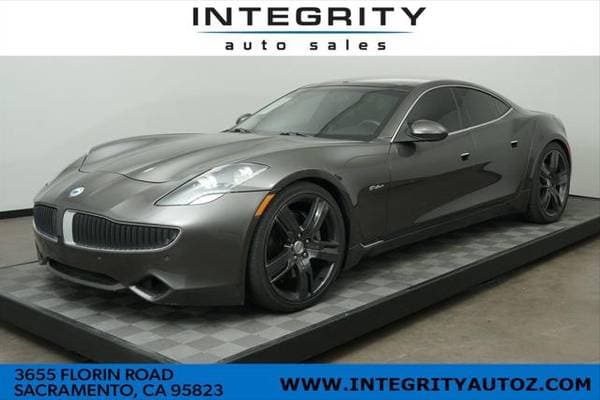
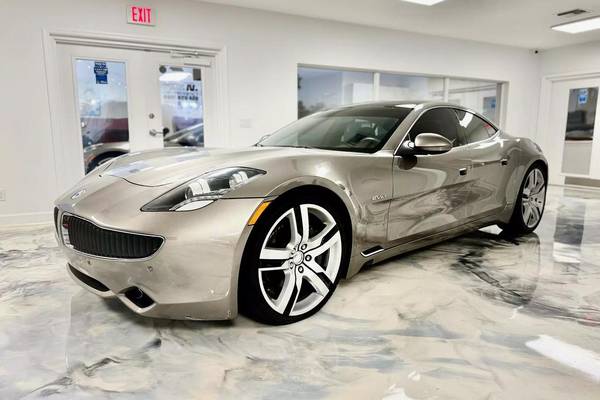
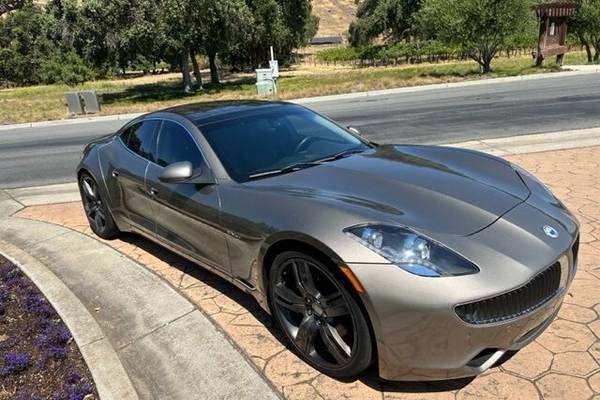
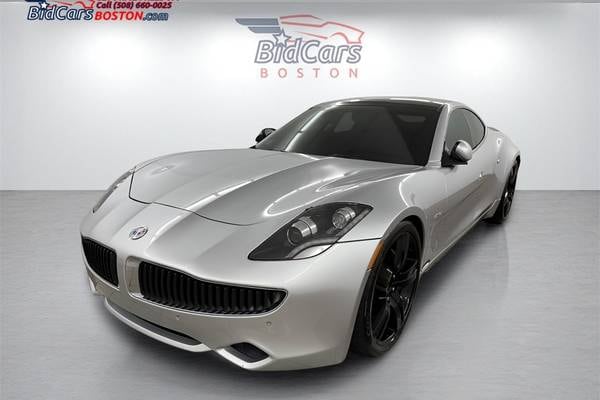
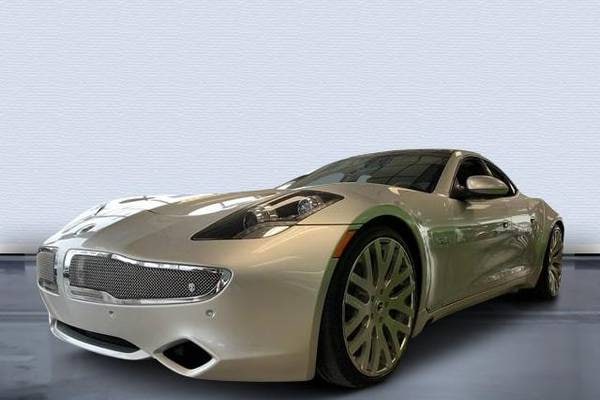
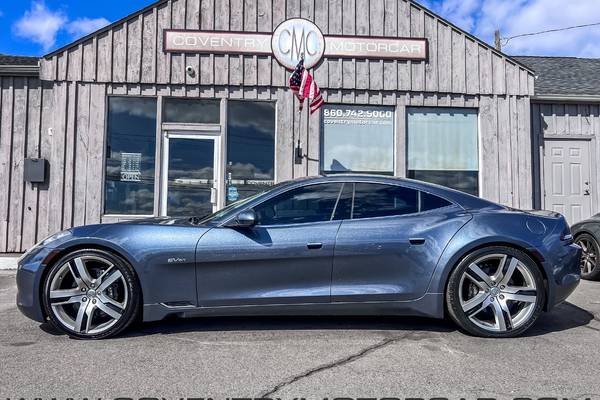
    A long wheelbase and wide stance give the Karma a sturdy, athletic look on the road. | February 18, 2011

Road Test

2012 Fisker Karma First Drive

A Premium, Range-Extended EV That Could Be a Legitimate Alternative to a Porsche Panamera

    44 Ratings

    Back in 2007, we cautiously admired the choice by Henrik Fisker and longtime business partner Bernhard Koehler to completely change their business model. Instead of rebuilding BMW and Mercedes convertibles through Fisker Coachbuild, the partners instead dove headfirst into the eyebrow-raising Fisker Automotive, a company that would be dedicated to building electric cars of its own design.

    After the usual ups and downs of an automotive startup, Fisker showed up at the 2008 Detroit Auto Show with its eye-popping Karma sedan concept. Now, three years later, we're in Southern California to drive the first pre-production examples of what will be the 2012 Fisker Karma EVer (i.e. electric vehicle extended range).

    Eco, Eco, Eco...
    The Fisker Karma grabbed the "Eco" label early and ran with it. It's a big reason why the company was able to attract a substantial amount of private investment, not to mention a cool $529 million from the Department of Energy. Much of the latter was earmarked to fund Fisker's purchase of GM's former Delaware plant that built the Kappa-architecture roadsters and will, by the end of 2011, be building units of the lower-priced Fisker Nina.

    Every single supplier and associate Fisker Automotive deals with is, in one way or many, a green-obsessed company. These include the free-range sustainable Scottish leathers used in the EcoSport to the wood trims sourced from existing sunken and fallen Michigan timber to the optional metal-flake metallic paints that get their sparkle from recycled material.

    More importantly, Fisker is touting the Karma as the first pure-electric luxury car. It's powered by twin 150-kW electric motors and a lithium-ion battery pack. As with the Chevrolet Volt, there's a GM-built four-cylinder engine onboard to keep the Karma on the road even after the initial battery charge is done. Fisker is promising a 50-mile EV range and a 300-mile range extended capability.

    Green Track Time
    After a little track time with the Karma, we can report that owners who have the gumption to push their car toward a sportier drive will be rather pleased. The double-wishbone suspension with its forged aluminum arms and self-leveling rear dampers puts the Karma near the top of the sporty premium four-door class in terms of handling characteristics. Some credit also goes to the exceedingly long 124.4-inch wheelbase, wide front and rear tracks and 22-inch Fisker "Circuit Blade" wheels wrapped in Goodyear Eagle F1 performance tires.

    Fisker also likes to point out that the Karma has 981 pound-feet of torque, a number bested only by the Bugatti Veyron.

    During our initial laps, we left the powertrain in the default "Stealth" or full-EV mode, which cuts the 2.0-liter turbo four-cylinder gasoline engine out of the equation completely. Power is limited, but Fisker says it can still go from zero to 60 mph in 7.9 seconds despite its nearly 2-ton curb weight (a final number isn't available yet). Top speed in Stealth mode is an energy-conserving 95 mph.

    For this phase of the drive, our only gripe was that the Karma didn't feel as solid all around as its German and Japanese competitors. A Maserati Quattroporte came to mind in this difficult-to-quantify part of the argument. Wind noise and road noise, however, are very well contained overall. Some smaller wheels might help out in the ride quality department, too, but according to Fisker's engineers, a change in that direction would bring the center member of the steering mechanism a little too close to the ground. A set of 21-inch all-season tires is as small as they're willing to go.

    And Then Comes Sport
    It is when we arrive in Sport mode via a single pull of the left steering-wheel paddle that some good things happen. And a couple not-so-good things.

    The first thing we notice is the sound of the 2.0-liter turbocharged GM Ecotec inline four-cylinder engine. The 255-horsepower, direct-injected power plant is mounted longitudinally in a front-midship position and is reasonably quiet. At least initially.

    Then we dip into the throttle a little more to experience the Karma's "Sport" mode, the one that Fisker says will deliver a 0-60-mph time of 5.9 seconds and a top speed of 125 mph. Suddenly, it sounds as if the Ecotec engine is sitting in the passenger-side footwell. They're not exactly the kind of noises we expect from a $100,000 luxury sedan.

    It shouldn't have come as much of a surprise, as the exhaust exits for the Ecotec engine are positioned just behind the front wheels. "We are aware of this concern," says Koehler, "and we have on order an all-new muffler to help deal with this." Fisker adds, "We envision customers spending over 80 percent of the time on average in Stealth mode around town." If the sport noise remains, though, they'd better hope people stay in Stealth for 99 percent of the time. This is not a question of a poor extended-range engine choice, but of incorporating it better.

    Numbers Are There
    Cracking the magic "400" at 403 hp from the two 201.5-hp JEE electric motors was of major image importance to the 2012 Fisker Karma's credibility. It all hits the road differently than internally combusted horses, as the momentum is right there under your foot immediately. Fisker also likes to point out that the Karma has 981 pound-feet of torque, a number bested only by the Bugatti Veyron.

    Thankfully, the Karma also features vented Brembo brake discs — 14.6 inches in diameter up front with six-piston calipers and 14.4-inch discs in back with four-piston calipers. They stop things as if hitting a wall of wet cement, so we were able to late-brake with almost no fading by the final hotter lap. No carbon ceramics will be offered, partly since, as Fisker tells us, "they cost nearly one-sixth the price of the total car." And, as a parting bit of goodness, the tail end lets go predictably and smoothly whenever such constructive letting-go serves the line through the curve. We're now eager to get this thing fully track tested with full numbers.

    The Fisker School of Design
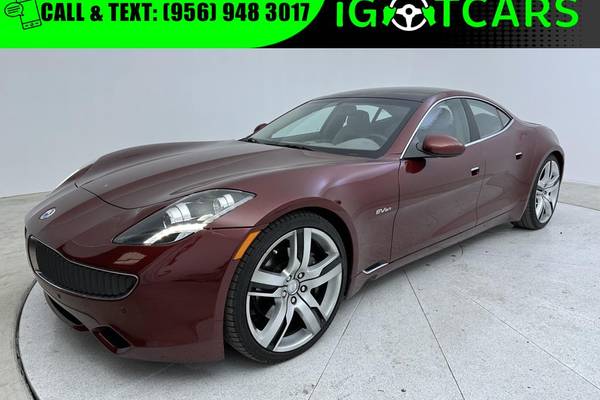
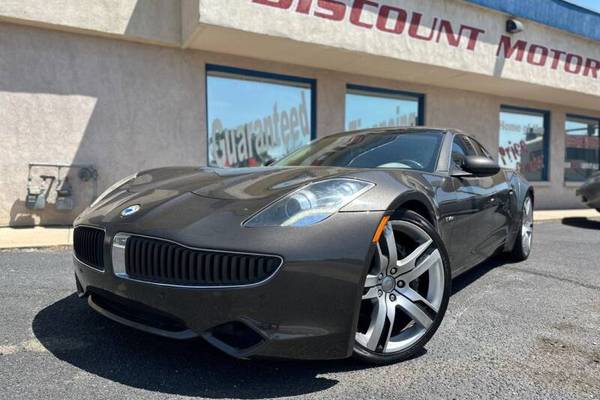
    So the Karma doesn't always sound refined. Thankfully, it always looks refined. It's more attractive than the 2008 showcar and buyers will feel suitably unique compared to the other four-door executive grand tourer sedans out there. We expect plenty of buyers to pony up the $95,900 base price for that alone.

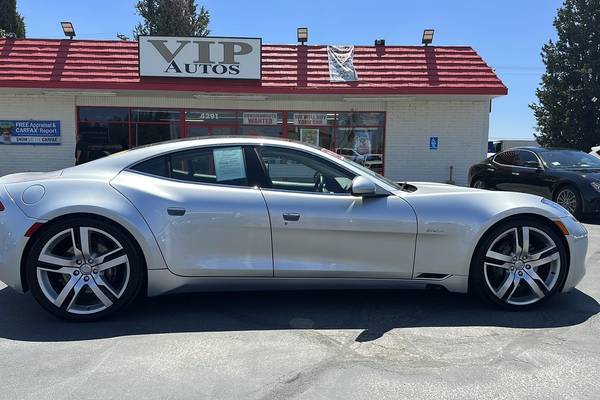
    All the exterior panels on the Karma are made of either aluminum — including the hood and outer door panels — or molded resin composite as on all four fender panels. The supersize 124.4-inch wheelbase (almost 10 inches longer than on a Porsche Panamera) is the exterior's most notable dimension and the 22-inch wheels bookend the look quite nicely. No antennas or little fins are visible since satellite and GPS receptors are concealed beneath the composite rear deck lid. The 52.4-inch height definitely helps the car's impression as a capable performer, and we never once banged our head while getting in or out of the front or back.

    Interior finish and materials quality are exceptional for this class and there is no cabin more ecologically conceived as this. The steering wheel is a tad overdone, though the thickness of the wheel itself is just right.

    Central to the cabin's controls is the standard 10.2-inch interface created with Visteon called the Fisker Command Center. All audio and climate controls are housed in the system, as are all general system tools and diagnostics. The touchscreen functionality appears fairly straightforward, although our interaction with it was limited.

    But Will It Catch On?
    Surprisingly enough, the 2012 Fisker Karma is in an admirable state of readiness just 37 months out from its concept debut. There are key NVH issues to deal with, but everything else is market-ready. "Most of our other-brand shoppers," says Fisker, "are coming from Mercedes. They really enjoy the feeling in Stealth mode around town especially."

    There is clearly a niche of wealthy early adopters out there who want this car, given the 3,000-plus pre-orders for the Karma. We can see people cross-shopping the Fisker with a $95,000 Porsche Panamera S Hybrid, or the base Panamera at $74,400 and 4S at $94,700.

    Then again Henrik Fisker says, "Many of these customers will have these other cars already in their garage and simply wish to add something unique and at the leading edge of green innovation." He could be right, but if Fisker doesn't muzzle that exhaust note, those customers will surely wonder if being that far ahead of the curve is worth it.

    Edmunds attended a manufacturer-sponsored event, to which selected members of the press were invited, to facilitate this report.

    Sort By:

    ilivecars says:

    06:55 PM, 03/04/2011

    How did I miss this article until now?

    My comments:

    -Rear-end looks like an Alfa copy.
    -Hate the steering wheel design.  Hate It. Hate It. Hate It.
    -Buttons for the "transmission" look cheap as hell.
    -Rest of the car looks awesome though!

    zokomo91 says:

    08:34 PM, 02/25/2011

    the guys who had the cars out was saying the car will be out for sale in the next 2 months.. would love to see one of these out on the road.. they are really nice..

    zokomo91 says:

    08:31 PM, 02/25/2011

    seen this car today in action in fontana speedway in ca.
    it is really quite and it can move thru the turns and gets up pretty fast..
    looks really nice up close.. and is very roomy inside and got solar panels on top..
    there were 3 out in action when i seen them..

    detroit_iron says:

    09:26 AM, 02/24/2011

    Those who have commented that the ICE does not power the wheels are correct, it only runs a generator to recharge the batteries and power the electric motors. As for all the others, there is NO other car out there with the technology the Karma has under her skin.
    Also NO taxpayer money has been used to build this car. The DOE money is a line of credit not a lump sum payment, and this money is to buy the Delaware plant to build the Nina, coming later.
    The Karma has been developed and built on investor money only.
    Also the reason the car is built in Finland is because there are not a lot of plants you can hire to build competitive vehicles. I don't think Toyota, BMW, Porsche or Nissan will want to build cars for competitive start up companies. I do love how people who will never drive a car like the Karma are such experts.
    Fisker may not be perfect yet. But they are the first, and don't tell me about Tesla. Fisker doesn't buy other people's cars and put electric motors and batteries in them, they design, engineer, and build their own products.

    bsegalis says:

    09:24 AM, 02/23/2011

    @julianb

    When you say that the Prius is not profitable, you are being misleading.  It is not profitable in the same sense that the Boeing 787 will not be profitable until a certain number of airplanes is sold to cover the development costs.  This is true for any car company.  BMW 3 series is not profitable until the R&D cost is covered.  For Prius, this will take longer because the technology was all new.  

    I don't know what to make of the rest of your comments about designers not knowing what they are doing, but engineers knowing, etc....  What's the basis for all of this?  Tesla and Fisker are pioneers, they took risks to move technology to the next level.  We should solute them for that.  It's much harder to do that than sit at your desk designing the door handle for the next Chevy.

    So far, both seem to be doing well.  Tesla in particular has attracted attention and investment from other car manufacturers, and that's a huge vote of confidence.  I think you're not recognizing the reality if you don't believe that hybrids and other alternative power platforms will eventually replace in large part the traditional internal combustion platform.  As gasoline gets more expensive and hybrid, electric and fuel cell technologies mature, this will happen naturally.  I am not the one saying this, the car companies are recognizing this by working hard on developing these very same technologies.

    ChromieD says:

    09:14 AM, 02/23/2011

    @julianb

    Those rear diamond-shaped items are not fake tailpipes at all. They are light units you understand only at night.

    The government didn't spend one of your red cents on this car. All that loan money (LOAN money) is for the second (cheaper and more practical) Nina project that will be ready in the end of 2012 - which includes the purchase of the ex-GM Delaware factory for next to nothing compared to what bailed-out GM spent on it on its road to ruin.

    bsegalis says:

    09:10 AM, 02/23/2011

    @nobnox

    Can you afford the space shuttle, the F22, the F35 or the international space station, among other things?  We give taxpayer money to support this project because it creates jobs for people who can't afford these expensive things, so that they can affort other things in life.  Also, think about how much of your taxpayer money went to support this project? 5 cents? 50 cents?  Most of your taxpayer money goes to pay for medicare, social security, the military, etc.  

    dusicyon says:

    11:11 PM, 02/22/2011

    What really gets my goat is Fisker's comment on the 22" wheel size: "Some smaller wheels might help out in the ride quality department, too, but according to Fisker's engineers, a change in that direction would bring the center member of the steering mechanism a little too close to the ground."

    Wow.  Last I checked, your wheel size does not entirely dictate your tire's external diameter.  In other words, they could spec a "conservative" 20" wheel and pick a tire with more sidewall.

    What kind of lame answer was that?  What planet is Fisker from?

    julianb says:

    08:02 PM, 02/22/2011

    This car is a waste in so many ways.... First a designer comissioned the build, not really understanding the business or engineering relationship side that needs to go into a sucessful car. Second modern electronics technology depreciate quickly, also devaluing the cars future worth. On top of that the aesthetic design of the car is purely for nice looks and doesn't have a theme. In other words it's sporty, luxury, economy, and useless (i.e. fake rear exahaust tips), all at the same time. Lastly, taxpayer money helped build this thing. This car wasn't thought out well.

    As a mechanical engineer who understands business, you don't try to start a car company by making a "buzz car" that only sounds nice in the development phase (as Gas was way too high, and other Autos are suffering from the economy). By the time it comes out it's literally old technology, especially dealing with old discontinued car engines and electronic tech that will fade easily. If I have enough money I want a car to stay relevant for a while, aesthetically it will but not from a technological perspective.

    P.S. - Toyota doesn't make money selling Priuses because the engine is about $7K and it's only a $20k car. GM took a page out of Toyota's book and built a PR car for image purposes as well. The difference is the Volt is $40k and may actually make money. Ford chose the smarter path by building more mild hybrids, rather than 1 or 2 advanced hybrids. I GURANTEE IF GM MAKES MONEY ON THE VOLT, U WILL SEE TOYOTA CHANGE ITS GAME PLAN, BECAUSE THEN THEY WILL HAVE LOST PRESS ATTN AND THE PRIUS ONLY BREAKS EVEN AT BEST IN PROFIT.

    What I'm trying to say electric cars serve as buzz machines, but none of the adavances hybrids (not mild hybrids) make any money at any atuo company. Bad move Fisker, Tesla... u can't just "wing it" when u start a car company. I know alot a Euro companies deal with low volume high price cars, but that concept has yet to work with electric cars. The simple fact is if you have that much moneyto buy the Fisker car, the SMART thing to do is to buy a cheaper sporty car and make it lighter with body panels and seats and turbocharge a direct injection engine. And when u tune the turbochared powertrain do it for Fuel mileage not performance (Pontiac G8, Ford Taurus, Dodge Charger, almost any midsize family sedan). You can do that for under 100k, easily.

    The thing is, the same things that make a car sporty make them more fuel efficient as well, such as lighter weight, launch control, increasing horsepower w/o increasing fuel consumption per unit of time (EFI does this), Dual-Clutch, transmissions, Aerodynamic efficiency, Power-to-weight ratio, etc. I could go on and on.

    tempesting says:

    03:58 AM, 02/22/2011

    Panamera has got a nice competition inbound :-)

    Sort By:

    Close

    Share on Facebook Share on Facebook
    Share on Twitter Share on Twitter

    Advertisement

    Speed Read

    Vehicle Tested:

    2012 Fisker Karma

    Base Price:

    $95,900

    Engine:

    Dual 201.5-hp (150 kW) electric motors

    Gearbox:

    Single-speed automatic

    Power:

    403 hp

    EPA Rating:

    N/A

    On Sale:

    May 2011

    Tags

    Specs & Performance

    Vehicle
    Year Make Model2012 Fisker Karma 4dr Sedan (2.0L 4cyl 1AM)
    Estimated MSRP$95,900
    Assembly locationUusikaupunki, Finland
    Drivetrain
    ConfigurationLongitudinal, front midengine combined with electric motor(s), rear-wheel drive
    Engine typeTurbocharged, direct-injected, inline-4, gasoline
    Displacement (cc/cu-in)1,998/122
    Block/head materialAluminum/aluminum
    ValvetrainDOHC, four valves per cylinder, variable intake + exhaust-valve timing
    Compression ratio (x:1)9.2
    Horsepower (hp @ rpm)255 @ 5,900
    Torque (lb-ft @ rpm)260 @ 2,000
    Fuel typePremium unleaded (required)
    Electric motor rating (kW)300
    Combined horsepower (hp @ rpm)403
    Combined torque (lb-ft @ rpm)981 @ 0 rpm
    Battery typeLithium-ion
    Battery voltage20 kW
    Plug-in type (110v/220v)110/220
    Charge time (hours @ 110v/220v)14/6
    Plug-in driving range, mfr. claim (mi.)50
    Transmission typeSingle-speed automatic
    Chassis
    Suspension, frontIndependent double-wishbones, coil springs, monotube dampers
    Suspension, rearIndependent double-wishbone, coil springs, Nivomat self-leveling dampers
    Steering typeElectric-over-hydraulic-assist, speed-proportional, variable-ratio, rack-and-pinion power steering
    Tire make and modelGoodyear Eagle F1
    Tire typePerformance front and rear
    Tire size, frontP255/35WR22
    Tire size, rearP285/35WR22
    Wheel size22-by-8.5 inches front -- 22-by 9.5 inches rear
    Wheel materialAlloy
    Brakes, frontTwo-piece ventilated steel discs with 6-piston fixed calipers
    Brakes, rearOne-piece ventilated steel discs with 4-piston fixed calipers
    Track Test Results
    0-60 mph, mfr. claim (sec.)7.9 (standard mode), 5.9 (Sport mode)
    Dimensions & Capacities
    Length (in.)196.7
    Width (in.)78.1
    Height (in.)52.4
    Wheelbase (in.)124.4
    Track, front (in.)66.6
    Track, rear (in.)67.0
    Legroom, front (in.)48.6
    Headroom, front (in.)38.3
    Headroom, rear (in.)35.7
    Seating capacity4
    Trunk volume (cu-ft)7.1
    CollapseSpecs and Performance Expand Collapse

    Advertisement