2009 Hyundai Genesis: What's It Like to Live With?
Read the latest updates in our long-term road test of the 2009 Hyundai Genesis as our editors live with this car for a year.
What do you want to know about?
- Introduction
- Genesis on the Tour
- Gauges Don't Look Very Luxurious
- Lexus-like
- Somewhat-Tall-Guy Seat Report
- Electronic Oddities
- 3-2-1 Contact
- Back Seat Better Than the Front
- Track Tested
- Face-Off!
- Back on the Road
- It's all about space
- Desert Blitz
- Little Things That Make You Feel Like Home
- Crash Test Videos
- 2009 Hyundai Genesis or 2009 BMW 750i?
- 2009 Hyundai Genesis or 2009 BMW 750i? Part II
- Great Weekend and Idiot Lights
- Seat Hotters
- Service at 7,500 miles
- Cancelling route guidance > It's a secret...
- Classy Looking Interior
- When is a Sedan like a Crossover?
- Where Did I Park It Again?
- Groggy iPod Interface
- Electronics and Liquids Don't Mix
- You Guessed It
- 4th of July
- Anybody Hear Banjos?
- 10,000 Miles
- Clampetts Part II
- Is Hyundai the New Lincoln?
- The Driver Is Always Cool
- Yeah, It's Just a Car, But It's a Good Car
- The One Thing That Feels Downright Cheap
- Can't Find What's Missing
- Found That Trunk Release!
- Another Road Trip
- Suspended Animation
- Say Hello To My Little Friend
- Sightseeing
- The Utah Plains, Trunk Trouble, Etc...
- The Ice Breaker
- 10 Things
- Detail Observation
- Woof
- Can it take down the Acura TL?
- Everywhere
- Cool Customer on a Vegas Cruise
- Suspension Walkaround
- Sticky Audio/Nav Button Update
- Tighty-Righty?
- Help, I Can't See
- Ergo Turn Signal Stalk is Nice Touch
- Beats the Bus
- Passes the Trunk Test
- Open Thread
- ULEV The Good Life
- Lights Up Like a Convenience Store
- Answers
- Plenty of Time to Pair a Bluetooth Phone
- Give My iPod a Pause When a Call Comes In
- Our Favorite Caption
- You Write the Caption
- Another pleasant surprise
- Battery Correction
- Too Bright, Too Blue
- Screen Saver
- Even BMW Owners Like It
- This Is a Hyundai?
- Auto door locks
- Radio Silence
- Ocean View
- From the Drivers Seat
- Braking
- Pop! Goes the Hood Latch
- Happy Belated 20K Milestone
- Feels Good At 124 MPH
- Road Trip Review
- Tire Pressure Warning Again
- Blue Light. Special.
- Sales Figures So Far
- 22,500-mile Service
- Another Long Distance Trip
- TPMS Makes Me Thankful
- Which Options Would You Choose?
- Oops
- Our Favorite Caption Part Two
- You Write the Caption Part Two
- Wrap-Up
Introduction
It's hard playing catch-up, especially when the race is for people's emotions.
The 2009 Hyundai Genesis V6 will tell us if the Korean manufacturer has learned this lesson. It's not an easy one to learn, as Lexus has discovered after two decades of persuading the market that it's up to more than re-branding Toyota hardware. Cadillac knows the lesson as well after nearly as many years spent trying to establish a European kind of credibility for its American luxury cars. And so Hyundai once again seeks to escape the stigma of its past, playing catch-up in the credibility race. Model by model, year by year, it slogs forward, as increasingly better vehicles amass an increasingly larger market share at the same languid pace as the rising oceans swallow our beaches.
If our experience so far is any measure, the Genesis might finally establish Hyundai's legitimacy in mainstream consciousness when it comes to luxury. Times are troubled, so people are making every penny count, and this makes them sensitive to Hyundai's traditional value-oriented message. And because they want change without sacrifice (so like those in the green movement), they're likely to be captivated by the way the Genesis offers all the toys of automotive luxury.
A premium purchase with no worries about hidden toxic assets — even Wall Street bankers can understand what the 2009 Hyundai Genesis V6 is all about.
What We Got
This 2009 Hyundai Genesis comes very well equipped with power leather-upholstered seats, a leather-wrapped steering wheel with integrated controls for the audio system and tripmeter, an AM/FM/XM stereo with full iPod integration, Bluetooth phone connect, carpeted floor mats, foglights, proximity key access with push-button start and dual-pane front windows and windshield. Also standard is Hyundai's claim to "America's Best Warranty," which includes a five-year/60,000-mile new car warranty and a 10-year/100,000 powertrain warranty. This is a lot of stuff for an entry price of $32,250.
To motivate our Genesis, we selected the 290-horsepower 3.8-liter V6 with its Aisin-built six-speed automatic. The 4.6-liter V8 offers 85 more horsepower and a ZF-built six-speed automatic, but it comes with an extra 200 pounds and $5,000 more on the bottom line. The V8 car also has a somewhat sleepier personality. As our test driver reported in our comparison of a 2009 Hyundai Genesis V8 and a 2008 Lexus GS350, "Not an impressive V8. Lacking both big torque and high-rpm punch, this engine seems rather pointless. Not much quicker than the V6." The V6 might be slightly slower than the V8, but it feels good and returns better real-world fuel economy with a rating of 18 mpg city/27 mpg highway.
Besides, for the same price as a V8-powered base model, you can have a V6 example with all the options. We like options. Our Genesis came with the Premium Plus package, which adds 18-inch cast-aluminum wheels, leather-wrapped door and dash trim, a power sunroof, power tilt-telescoping steering column with integrated memory, and rain-sensing wipers. This option is $3,000.
Our '09 Genesis is also equipped with the $4,000 Technology package. The money goes toward a navigation system with a six-disc CD/DVD changer; a 528-watt, 17-speaker Lexicon stereo system with Logic7; discrete 7.1 surround sound; HD Radio; and a one-year subscription to XM Radio and Navtraffic. It also includes some more functional bits like adaptive HID headlights, front and rear parking sensors, a cooled driver seat and a display for your Bluetooth connections.
Add the $750 inland freight and handling charge and our new 2009 Hyundai Genesis carries a sticker price of exactly $40,000.
Why We Got It
Hyundai came out swinging with the introduction of the Genesis by saying, "It's the size of the BMW 7 Series with the performance of the 5 Series and at the price of the 3 Series." If there's anything Americans like, it's something that's both bigger and cheaper. Finding cars to compare with the Genesis is a fruitless endeavor; they're either too small and too expensive or too big and too expensive. And then you consider the options. Just consider the 2008 Cadillac CTS in our long-term test fleet, which has similar gizmos but is 5 inches shorter and $6,000 more expensive.
On paper, the 2009 Hyundai Genesis V6 is a formidable package. Our full test confirmed our initial impressions that the Genesis sedan is something beyond Hyundai's usual lunge for a Lexus-style statement for its premium cars. As we said, "This is a different statement from the Korean automaker, one that promises a quiet appreciation that content matters more than simple branding. The Hyundai Genesis is the kind of sedan that will quietly transport you around town in secret sumptuousness." This kind of praise made it clear that a Genesis had to be a part of our long-term test fleet.
Another Lap Around the Block
This is not our first time around the block with a Hyundai product. We've had both a Sonata and an Azera, and a 2008 Hyundai Veracruz V6 has come and gone. These different vehicles garnered different specific reactions, but there are very few lasting impressions. Can the Genesis be the first long-term Hyundai we really remember? After 20,000 miles and 12 months, will we still be sold on its Lexus-fighting abilities? Will the Genesis' luxury accoutrements win us over in the long run, convincing us further that Hyundai has finally caught up with the premium competition, or will this be yet another Hyundai that ranks as a great commuter car, but little more?
Stay tuned to our long-term road test blog for the next year as we explore the ins and outs of the 2009 Hyundai Genesis V6.
Current Odometer: 1,253
Best Fuel Economy: 20.4 mpg
Worst Fuel Economy: 15.7 mpg
Average Fuel Economy (over the life of the vehicle): 17.9 mpg
The manufacturer provided Edmunds this vehicle for the purposes of evaluation.

Just when you thought you'd seen all the Tour of California blogs, another one appears. I loaded the three-strong family into the Genesis — no easy challenge given that the most recent addition is still only 11 months old. Those with kids know how much accoutrement kids this age require. And I wasn't going without the Super Stroller.
What's the Super Stroller, you ask? Hit the jump to find out.

That, friends, is the super stroller. And, oh yeah, behind it is the Genesis. Anyhow, thanks to an elegant redesign which accommodates large wheels, the Stroller can tackle any terrain. And it does so almost as comfortably as the Genesis managed to swallow it and every manner of kid-associated crap we brought along, including the world's largest convertible baby seat.
We also found a new use for the Genesis' trunk.

I let the Genesis stretch its legs on the way to San Diego County and was thrilled to find out its nav system allows one to set a destination while moving (Relax, maybe the wife entered the destination. Maybe.).
Hyundai's new sedan also has a superbly simple Bluetooth interface and is a quiet enough inside that the kid slept like, well, you know. It's also darned good looking. Just look at the thing. I'm not really a big sedan guy, either. That honor goes to Brian Moody. But the Genesis has won me over. It strikes a perfect balance between large and drivable. And it's not unwieldy or too soft.
The day was going swimmingly. Until, that is, this loser showed up and began heckling every rider — hardly what they need when competing at the ragged edge of their physical ability. Sheesh.


Earlier this week I raved about the gauges in the 370Z. They are clean, easy to read and perfectly suited to the car's purpose.
The picture above shows the gauge cluster on our new Genesis sedan. For a luxury car they don't look very luxurious do they?
And what do "luxurious" gauges look like? Well, a little chrome might help. Maybe a different font? I'm not entirely sure, but I do know that every time I look at the current setup it reminds me of Hyundais of old. And that's not a good thing.


The 2009 Hyundai Genesis V6 is a great car — it's the best $32K sedan out there.
And loaded at $40K, one of the best, for sure.
But is it, as some have written, comparable to the 2009 BMW 750?
If I were a 13 year-old girl or United States Congressman, I would respond to that by text or tweet,
"OMG! LOL! Luv ya! Muuaaahh!!"
The Genesis does compare quite well to another luxury car: the Lexus GS350.
In a previous life, I had a lot of experience benchmarking Lexuses (Lexi?), including the GS.
For me, the Genesis is almost identical to it in driving dynamics.
When I first drove a Genesis, if I was blindfolded I'd swear that I couldn't tell the difference between the two. The similarities are remarkable!
The ride in particular is quite Lexus-like: super smooth and a bit cushy. Although the ride is flat, well-controlled, and slightly sporty, the Genesis can get a bit floaty over sinusoidal whoops. And while the Genesis has better impact isolation and attenuation than the GS, the overall suspension feeling is somewhat soft — like a Lexus.
I personally prefer a firmer, more controlled ride (e.g., CTS, 750, TL) than the Genesis or GS. But that's me.
Where the Genesis stands out is in value. A 2009 Lexus GS350 RWD with Navi and premium Mark Levinson audio rings in at a rather expensive $52,000.
That's $12K more than the Genesis for very similar vehicles. The Genesis has similar high quality materials and assembly, and a lot more interior room than the GS.
Is the GS worth the difference? Up to you.
Lexus did recalibrate our luxury car dealership expectations to a higher level.
And Lexus reliability and durability are equalled by but a few.
Although Hyundai is manufacturing some very well-built vehicles today, even my terrible memory can still recall all the broken-down Excels littering the sides of the road when they first entered the U.S. market.
In the luxury car arena, image is important. It's difficult to re-build a reputation that you burned to the ground — even if that was 20 years ago.
Oh, and good luck explaining your new car purchase to your non-enthusiast spouse:
"Honey, I just spent $40 grand — on a Hyundai!"


Not only is the 2009 Hyundai Genesis a cut-rate luxury car, it's also a leg connoisseur, demonstrating particular preference for short femurs (the part of the leg above the knee) and long tibias (between the knee and foot). It's a discriminating taste to be sure.
Here's what I mean. The bottom seat cushion is too short. Right now, it accomodates short femurs well but needs to be longer for anyone else (like me). The extendable thigh cushion found in other luxury and near-luxury cars would address this.
Also, the seat doesn't crank down far enough. I'm 6'1" and in the Genesis the seat really needs to be another inch or two lower. Headroom is fine — it's just that when I'm in my regular driving position the pedals are a peculiar downward reach for my feet. Maybe if I transplant a section of my femurs into my tibias I'd be all set. Let me work on that.
Aside from those quirks, these seats are pretty darned comfy. The heated and ventilated driver's seat is just fine by me, too.

Not everything about the 2009 Hyundai Genesis is well-sorted. The Bluetooth, navigation system and integrated iPod connection generally work better than average, but there are a few notable hiccups.
Take the above phone number, dialed via Bluetooth. It's supposed to read 1 (805) 637-7243*. The way it looks makes it seems like I'm calling France, or something.
*Don't bother calling. It's a dead-end unless you're calling from your own T-mobile phone, in which case you're already dialing this number each time you check your own voice mail.
The guidance volume for the navigation system is even worse.

It can't be turned off — I could only dial the nice nav lady down to "MIN."
That means I couldn't become engrossed in anything playing on the stereo, especially a spoken-word podcast or audiobook, because each time the nav lady says "left turn in 3 miles" and "prepare to turn left" followed by "turn left in 300 yards" and finally "now turn left" the radio cut out for a good 4 or 5 seconds. And the nice nav lady never shuts up; she's always jawing about something.
But there is no "off," so I gave up and cancelled nav altogether (once I found the buried "cancel route" command). I only need guidance during the last 5% of any given trip anyway.
Other gripes:
A given iPod track doesn't go into pause mode when the phone rings or I dial out. It keeps playing despite being forcibly muted. This is atypical behavior for a car with an integrated iPod connection. My workaround here, when I remember to do it, is to manually hit the AM/FM button, an action that also pauses the iPod.
The "Details" page in the iPod menu, which is also buried deeper than it should be, wastes the entire screen with just the track name floating in a giant sea of blue. It would be nice to see the album title, artist name and the time remaining alongside it on the same screen; you know, details.
I have one audiobook on my iPod, but the Genesis didn't sort it into the Audiobook category. It reminds me of Rex Kramer in Airplane, who conspiratorially said, "No... that's just what they'll be expecting us to do." It didn't end up in the Podcast section, either. Nope, Neil Gaiman is apparently a rock-n-roll band, and The Graveyard Book is apparently his latest album; and a 7-hour album, at that.
These are nice problems to have, I guess, because the Genesis' iPod connection, unlike many others, actually has Podcast and Audiobook categories in the menu.
And our new BMW 750i, with its "new and improved" iDrive and a much, much higher price tag, doesn't even have an integrated iPod connection — all it's got is a plain aux jack. I'd never have guessed that iPod integration would be an option on a new car in this price range at this point in time.
Still, if the stuff's there, it should be sorted out better than this. The Genesis certainly has room for improvement in the Infotainment department.

Our loaded 2009 Hyundai Genesis is equipped with front and rear parking sensors.
I like parking sensors a lot and trust them more than back-up cameras.
With the back-up camera, the view is distorted and it's difficult to get a true sense of an object's range — is that thing I might hit near? Or far?
The proper way to use the back-up camera is to first verify that there is nothing under your bumper (like sleeping children), then proceed to look out the back window. As pretty as it looks, you're not supposed to stare at the display screen during the reverse maneuver.
But with parking sensors, you just go about normal backing-up. And when you're about to nail something, you are warned — then you FREEZE. Now you can check the display and re-check your surroundings.
The Genesis system has a nice display with 3 lines around the front or rear bumpers that appear then decrease to 3-2-1 lines as you get closer to your object of non-desire.
There is also an auditory alert that beeps with increasing frequency until it is constant-on, signaling impending doom.
It works great. That is, when it's On.
You see, the Genesis system is defeatable, as I unfortunately found out last weekend.
I didn't notice the sensors were off until afterwards. Apparently, another Edmunds staffer found the system annoying and defeated it with the switch near the driver's knee.
Yeah, the Genesis parking sensors (4 front, 4 rear) will alert on pedestrians too, but even still, I always like to have the system on. Just in case.
Here's the thing: drivers are not infallible. Whether they work at Edmunds or not.
And we care about our cars, just like you. Some of us operate in an urban jungle with a lot of hazards, driving many miles.
And like you — we're human: we make mistakes, we are sometimes careless, we are sometimes tired, and we even "look but don't see".
So as long as we don't rely on parking sensors without regard to common sense, technologies like these can be helpful to alert even experienced drivers.
Now if you will excuse us — we have to schedule that appointment with the body shop.


As Jay mentioned in an earlier post, the front seats in our Genesis long-termer have short thigh cushions. Even with my length-lacking legs, I still find the seats don't fit right under my thigh.
But the back seat area in the Genesis is truly magnificent. With 38.6 inches of legroom, an over-six-footer can sit comfortably behind another tall guy.

Rear passengers get their own climate controls and the air-conditioning vents are set high on the b-pillars so that they get air on their bodies, not just their knees.
The seat bottoms are deeply cushioned and sooo comfortable.
It's cheesesteak Friday here at IL, so after lunch I might sneak down to the garage and take a nap back here:

The 2010 Hyundai Genesis Coupe has been getting all of the attention lately. What with its good looks, compact size and G37esque-for-less performance, it's no real surprise.
But we don't have one around anymore so we brought our Long Term 2009 Hyundai Genesis V6 out to the track for our usual battery of performance tests including 0-60, quarter-mile, 60-0 braking, slalom and skidpad. Follow the jump for full specs and testing data.
Vehicle: 2009 Hyundai Genesis V6
Odometer: 5,508
Date: 03/31/09
Driver: Josh Jacquot
Price: $40,000
Specifications:
Drive Type: Rear-wheel drive
Transmission Type: 6-speed automatic
Engine Type: V6
Displacement (cc / cu-in): 3,778cc (231cu-in)
Redline (rpm): 6,750
Horsepower (hp @ rpm): 290 @ 6,000
Torque (lb-ft @ rpm): 264 @ 3,500
Brake Type (front): Ventilated disc
Brake Type (rear): Disc
Steering System: Speed-proportional power steering
Suspension Type (front): Multi-link
Suspension Type (rear): Multi-link
Tire Size (front): P235/50R18
Tire Size (rear): P235/50R18
Tire Brand: Dunlop
Tire Model: SP Sport 5000 M
Tire Type: All-season
Wheel Size: 18 front — 18 rear
Wheel Material (front/rear): Alloy
As tested Curb Weight (lb): 3,864
Test Results:
0 - 30 (sec): 2.3
0 - 45 (sec): 4.1
0 - 60 (sec): 6.2
0 - 75 (sec): 9.0
1/4 Mile (sec @ mph): 14.4 @ 96.5 (14.5 @ 96.2 w/ traction control enabled)
0-60 with 1-ft Rollout (sec): 5.9 (6.0 w / traction control enabled)
30 - 0 (ft): 29
60 - 0 (ft): 115
Braking Rating: Good
Slalom (mph): 63.9 ( 61.7 w / traction control enabled)
Skid Pad Lateral acceleration (g): 0.84 ( 0.84 w / traction control enabled )
Handling Rating: Good
Db @ Idle: 49.9
Db @ Full Throttle: 74.0
Db @ 70 mph Cruise: 66.4
Acceleration Comments: Best run w/ traction off: power brake to about 2,000 rpm then release brake and wood the throttle in "d." No manual shifting. Right rear wheel spinds but only minimally. Shifts arrive near redline.
Braking Comments: Stops were consistent and pedal feel good. Did get some minor pedal fade later during accel testing, however.
Handling Comments: Skid pad) Good stability control calibration. Follows steering inputs closely and doesn't punish overshoots with too much throttle intervention. Decent body control for a car this comfortable. (Slalom) Stability off = longer leash but not truly off. Smooth steering inputs keep the stab control at bay here. Otherwise it will punish with heavy brake / throttle interference. Otherwise, predictable, stable and easy to place. Good for a car this big / heavy.

You asked for it, and now we deliver ... sorta. The Hyundai Genesis has been compared to several full-size luxury sedans like the BMW 750i because of its impressive performance, enormous interior and generous feature content. Of course, it wears the humble badge of a once laughable car company and costs exponentially less than the Bimmer.
This week's Face-Off over on the Edmunds Daily blogs pits these two cars and their wealthy potential owners against each other. You can decide who/which wins.

We delivered our Hyundai Genesis to Burke's Auto Body in Long Beach after its unfortunate run-in with an inanimate object the other week. After 7 days of surgery we were told the Genesis was ready for pick-up. It would have been back in our hands sooner but the trim piece we so deftly mangled required some extra love.
Welcome back, Hyundai Genesis.

Bigger is better. I really like the Genesis because it allows the buyer to get more room (good) without spending more (bad). Here's a little formula I couldn't stop thinking of as I loaded the trunk full of kids stuff and a few bags of clothes to donate: Luxury=space, space=freedom, freedom=luxury.
See that extra space? That makes me feel all cozy inside - ditto for the roomy interior. Just curious - is there anyone out there looking to spend more money only to get less car?

I ran our long-term 2009 Hyundai Genesis sedan to Vegas and back from L.A. on Saturday for the final round of the Supercross championship. As a long distance machine, the Genny excels, happily eating freeway miles as the soft first portion of the suspension's travel makes for a cushy cruiseliner. This not-quite floaty ride combines with solid straight-line stability, light steering, amply adjustable seat/wheel, an impressively quiet cabin (even in severe desert crosswinds) and solid audio quality to form a mile-eating cocoon.
Though tuned for the masses and not enthusiasts, the Genesis doesn't embarrass itself when given the cane on desert backroads, and the V6 provides thoroughly adequate hustle. When pushed through its soft veneer, this big rear-wheel-drive sedan actually hunkers down reasonably well. The brake pedal is surprisingly firm, but it lacks a proper dead pedal. The light steering is accurate even if the wheel is a little thin, and the front seats feel more rubbery than leather-like, but overall the Genesis chassis provides a very livable compromise between ride quality (on the soft side) and control.
Before heading to Sin City, I had to reboot the a/v system (shut down, then restart the car), to get the Bluetooth to sync with my phone (Blackjack II), but it then synched up fine. Inbound audio quality on the phone is quite poor, though callers had no problem with intelligibility. The optional full-zoot "Lexicon" audio set-up has the wildly welcome feature of letting you make acoustics adjustments for each type of input (XM, MP3, CD, etc.), allowing tailoring of sound by source.
A savvy feature when reversing is the ability to flop the driver's side-mirror down into curb-view mode using the door-mounted adjustment switch. The nav-system failed to find a street address in Vegas (though the road was present and correctly labeled on the nav screen), but provided adequate detail across the remote Mojave.

As for the Supercross event, James Stewart charged into an early lead (that's his championship winning Yamaha on the right), before being run down by a possessed Ryan Villopoto and then later getting hacked by displaced champ Chad Reed. Stewart cruised to a third-place finish to secure the SX championship in front of a rowdy packed house at Sam Boyd Stadium. Near idyllic mid-70 temps meant fine conditions for fans, though some blustery winds made it interesting for the airborne racers.
Heading home, high beams with a long and even spread made it an easy decision to abandon the west-bound race transporters on the freeway, cutting south through Cima on deserted backroads while sailing through joshua trees backed by an amber sinking moon. Back in L.A. after a swift 700-mile day, our Genesis continued to impress, again making strong arguments for the V6 version.

I'm in a rush to get somewhere, pretty much all the time. So on those occasions when I get to drive one of our long-termers, I don't usually have time to study the nuances of the car's functionality. Controls that aren't backlit properly, aren't where you expect them, or cryptic symbols drive me batty. I want adjustments to be straightforward: seat, mirrors, radio settings — you know, the little things that make a car feel more like home.
And it's there where the Genesis started to impress me. As a chronic channel surfer, I liked that controls for volume up/down and radio station selection were all part of one button on the left of the wheel. Simple as it sounds, I also appreciated that the mirrors were controlled quite easily from one button on the armrest. (I don't enjoy mirror or window controls on the door or on the console between the front seats.) Ever been in a car and reach to lower the front window, only to lower the back window instead — every time you do it? I have. None of this is an issue in the Genesis. Even the nav system was pretty straightforward.
The Genesis isn't trying to dazzle me with electronics that take a graduate degree to figure out. So despite the fact that Hyundai is going for the upscale market, it appears to be remembering its humble roots and not get all high-falutin' about it. It would be that much harder to take the Genesis seriously if it did.
Does this mean I'd buy the car? Maybe, but not necessarily. Sure, the leather seats are great (really!), the ride is super comfortable, the handling plenty sufficient for my gotta-get-there-now maneuvering. The thin, chrome trim around the vents is a nice touch and the paint is, well, sparkly. But there's nothing in the design — inside or out — that I found particularly inspiring or that blew me away with its luxury. It's a good car. It's a good value. Often, that's more than good enough.

Mike Schmidt just handed me the clipboard. "What do you want to drive tonight and for the weekend?" he asked.
Well, last night I drove our long-term BMW 750i. And I thought about just keeping it until Monday because I need a large sedan on Saturday for some family business. But wait, our long-term Hyundai Genesis V6 is available? I'll take that.
No I'm not kidding, I really did it. I just swapped the key to a $90,000 BMW for the key to a Hyundai. Why? Because the Genesis is that good.
What would you have done?

I understand if you think nobody would ever choose our long-term Hyundai Genesis V6 over our long-term BMW 750i. But in the words of the great Bob Falfa, "I ain't nobody dork."
Yesterday I posted that I had gladly swapped our 750i for our Genesis. Man, did it bring out the haters. I was called crazy, unreasonable and accused of writing something untrue just to get a rise out of our readers.
Thank you to those that came to my defense and the defense of the Genesis.
The truth is I really do prefer the Hyundai. I've spent quite a bit of time in the 750i now (not to mention that a 2001 740iL with the sport package is one of my dream cars), and the more I drive it the less I want to. It's hard to explain, but I'm just not in sync with the machine. It has several combinations of tune that the driver can choose; Comfort, Normal, Sport and Sport+. And I don't seem to like any of them. I find myself constantly changing modes looking for a sweet spot that never comes.
It's like Goldilocks. This one is too firm. This one is too soft. But "this one is just right" just ain't there.
I have a hunch the Sport Package and 19-inch runflat Goodyears on our test car have quite a bit to do with this, but it's just a hunch. The car's overall damping doesn't seem to be the problem, it's the intrusion of the road's surface into the driver's seat and steering wheel that trouble me.
Somehow the 750's steering is missing that magical combination of road feel and isolation I've enjoyed in BMWs for years, including our two long-term M3s and our 135i. There's just too much noise in the wheel and it adds a crude quality to the mix that is out of character for a BMW or any luxury sedan at this price point.
Sure it outperforms the Genesis. And everytime I nail the throttle in the twin-turbocharged BMW all is forgiven for the few seconds my head is pinned to the back window, but I've never been in the Hyundai and felt like it needed more power. Plus, I prefer its steering and its suspension tuning in the real world. My world, where there are rippled concrete freeways and constantly changing road surfaces.
Of course the 750i will leave the Genesis for dead on a mountain road, but I don't drive to work in the twisties. So some of you might think I've lost it, but the reality of it is that the most expensive car with the most prestigious nameplate isn't always the one you prefer to drive.
In fact I did not regret my decision last night, as the Genesis and I cut through the rush hour traffic. And so I'm spending the weekend in the Hyundai. I'll let you know how it goes on Monday. Personally, I think it looks pretty cool in my driveway.

I had a great weekend in our long-term Hyundai Genesis. I really could own this thing. On Saturday it hauled around the entire Oldham clan, kids and all, in total comfort and on Sunday it took the wife and I to the theatre in style.
But I did find a couple of things to complain about just so you don't think I've begun moonlighting for Hyundai's marketing department.
1) The driver's seat bottom is a wee bit too short for me. A half inch to an an inch more length would be appreciated, but the seat is still comfortable as it is.
2) That annoying green light in the above photo stupidly appears on the instrument panel when you turn on the headlights. It stays on and is constantly in my peripheral vision. Hey Hyundai, I know the lights are on because I just turned them on. I'm dum, but not that dum.
3) The rear windows are not auto up or down. Just the fronts.
Oh, almost forgot to mention. As you can see in the photo our Genesis has blasted past the 7500 miles mark, which means it is due for its first scheduled maintenance. We'll hopefully get it to the dealer this week.

The seat heaters in our long-term Genesis might have three levels, but the lowest setting is all I can stand. Now I grant you that I have a low seat heater BTU tolerance, but putting that sucker on high is like sitting on open flame. My wife likes it of course, but she would be cold on the surface of the sun.
And they warm up quickly too.

There she is, our long-term 2009 Hyundai Genesis V6. Waiting patiently in line for a 7,500-mile service.

We called Cormier Hyundai to request a service appointment yesterday. The advisor we spoke with asked, "Why are you bringing in the car? ...Well, if it's just for a 7,500-mile service you don't even need an appointment. Show up anytime between 8 and noon. We'll take care of you."
This isn't the first time we've received this treatment. The last time we called our Ford dealer to schedule service we heard the same story. Just show up. No appointment necessary. Is this the latest trend in customer service? It seems like a recipe for long wait times and customer frustration.
Has anyone else noticed a reluctance of dealerships to schedule appointments recently?
Total cost: $78.09 (oil/filter change, tire rotation and open recall to update airbag control unit)
Days out of service: None

Entering destinations into our long-term Hyundai Genesis' navi system is a breeze. Both street address and point-of-interest (POI, shown) destination are simple and straightforward. The only beef I have is that for street address input, you cannot enter the city before you enter the street and house number. I like to enter city first because it speeds things up when the system filters down to the street and house number. But this is not a big deal because this navi system processor is pretty fast. And destination entry is not locked out while the vehicle is in motion.
Overall, the Genesis navi system is quite good, with one glaring exception: cancelling route guidance. You see, cancelling guidance it seems, is a secret. It took me forever to figure out. I showed a few Editors here, too, when they couldn't do it.
Many times, I like to initiate route guidance if I don't know where I am. Then I will cancel the route when I get to an area that I know and can find my way home. But accomplishing this the first time in the Genesis was a challenge.

There's nothing in the Destination menu that is of any help. Same with Route Overview — nothing.

Cancelling Route Guidance must be in the Change Route menu — let's check.

Hmmmm...nothing listed there either. What's going on?
Well, you have to look closely when you're looking at the navi display in the vehicle.
See that tiny pimple of an arrowhead on the right side of the screen?

That arrowhead is the only thing on the far right side of the screen. For every other function, you can choose from both halves of the screen by tilting the controller knob left or right. But nothing else is on the far right.
Let's tilt the navi controller to our destination, then tilt again to select that arrowhead.

There it is, in a tab behind the main screen. Not so easy to find the first time. No problem after that. But cancelling route guidance should be in a more logical location, or that arrowhead should be larger.
Anyway, cancelling guidance in our Genesis is no longer a secret.

I had to give a neighbor a ride to the airport in our Hyundai Genesis last week. He's not into cars, so for the first few miles he didn't even bother to ask what we were in. But then he started looking around paying a bit more attention to the interior. "Hey, this is a pretty nice car," he remarked.
I'm not sure if Hyundai would consider "pretty nice car" a compliment or not, but I think its designers did a nice job in creating an upscale ambiance for the Genesis. The symmetrical dash layout and sweeping, soft curves are pleasing, and the chrome piping along the dash, air vents and steering wheel is tastefully done. Our car also benefits from having leather on the dash that's part of the optional Premium Package.
The Hyundai Genesis doesn't have a luxury-brand badge on its trunk, but as we've noted in our various road tests, that's about the only thing missing from the luxury-car experience.

Answer: When you shove multiple automotive parts into one.
In this case I was trying to carry some Ford GT belly pans home, along with some large interior panels, and the only vehicle available was our long-term Hyundai Genesis.
But as my older brother is fond of saying at such times: "Ahhh, it'll work."

And he was right. Despite lacking a fold-down rear seat (it does have a pass-through) I was able to get the larger interior panels in the trunk and the belly pans in the rear seat. The trunk lid's hinges are effectively designed to have minimal intrusion into the trunk area. I also used rags on the edges of the belly pans to keep them from marring the Genesis' leather surfaces. Despite being a rather wide car the pans barely fit in the rear seat, and only after placing them at a creative angle.
But don't try this unless you're an expert at making sedans act like utility vehicles. For example, here's a shot of our former long-term Chevy Malibu (which does have a fold-down rear seat) carrying four pieces of 8-foot lumbar last weekend. It was also hauling two kids at the time. Necessity is the mother of invention.


I had to leave our Hyundai Genesis at the airport for a couple days. Upon my return, I was momentarily confused by the adjacent silver Lexus LS460. Other than their front grilles, the two cars looked surprisingly similar next to each other.

Our 2009 Hyundai Genesis has an iPod interface. In theory, the car's iDrive-like navigation controller wheel makes iPod operation a breeze. Alas, the wheel is hampered by interface software in need of fine-tuning.
With the disclaimer that I've only had my my 30GB video iPod available for testing, I'll state that I've encountered two main problems. One, the system has an annoying delay when you try to page down on lists of artists or songs. It can take a very long time to get to the bottom of a list. The second issue is that the controller's "back" button doesn't work ideally. If you're scrolling down your list of artists, for instance, and you select one, backing out of that selection via the back button puts the highlight at the top of the artist list rather than where you originally were. So, if you were at "Lady GaGa" for instance, you're now back at the top to "ABBA." To get back to the "L" artists, you have to use the groggy page-down function again.
Having the interface is better than none at all (you still get battery charging, for instance), but this setup is the most aggravating I've encountered in some time.


Our Hyundai Genesis' iDrive-like audio/nav controller is located right next to the front cupholders. Normally, this is just fine. However, the close proximity of electronics to the cupholders could be a problem if you were to spill a beverage. Or, even better, you might bring in a bottle of soda, shake it up real good and then open it right above the front cupholders.
Who would be so foolish to do that? Well, me, it seems.
You might think I'm just making this up, but the only variance in this story was that it was a bottle of fancy "kombucha" tea, not soda. I had never had it before (just purchased on a whim during grocery shopping) and taken the unopened bottle into the car and was shaking it up before opening it. Who has ever heard of fizzy tea? I hadn't. But it seems the tea is cultured ("with enzymes + probiotics!'") and produces gas.
Just as would happen with soda, fizzy purple tea sprayed all over the front cupholders, the nav/audio controller, the driver seat and my shorts. I had a towel nearby, so thankfully I was able to sop up the spilled liquid pretty quickly. And the controller wheel still works normally, which is good. But a couple of the buttons, like the XM and DISC/AUX, have a sticky operation now.
The tea didn't even taste good, so the whole experience pretty much sucked. If anyone out there has an idea how to make our Genesis' buttons unsticky, please let me know.

= Not recommended for automotive consumption

Why am I always surprised that you guess these so easily? Yes, the Stig was standing in the trunk of the 2009 Hyundai Genesis.
With 16.0 cubic feet of cargo space, he has plenty of room for all his top gear.
P.S. Is it just me or does the Stig look a little like the White Ranger?


Saturday night, I piled a bunch of friends into the Hyundai Genesis and took off toward the fireworks.
With a backseat that has 38.6 inches of leg room and 54.3 inches of hip room, we had three people back there with no problem. Of course, we were only driving about a half mile, so I'm not sure how they would feel about the backseat on a long trip. But those seats sure are cushiony.
Click through to see a picture of a firework that looks like the Death Star...and a picture of the Genesis back seat.


Physics. You just can't beat physics. Which is why, after the video crew appropriated the absolutely-perfect-for-the-job (not to mention huge) Ford Flex I had intended to take on this week's trip to the mountains, I'm left hearing banjos. In the Hyundai Genesis.

OK, so here's the routine. Three people, three people's crap (including a 15-month old), one bike, one super stroller (that's it there on the left in travel mode), 540 miles — one way. Just call us the Clampetts.
More on this potential fiasco next week. If we get home.
Good thing I like bluegrass.


In case you missed it yesterday, our Hyundai Genesis hit 10,000 miles last weekend. And we didn't run out of fuel.

Covering 1,427.7 miles at an average consumption of 21.9 miles per gallon, the Genesis treated us right between Socal and Norcal and back this week. Fuel economy jumped to 23.1 mpg on the more open stretches of the 5 freeway. And remember, that's with the rack fully loaded.
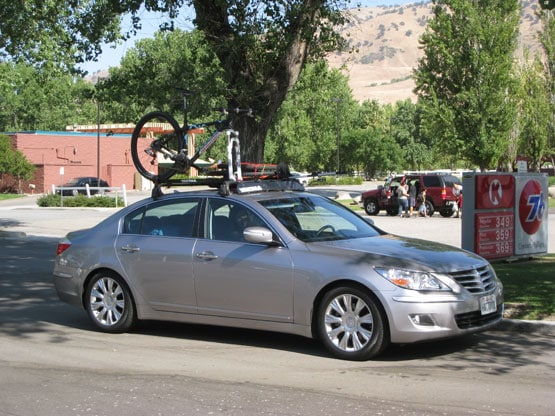
The only real problem I had were the sticky "XM" and "FM/AM" buttons on the nav/audio controller which Brent mentioned a few weeks back. They still work, but their feel is awful. Otherwise, as I've said before, this car's navigation system and Bluetooth interface are both fantastic — among the best made today.
It's also a comfortable machine. Unlike the Mazda 6 (yes, a very different car), I can put down five hours in this thing no problem.
It might not have the cargo space of the Ford Flex (duh), but it's a heck of a lot better for a drive like this where ripping across Mojave desert in July is a requirement. We also rolled through our share of mountain-road miles. The Genesis offers intuitive control feel and is light enough on its feet to not embarrass itself in the mountains. But it's still smooth as butter and quiet on the freeway. An impressive balance, really. And with a kid in the back seat, a bike on the roof and an easily nauseated wife riding shotgun, it's easy for chaos to ensue.
But it never did.
Ask anyone who's travelled with an infant and they'll tell you that there's nothing more valuable than having the right vehicle. Ample space, amenities (like good navigation and ice-cold A/C) and ride comfort are invaluable.
We hit 10,000 miles on this trip as I was thinking about stopping for gas. Didn't do it for another 82 miles when the Genesis convinced me it was time.


As I was driving into work this morning, I spotted a Hyundai Genesis in the lane next to me that was being used as a livery cab.
Usually, the sedan of choice for these companies is a Lincoln Town Car.
So, limo companies think the Hyundai Genesis is luxurious enough to shuttle around their clients. Interesting.
It definitely has one of the most comfortable back seats in the business.
And it is surely less expensive to outfit a fleet with Hyundais.


I drove up to see a friend in Valencia, California, yesterday in our long-term 2009 Hyundai Genesis sedan. The car's outside temperature gauge told me it was 106. I started using the ventilated seat as soon as I hit the San Fernando Valley, and it worked quite well.
When I picked up my friend, I enthusiastically directed him to turn on the ventilation for the front-passenger seat as well... and then, I realized our Genesis doesn't have that feature. In fact, no Genesis does. There's just a seat heater on that side.
A ventilated driver seat is part of the Technology Package that you can order for either a V6 or V8 Genesis (on our V6, it requires both the Premium and Premium Plus option groups).
I blasted the air-conditioning instead and that also works quite well in our Genesis.

During my first 15 minutes with our 2009 Hyundai Genesis V6, I decided it was just a rear-drive evolution of our long-term Hyundai Azera. Melt-in-your-mouth ride quality? Check. Light, overboosted steering? Check. Hyperactive throttle response from 3.8-liter V6 at tip-in? Check.
Then, I accelerated up to speed on the freeway and realized I had it all wrong. Our Genesis is about 10 times more refined than the Azera, and like the Genesis Coupe, it gives the impression that Hyundai has turned a corner in vehicle dynamics. The more I drive it, the more I like it.
To start, the six-speed Aisin automatic transmission Hyundai uses on the V6 model is quite good. It upshifts smoothly under heavy throttle and downshifts promptly in passing situations. It all happens so unobtrusively, that I just can't imagine wanting any other engine in this car. Two-hundred-ninety horsepower is plenty. I can't really hear the V6 and I'm fine with that. A loud exhaust note wouldn't make sense in a Genesis sedan.
Then, there's the chassis tuning. This Genesis feels a lot more sophisticated than the Azera ever did. I notice it accelerating out of a long, sweeping entrance ramp. Body motion is well controlled, and the steering, although not especially communicative, is very precise.
Later in the weekend, I notice that I'm having an easy time parking the car. And I think it's the accurate steering combined with a good driving position that makes it easy to get a feel for the car's perimeter.
Back on the freeway, the ride remains soft and forgiving, but the choppiness you sometimes get in the Azera over rain-grooved sections and seams in the concrete has been banished. The Genesis just rides well — wherever it is.
Noting my enthusiasm for the long-term Genesis, a friend commented, "I like how it's just a car. It's not trying to look overly trendy or high-brow."
And I like how that ethic carries into the driving experience.

I'm not against corporate parts-bin sharing. It's a reality. There are a finite number of suppliers (and the ranks will probably get really finite until sales pick up). And once you get a head unit you like, you're going to use it in more than one vehicle in your lineup. I get that.
But I've never liked the power mirror adjustor Hyundai has used in recent years. I don't like it in less expensive Hyundais and I really don't like it in our long-term 2009 Hyundai Genesis V6. The left/right slider nub is kind of sharp and unpleasant to the touch.
You could argue that I wouldn't have to adjust the mirrors as much if I wasn't sharing the Genesis with 20 other drivers. But maybe I would. This isn't the kind of car I'd own by myself. More likely, I'd share it with a spouse. And although the Genesis has memory for its driver seat and steering wheel, it doesn't have it for the mirrors — in which case I'd be fiddling with the adjustor several times a week.

I spent the weekend driving our long-term 2009 Hyundai Genesis, determined to find a luxury feature that the Korean sedan does not have.
Heated and cooled seats, check. Distance to empty, check. iPod connection, check. Rear backup camera, check. Every where I looked it was check, check, check.
Until I stopped at the gas station this morning before heading to the car wash.

While the fuel was pumping, I walked around to see if the trunk needed to be vacuumed. I felt around under the decklid for a touch-pad release. And nothing!
Alas, poor Genesis owners will just have to make due with two trunk release methods: the button in the driver's door, and the one on the key fob.

Yesterday I posted about our 2009 Hyundai Genesis' lack of rear trunk release, and several of you kind commenters came forth to set me straight.
This morning I asked IL news correspondent and quasi-independent-third-party Mike Lysaght to verify or strike-down my perceived stupidity.
Sheepishly, Lysaght returned from the garage with photographic proof confirming my mistake.

Turns out, there is a long touch-pad on the right side of the trunk.
In his report, Lysaght tried to spin it for my protection, saying it worked best when pressed in the exact middle. (Note the indentation in the center.)
I think he was just being nice because I'm his editor.

This shot was taken on the NorCal road trip a few weeks ago, but tomorrow morning I'll be loading the Genesis similarly for a ten-day road trip to Wyoming. I'll update our progress as often as possible, but with WiFi hotspots about as common as stop-and-go traffic in the Cowboy State, I don't expect many opportunities.

Let me preface this post by saying that I really like the Hyundai Genesis sedan.
But every time I drive it, I can't help notice there is something a little off about its suspension.
I can't put my finger on it. It's not that it's too soft or too stiff. It handles bumps well and when taking a corner, I think it's going to mush over but then it holds itself up.
There's something unnatural about the way it feels. It's like Hyundai made it soft and then added something to it later to hold it up. Is it my imagination?
It's not enough to keep me from wanting to own one someday.
Perhaps I can convince Dan to do a suspension walkaround and solve the mystery.

This is the kind of thing you find in Wyoming. If you know where to look.

Devils gate is a rock formation carved by the Sweetwater River about 60 miles Southwest of Casper, Wyoming. This is the least impressive view (the gorge is about 300 feet deep), but it's about as good as one can do and still get a car in the shot.
More sightseeing issues after the jump.

I generally like the Hyundai's ventilation controls. I'd prefer knobs for temperature control, but the buttons work well in the otherwise-clean design. One consistent problem, however, is seeing which features are currently in use (as indicated by little blue lights on the buttons). It's difficult to see these lights in direct sunlight.
In the photo above, it's clear that the system is in "AUTO" mode as indicated by the blue light on the "AUTO" button. Can you tell which other features of the system are in use?
Neither can I.

Did you know that Utah has opened up "test sections" of Interstate 15 with an 80-mph speed limit? Neither did I until last week. Here is my favorite shot from the trip — the Utah plains from the cockpit of the Genesis. The Escort performed perfectly as we covered 2,501 miles at a reasonable pace with no tickets. Plus, with an 80-mph speed limit, there's hardly any need to go much faster than that.
This post will mark the beggining of a few reports from the trip.

As usual, the Genesis handled road duty well, swallowing massive mileage at speed while offering ample comfort. Here, however, is the one glitch we encounted. With only 180 miles to go, the trunk release failed. Or, perhaps I should say, every means to open the trunk except this emergency key failed. The release on the driver's door, the key fob and the electronic switch on the trunk itself all refused to function. Thankfully, Hyundai thought of that and gave us this option.
More to come.

"That's the new Hyundai, right"
"Yeah, it is."
"How do you like it?"
"I like it a lot."
"Can I have a look?"
And so it went all weekend long: at the super market, at the car wash, and in my own driveway. In retrospect, I think I get this line of questioning more often in this car than any other car in our fleet. Sure, we get thumbs-up when we're driving the Nissan GT-R and spontaneous street racing challenges when we drive the Evo(s), but nothing, past or present seems to elicit questions and genuine interest like our 2009 Hyundai Genesis does?
Does anybody ask you about your car? I doubt it.
Oh, and hit the jump to see what an empty freeway at 5:00a.m. can do for "reported" fuel economy.

Pretty impressive, eh?

It's time for 10 Things I Like About You: Hyundai Genesis Edition
1. quiet, peaceful interior
2. smooth upshifts
3. strong brakes
4. being a passenger sometimes (the rear seats are really comfortable)
5. how it handles my iPod
6. cool-toned courtesy lights when I shut off the car
7. its V6 is more than sufficient, don't need to drop money on the V8
8. roomy, easily accessible trunk
9. cushioned, leather-wrapped dash
10. can comfortably fit 5 adults
Have anything to add to this list?

Architect and furniture-design dude Charles Eames once said "The details are not the details. They make the design." Seems like the folks who designed the Genesis agree, and the sedan's cabin is a more luxurious place because of it. Love the stitching on the doors, seats and dash. And the metallic accents seen throughout strike just the right tone — subtle, never jarring.

We rolled to lunch this week in our long-term 2009 Hyundai Genesis V6 and caught this guy enjoying the SoCal sunshine.
What does this pooch and our Genesis' rear seat have in common? They're both big puppies!


I spent this past weekend with a loaded front-drive Acura TL with Tech package. Although it's more of a sport sedan, it matches nearly straight-up with our long-term Hyundai Genesis V6.
Our TL rang up at just $550 less than the Genesis' $40K MSRP.
How do they compare?

The Genesis is larger and more spacious, of course, and is more of a luxury car. Both use very good materials and have excellent build quality.
The TL is more sporting, with an excellent ride/handling balance that is better controlled than the softer Genesis ride, and with less body roll. They both have some understeer.
The TL's 5-speed auto transmission has some downshift delays and shift shock, while the Genesis' Aisin B600 6-speed auto has smoother shift quality.
Both of these vehicles, though, have funky variable-assist steering. The Genesis' hydraulic power-assisted steering suffers from input lag, especially during quick transitions. The TL's electric-assisted steering (EPS) has dead spots just off center.
The front-drive TL also has some torque steer during hard acceleration from a stop.
But Acura has an excellent reliability record and a luxury channel dealer. I'm not sure of either of those items with Hyundai, although our Genesis has given us no problems.
Although the Genesis' styling is pleasing but derivative, the TL is fugly.
What is not clear is whether the front or rear styling is worse.
While you don't see many Genesis examples in SoCal (although they are increasing in number), I haven't seen any new TLs.
Does that make either of these vehicles special? No.


Over the past few days, I've noticed a lot of Genesis sedans on the road, so I decided to do some research. Turns out the Genesis has indeed been selling pretty well (over 2,000 models were sold in July), and the Hyundai brand in general has been moving product like crazy.
Edmunds AutoObserver reported that Hyundai and Ford have been the biggest winners in that razzle-dazzle sales spectacular known as Cash for Clunkers. Hyundai/Kia's August sales are expected to show a 63 percent increase relative to August 2008. August 2009 market share is expected to come in at 9.3 percent, compared to August 2008's 5.3 percent.
How many of you would trade in your current ride for a Hyundai or a Ford?


The girlfriend and I decided to hit Las Vegas for a quick, 24-hour get-away from L.A. And no, we didn't get married. Having heard that the Genesis was a great road trip car and not yet having any substantial seat time in it, the Hyundai was requested.
During the ride back the Genesis hit 15,000 miles, but I must confess I had the display on the tripmeter function (the "ODO" display only shows either total miles or trip miles) and realized it after I arrived back in L.A., hence the 15,268 miles shown. I gave the Genesis a belated happy anniversary card and a bath at the car wash, so we're copasetic now.
Follow the jump for my random observations of the Genesis, as well as how to count cards like Rainman and win big in Sin City.

We decided to make it a Sunday to Monday trip to avoid traffic, and it was smooth sailing nearly the whole 275 miles each way. With the help of the Genesis' near-300 hp V6, a 70-75 mph speed limit and a buddy's V1 detector, we were able to make pretty good time. Including a one-hour stop, it took us 4:45, meaning the drive time was 3:45. No, this isn't a shot from France — we stayed at the Paris hotel, which comes with its own scaled-down Eiffel tower.
— Although the outside temp was 97 degrees, the car's coolant temp never even hit the half-way mark; it remained just below that throughout the trip.
— Nice seats for a long drive — soft yet supportive and the cooling feature (driver side only) prevented sweaty leg syndrome.
— The Lexicon audio system is incredible — good separation and powerful without getting boomy or tinny when you crank it up.
— Setting radio stations is a PITA, as rather than simply tuning into the desired station and then pressing a numbered button on the dash, you must us the multi-function knob to go to the tuning function, find the station, then go back to the preset function and scroll to the desired preset number then push the knob to lock it in. You have to do this back-and-forth dance for every preset. Of course, once you have all your faves locked in, this is no longer an issue.
— The Genesis rolls down the highway at high speeds like a bullet train - silently, comfortably and unwaveringly.
— Nav system has bright and clear displays. Mostly easy to use too, except it got befuddled at the 101 and 10 interchange as we got into L.A., telling us to stay left to stay on the 10 when in fact you must stay right. Later on, it tells you to stay right and shows what you've actually already passed, so for some reason it has a one mile or so lag in this area. This is not the first nav system to do this here, however, as I've experienced this in other cars.
— Below the veneer of its soft-touch dash and convincing faux wood accents, the Genesis still exudes quality; everything from the selecting a gear to working the multi-function knob has a precise, polished feel to its action.
— Over 604 miles (including over 50 miles of driving around L.A. after the trip) the Genesis averaged 24.1 mpg.
Oh yes, I was kidding about counting cards and winning big. I actually lost my shirt! Yeah, it was a T shirt from a 5k that I ran a good time in...hmmm, must've left it in the hotel's bathroom. However, I'm not kidding when I tell you I was quite impressed by the Genesis and would have no problem recommending this car to my dad, were he in the market.

I've been sitting on the photos of the 2009 Hyundai Genesis V6 sedan suspension walkaround for a week because I wanted to put them up about the same time as those of a 2009 Hyundai Genesis Coupe V6.
From the name similarity, some might figure that the two share a chassis. But that assumption turns out to be bogus. There are some humungous differences within these fenders.
About all I can conclude from this exercise is this: The common thread that links the two Genesis products in the Hyundai lineup is rear-wheel drive.

The front suspension of our Genesis sedan could not be more different from that of a Genesis Coupe.
First, it's nothing close to a MacPherson strut setup. It looks like a double wishbone layout with an elongated knuckle (white) leading to a high-mount upper arm and a coil-over shock (black).
But there aren't any upper and lower wishbones because dual links with separate ball joints are used top (yellow) and bottom (green). Some people might call this a 4-link suspension, while others will include the steering tie-road and call it 5-link. But I find that nomenclature too generic without pictures to back it up.
If that wasn't enough, most of what you see here is made from aluminum. You can afford to make those sorts of upgrades when the price tag is $10k higher than your sibling's.

Imagine where these dual upper links would intersect in space if they were projected out and you'll find the location of the virtual steering axis. Yeah, that's right; about 1.5 inches out from your computer screen.

The same thing is going on at the bottom, too. It looks more like the Genesis Coupe down here, except everything is made of aluminum.

Here we can see how the short link from the front stabilizer bar (white) connects to a bracket (black) on the lower end of the coil-over housing. This means they both share the same motion ratio with respect to the lower link. I call it 0.65 or thereabouts.

The major steering and suspension components are all carried by the front subframe, Direct-mounting it to the chassis (white) is a move intended to foster good steering precision.

The front brakes are single-piston (white) sliding calipers and one-piece ventilated rotors (black) — a tried-and-true setup that works well in cases where track use isn't in the cards.
Note the dual Hyundai and Kia logos molded into the casting.

The rear suspension of the Genesis sedan looks a lot more similar to that of the Genesis Coupe. That said, there are differences that make it likely that none of the parts are interchangeable.
Here you can see that the sedan employs a multilink suspension with 5 links — just like the coupe. Two upper links (white) and two lower links (black) locate the wheel and describe the caster and camber. The 5th unseen link, a toe link, keeps the tire pointed straight ahead.

This view looks similar to that of the coupe, but with one exception: the rear suspension knuckle (yellow) is made of aluminum, not steel.

Here we're looking back (and up) at the rear suspension, looking at the same pair of lower links (black) and upper links (white). But now we can see the toe link (yellow) and see that it is much shorter than the other links to produce a bit of stabilizing toe-in during hard cornering and emergency maneuvers.

Now we're looking from behind, and this is where some of the more visible differences from the Genesis Coupe can be found.
For one, the stabilizer bar attachment point is very close to the hub, creating a motion ratio somewhere north of 0.8. The stabilzer bar (green) can therefore generate a decent amount of roll stiffness, despite appearing far smaller than the one in the coupe. Is it generating as much roll stiffness as the Coupe? Probably not. But the difference isn't as big as your eyes tell you it is because of the different mounting strategies. (See here for the Genesis Coupe walkaround.)
Another big difference is the rear shock mounting point (white), barely visible here. It bolts directly to the hub for maximum damping efficiency. You don't need the shock to produce overly-high forces if you can make use of all it has to offer with a 1:1 motion ratio such as this.

Here's a better shot of the shock absorber (green) and it's direct-mount to the rear knuckle.

We haven't seen a bump stop yet, which means it's more than likely hidden within the dust boot at the top end of the shock absorber.

Like the front, the Genesis sedan uses single-piston sliding calipers (white) on the rear axle. Unlike the front, the rear rotors (yellow) are solid non-ventilated discs.

Our Genesis V6 sedan rides on Dunlop SP Sport 5000M all-season tires, sized P235/50R18. Together with their 7.5 x 18-inch rims, each weighs 50.5 lbs on my garage scale.
Sticky Audio/Nav Button Update
Some of you might remember that back in early July Brent spilled some fancy tea on our Hyundai's audio/nav controller buttons. His accidental attack only hit the three left buttons which operate the audio functions and he reported then those buttons were sticky.
I've probably driven this car more miles than anyone on staff since this incident, so I feel compelled to report that all the buttons still work. However, the buttons on the left side of the knob have a distinct click and require more effort to push while those on the right side of the knob function normally with no noise or additional effort.
I figured we would have had a failure by now. Impressive.

I know, I know. If this were my car, I'd know which way to rotate the knob to zoom in on a map, but there doesn't seem to be an industry standard on what happens to screens, menus, or lists in the clockwise or counter-clockwise direction. No matter what vehicle I'm in, it seems I always rotate first in the wrong direction before I get it right.

In the Hyundai world, rotating this knob clockwise, that's "tighty-righty" or the equivalent to screwing a screw IN, makes the map image zoom OUT. Does this seem counter-intuitive to you, too?


Some cars have the driver-side mirror positioned too high.
Combined with the large airbag-stuffed A-pillar, it blocks much of my view when making a left turn.
I like when the side mirrors are lower. Otherwise, I feel like a hobbit trying to drive a big boy car.
How is the view from your driver seat?
Click through to see the dramatic sky I saw on my way home on Friday...
...plenty of visibility out the front window.

Ooh, pretty.

After I hit the Genesis' turn signal stalk to indicate a left turn (the first turn of my drive home last night), a voice inside my head said, "That felt nice. Why did that feel so nice?" I paid extra attention the next time I had to turn and noticed that the end of the stalk is indented on the top and the bottom, in the exact spot where your hand touches it.
It's a really small thing, but I found that, for the rest of my commute, I looked forward to hitting the turn signal because of those little indentations.


Is that the most awesome bus you've ever seen?
Actually, the 2009 Hyundai Genesis is nice and big, too. And plenty roomy.
Its length is 195.9 inches overall on a 115.6-inch wheelbase.
Front legroom is a roomy 44.3 inches with headroom of 40.4 inches. Lots of room for tall guys.
Rear passengers gets lots of space, too, with rear legroom at a generous 38.6 inches and 37.7 inches of headroom.
More comfortable that the bus, I think.
Our 2009 Hyundai Genesis V6 is car of the week.

Picked up the Genesis at the airport over the weekend after a week in Frankfurt. An 11-hour flight will often bring out the pettiest of grievances, but in this case the Genesis escaped unscathed thanks to its well-designed trunk.
For one, the liftover is relatively low, which is good when you have a full suitcase packed with clothes mixed with heavy camera equipment. The opening is also wide which means you can pretty much just lift and chuck, no need for precise placement. As you can see, the lift arms don't intrude on the space either, so I could pretty much shove my bags anywhere. And finally, the cargo net is actually useful. I just threw my computer bag in and shoved it under a corner of the net to keep it from sliding around.
None of this stuff is new or particularly unique even, yet there are still sedans in this class that don't quite get it right. The Genesis is not one of them.
What do you want to know about the 2009 Hyundai Genesis V6?
Have your driven one? Sat in one? Want to buy one?
Write your questions and reviews in the comments section.


Check out the Hyundai's 3.8-liter V6 without it's big plastic engine cover. It's hideous. Might be the ugliest engine I've ever seen. Well, it's in the top five anyway.
Damn shame, this is one heck of an engine. Smooth, quiet, powerful, efficient and it is ULEV certified (check photo on the next page), which stands for Ultra Low Emission Vehicle. ULEV vehicles emits 50% less than other current models, and it's a great way to shut people up at dinner parties.
"Hey Scott, saw your big luxury sedan outside. You obviously don't care about the environment like the rest of us golf obsessed droids. You should have gotten a Prius like Bob, Jack, Jim, Larry, Ed, Mike, Burt and I."
"No thanks Tom. I'll keep my Genesis, it's an Ultra Low Emissions Vehicle just like Ed's wife's Honda Odyssey and the Accord your wife drives."

Sure they're Prius's are SULEV cerified, which means they are Super Ultra Low Emissions Vehicles and burn 90% cleaner than other models, but there's no way Bob, Jack, Jim, Larry, Ed, Mike, Burt and Tom know that. They are smug but dumb.
And I know that I'd rather drive our Genesis than a Prius any day of the week.


I enjoy the serenity of our long-term 2009 Hyundai Genesis. The cabin is quiet on the freeway, and the ride is mostly to my liking (i.e., composed, save for some choppiness on the I-10 freeway). But when I shut off the engine and open the door, serenity comes crashing down as if I've walked into a 7-11 at 2 a.m. The LED dome lights in this car are too intense.

I understand that LEDs are brighter and more energy-efficient. And, yes, I had plenty of reading light as I leafed through the owner's manual to see if I could adjust the intensity. (I don't think you can, but if I'm wrong, feel free to set me straight.)
At their current intensity, these interior lights clash with the otherwise serene atmosphere in the Genesis sedan.
Note: The top photo was taken in a garage, because my actual nighttime shots (2nd photo) weren't even close to sharp. Yes, I need a tripod for my SD800.
You can find the questions in the Open Thread. Here are the answers:
@wasabi911: Very quiet. The acoustic laminated glass, the padded leather dash, the tight seams all contribute to its quietness. Even the engine doesn't intrude much on the peace of the cabin.
@dbt: rear headroom is 37.7 inches. I'm only 5'4" so I can't really speak for the tall guys. I haven't heard any of them complain. I'll ask one of the six-footers to get back there and take a photo.
@altimadude00: The suspension feels a little strange to me but not harsh. It's definitely a comfortable ride. Read Dan's suspension walkaround for more info.
@line3: We lost a bit of paint when the Genesis got scuffed up back in March. But we haven't had any problems other than that. Highway ride is very pleasant. Smooth, quiet, comfortable with lots of luxury features. Strangely, I've never had anyone ask me about it. But people seem to ask Chris about it often.
@allenr13: Our car has the optional $4,000 technology package that adds the high-end audio system. I don't have a good ear for the differences between audio systems. But everyone else on the team seems to thinks it's first-rate.

Jumping from car to car, we pair our phones with a lot of Bluetooth systems. Some are simple while others are simply a pain. Leaving the office yesterday, it was a piece of cake to sync my BlackBerry with the Bluetooth system in the 2009 Hyundai Genesis. And I discovered a feature I wish others had.
The in-dash display showed me exactly how much time I had before the pairing process timed out: a full two minutes. Compared to other systems that give you no indication of how much time you have to pair a phone — and, even worse, give you very little time to complete the process before having to completely start over — it's a small convenience that's a huge help.
It shows that sometimes it's the small stuff that counts — and why the Genesis gives more expensive luxury sedans a run for their money.


Dan Edmunds has ranted in this space about the pain of not having music from an iPod pause when a call comes in over a car's Bluetooth system. Add the 2009 Hyundai Genesis to the list of offenders.
Driving back from the desert yesterday while listening to Wilco's killer new album on my iPod, a call came in. And when it ended I found I'd missed out on a few minutes of music. No big deal, since I could just go back to the track I was on.
But when another call came in I found that there isn't a quick and easy way to pause the music. While the steering-wheel controls allow skipping forward and back, there's no pause button. If you do want to pause the music, you have to go deeper into the iPod menu, as shown above. (The previous menu is pictured below.)
A minor gripe, but as in yesterday's (positive) post on the ease of pairing a phone with the Bluetooth system in the Genesis, these little things add up to whether owning and operating a car is enjoyable over the long term.


Thanks to sherief for this week's favorite caption.
Here are the others that made us giggle:
Drive it, Relish it! (ergsum)
The competion will have to Ketchup. (ergsum)
Jeremy Clarkson: "So what do they sell here, M3 Drivers?" (lowmilelude)
Ancient Korean proverb says that too many wieners eaten can give one a multi-link rear suspension. (ergsum)
Dog-length buns and bun-length seats: a necessary combination. (eidolways)
That's one way to improve your gas mileage. (altimadude00)
The Genesis visits the CNG refilling station. (altimadude00)
Seoul Food (ergsum)
GI Tract testing of the Genesis. (stpawyfrmdonut)
Genesis owners are not impressed with the quality of the local Hyundai dealership. (dougtheeng)
When I said fill up with gas... (mnorm1)
Yes, as a matter of fact, my first name is Oscar. (mnorm1)
So, this is entry level luxury (mnorm1)
What was your favorite?

Test Driver Josh Jacquot sent me this photo from his trip in the 2009 Hyundai Genesis.
We suggest: Baseball, Hot Dogs, Apple Pie and Hyundai
What's your caption?
We'll post our favorite at 4:00 PM.

My personal vehicle's battery discharged over the weekend; I needed a jump.
Lucky for me, I had our long-term 2009 Hyundai Genesis.
Now where's that battery at?
Is this thing going to be difficult?

Not at all.
There's the battery, on the P-side near the firewall.
It's enclosed in a good-fitting plastic box with easy to access exposed clips. (The battery is actually somewhere in the vicinity of this box, either under or behind the shock tower.)
Pop off the top of the box and you see the post covers.
Unlike some new cars where they hide the negative post (like our dearly departed CTS), with our Genesis both the positive and negative terminals are in plain sight.
(Why do some cars hide the negative post?: so that the vehicle can only be recipient of a boost, not a donor?? I don't understand.)

But instead of the usual round posts with bolted-thru lead clips, there are two wafer-thin battery terminals. Although they look delicate, they're quite robust.
The booster cable alligator clips fasten securely to these wafer leads, achieving better purchase than anything I've experienced.
And the packaging of the battery compartment is exceptionally neat & tidy, and easy-to-use.

Nice, Hyundai. With this you've given me yet another pleasant surprise.

A few notes of correction from the Genesis post from earlier. The battery is in fact located in the trunk, not under the shock tower somewhere.
Also, a negative lead is not necessary to boost another car. Any piece of exposed metal will do the trick, as several commenters have already pointed out. I've boosted cars using my personal car many times, and it has a rear-mounted battery and a front-mounted positive battery terminal. I attach the negative to a fatter-than-usual bolt conveniently placed nearby.
The Genesis' set-up actually makes getting or giving a boost easier since it doesn't matter which way the car is pointing when it dies.

Our 2009 Hyundai Genesis adopts the same interior lighting tradeoff found in our old Veracruz, about which I've already whined.
But allow me to re-whine. The instrument cluster is too bright at night, even when dimmed to the lowest setting. And when you peg the dimmer low like that, the little blue-lit buttons elsewhere in the cabin are all but illegible. Letters lit in blue have poor edge definition and so look fuzzy.
Hyundais get blue and Kias get red as a means to differentiate them. I get it, but it's silly. Form should follow function when it comes to information. Give Hyundais red backlighting, or anything other than blue.
At least the two primary gauges above didn't fall victim to this blue nonsense.

The layout of the Genesis' display screen has always struck me as being a bit counterintuitive, at least as far as it relates to the radio and HVAC.
Instead of having it be an afterthought at the bottom of the page, I'd rather have the song title be where the "Category" info currently is.
And I'd really like for there to be a full-screen display showing HVAC settings when the climate control is being adjusted. As it stands right now, all you get is is a narrow bar at the top of the screen (shown above) — as it's presented, the info is kinda hard to read when you're driving.
But these are minor gripes concerning an otherwise pretty stellar car.

Had a friend in town over the weekend who just bought a two-year old BMW 5 Series. It's his third BMW in a row and he loves it. Given his car owning history, I was curious what he might think of our Genesis since it's pretty close in price, size and performance to his 528i.
His initial reaction was pretty standard. He said, "Looks pretty good, better than I would have expected from a Hyundai." As we drove around L.A. he started to notice some of the Hyundai's smaller details like the iPod interface, the LED interior lights and how quiet it is on the highway. "Hmm...this thing really is nice. Feels like it's built solid too."
At one point, I let him drive for a bit to get the final word. "Wow, this has way more power than my BMW. Rides a little too soft, but my wife would probably love it. I'm pretty surprised though, it's really a much better car than I would have ever imagined."
Like I said, that's a pretty standard refrain when it comes to the Genesis, but when it you hear it from a long-time BMW owner you know Hyundai is headed in the right direction.

I rarely get to drive our 2009 Hyundai Genesis so every time I get into it it feels like the first time. So pardon me if I'm saying something that's already been covered before. But last night when I first opened its doors and those bright LEDs lit up, I couldn't help but exclaim, "Wowwww!" It's so luxurious...and it's a Hyundai!
This is definitely a lonnng way from the Hyundai Excel I used to own back in the day. Now it has interior materials that look and feel high-quality. Features like a power tilt-telescoping steering wheel, cooled/heated driver seat, XM radio and Bluetooth, too?
I had never really quite recovered from my ol' Excel even though Hyundai had improved its products awhile ago and I've jumped in several Hyundais since then. And, I know a beater hatchback and a loaded sedan are vastly different, but I would never have recommended Hyundai before now. Actually my dad is looking for a new sedan. I think he'd really love this one.

I had our long-term 2009 Hyundai Genesis V6 over the weekend and kept noticing that the doors were unlocked while I was driving.
I like having the doors lock automatically for three reasons:
1. I usually forget to lock them myself
2. I'm used to having the car do it for me since most new vehicles have this feature
3. I don't care for uninvited guests in my vehicle
C'mon Hyundai — how could you leave this feature out?
It turns out I should never have doubted our Genesis.

Of course the Genesis can do that — it can take of most of your comfort and convenience needs.
As you can see from the Info screen, you can have the doors lock when the shift lever is moved out of Park, or when the vehicle exceeds 12.5 mph.
Apparently, someone had turned off the auto door locking feature (perhaps the same person who previously turned off the parking sonar?)
The bottom pic shows the numerous features that the driver can customize, including if there is a signal tone when you lock/unlock the car.

Customizing these features is pretty convenient, and easier to exectute than on some other vehicles. And you don't have to visit the dealer to make adjustments like some brands require.
The Genesis has pleasantly surprised me yet again.

When I got into the Genesis last night and fired it up to go pick up my preschooler, I pushed the radio knob once to turn on the radio, but all that greeted me was silence. The nav screen indicated that the radio was, indeed, on, but there was nothing coming out of the speakers. Even if I turned the volume knob all the way up (see picture above), nuthin. I switched around from satellite to FM to AM, and still bupkis. I turned the radio off and then back on again. Zilch. I searched for a "mute" button that I may have inadvertently pushed. Nope; there isn't one. While at a stoplight, I even pulled out the manual to see if there was a troubleshooting section for "If your radio is silent," but I couldn't find one before the light turned green.
After I got to the kid's preschool and cinched her in her car seat, I started the car up again and the radio instantly came to life, like nothing had ever happened. Sounds like one of Dan Edmunds' "reboot" situations that we've seen with other cars? Everything was fine when I started it up this morning, too.
Ocean View
Over the past few days I've been coming into the office really early and the sky was foggy. But today I left later and the sky was perfectly clear.
I thought I'd share my beautiful ocean view with you. I'm driving the comfy Hyundai Genesis with my '70s mix playing on my iPod, the A/C blowing cold, and of course, the seat heaters at full blast.

We ran the Genesis down to San Diego and back this weekend with a trunk loaded with gifts for babies both recently and soon to be born. The gaping trunk probably could have held a whole orphanage full of toys, something to note with holiday shopping season right around the corner. With nearly 20K on the clock, I was curious to see how the ride quality of the Genesis was holding up from the driver's perspective.
From the highly adjustable pilots seat, things remain pretty rosy. After our dog-years mileage run up, impact harshness has increased just perceptibly, which is common on any machine as bushings age. The Genesis still rolls down the superslab with the best of them, eating interstate for breakfast, and floating in the kind of muted aplomb that makes it easy to wander over the posted limit. Cruise-control is most useful as a license-friendly speed limiter.
Most impressive still is the sophisticated feel of the rear suspension. The Genesis loves long, fast sweepers, and rear-wheel-drive means undiluted feedback through the mildly over-boosted but accurate steering. The aft suspension cuts through a veneer of puff to reveal some deftly controlled travel, and like the best multi-link setups, you can sense the 18-inch wheels working in the wells with little disruption to your line or heading. After decades of front-wheel-drive proliferation, the Genesis is a sweet reminder of why we like rear-wheel drive so much.
The V6 continues to feel strong and is remarkably smooth while cruising. Just off idle around town, when ambling between stop signs, the V6 is starting to sound a little gruff, almost as if it was in need of better gas, but this is the sole aural clue to its rapidly advancing mileage. Though it does not pull up top as hard as the V8, most will be perfectly happy with this snappy V6.
One of my few early gripes with the Genesis when it was showroom new was the quality of the seat leather, which I found to be a bit rubbery, and poor for ventilation even by tanned-hide standards. I was impressed when I heard that one of the few updates for the 2010 Genesis was the "ultra-premium" leather on all V8 models and V6 trims with the premium, nav or tech packages. Having said that, now that we've thoroughly broken in the seats, they seem fine and are even wearing pretty well.
A bargain from the sales floor, as Genesis sedans starts hitting the used market with a fat chunk of a decade warranty intact, you'll be looking an even stronger value.

While driving home last night I had to come to a rather sudden stop as some jerk flew into the lane in front of me from a driveway without looking, no turn signal, and no clue that there could be anyone else on the road.
Luckily, one of us was paying attention and the Hyundai Genesis has a good set of brakes and tires.
The disc brakes in the Genesis stopped the car quickly and the 18-inch Dunlops that came with the Premium package helped keep the car straight.
Of course, the mindless wonder didn't even notice that he almost caused an accident. He just continued on his merry way. Ignorance is bliss.

This is the view that greeted me as I walked up to our 2009 Hyundai Genesis V6 sedan on two separate occasions this weekend.
At first I was mystified. Had I improperly closed the hood after checking the oil? Somewhat confused, I re-shut the hood and went about my business.
Then it happened again. But this time I put two and two together.
Here's what I found...

I'm a habitual parking brake setter, you see. The Genesis has a pedal-operated parking brake, and like most other such designs it's located close to the left "kick panel" so it doesn't eat into legroom or interfere with the other pedals. No problem there.
I usually set the brake just as I leave the car, and it's all one motion: my foot comes off the pedal and goes directly out the door. In so doing it drags across the kick panel (hence the name). Again, nothing strange here.
But the hood release is mounted on that kick-panel too, and it is hinged at the top. Turns out that in this car my shoe can easily snag the hood release on its way out. Background noise kept me from hearing it "pop" the first time around, but the Genesis was sitting in my quiet driveway the second time.
If someone unknowingly has this happen and approaches their parked Genesis from the rear, they could easily drive off with the hood ajar. Sure, there's a secondary latch to prevent the hood from flying up, but perhaps someone at Brand H should look into this.
Anyone else out there got any hood-latch stories?


Oops! Our 2009 Hyundai Genesis V6 sedan quietly passed it's 20,000th birthday, but we didn't so much as buy it a card.
Sorry about that.
The Genesis crossed this threshold a week or so before it's 10-month anniversary, so it stands a good chance of eclipsing 24 or 25 thousand miles before its year is up, especially with the holidays coming up. This comfortable cruiser is sure to be on the short list of those with long year-end drives.
So far, the big Genesis sedan has lived up to EPA MPG expectations, achieving a 21.2 mpg lifetime average over that distance. The EPA combined rating is 21 mpg. It's best single tank of 28.5 mpg bests the EPA highway rating of 27 mpg.
Can it do better on a long holiday drive? We'll find out in a few weeks.

Yeeeeeeehaaaaaaaaaaaaaaaw...Happy Thanksgiving.
This year I give thanks for the high speed stability of our long-term Hyundai Genesis (it had plenty left in it). I also give thanks to our professional driver and the closed course in which this speed was achieved.
An now it is turkey time.

On Tuesday morning at 6 AM, in the dark, I climbed behind the wheel of our long-term 2009 Hyundai Genesis and headed north to Mazda Raceway Laguna Seca. I was to arrive by noon to watch Dodge's Viper Team attempt to break the track record for production cars, which they did.
I drove back the very next morning.
That's a 600 mile round trip of interstate in 24 hours. Not nuts. But not exactly the kind of trip you want to take in a Smart Fortwo. No, the right car is key.
I chose the Genesis very carefully.
This is the second road trip I've taken in our Genesis. The first was a family ski run to Mammoth Mountain last March. This one to Monterey was just as enjoyable.
I literally have no complains about this wonderful sedan. Good seat comfort, smooth ride, good mileage (nearly 26 mpg), long range (over 400 miles), an easy to use navigation system, excellent visibility and more than enough passing power, even on the truck heavy and hilly Route 46, the 50 miles stretch of two-lane that connects Interstate 5 with California Highway 101.
I chose the right car for the trip. And I'd choose it again without hesitation.

A day without a tire-pressure warning is like a day without sunshine. At least for me lately.
Actually, with this week's weather in Southern California I've seen more tire pressure warnings than sunshine. The most recent came courtesy of our long-term 2009 Hyundai Genesis yesterday morning. I was up early and probably a good mile from the house before I looked down and noticed the "Low Tire Pressure!" message in the Hyundai's information screen.
After a few colorful phrases I looked closely and saw that both rear tires were flashing in the icon.
Even with my recent tire luck it was hard to believe both rear tires were dameaged and losing air. More likely the cold (for Southern California) temps had bunched all the atoms in the tire's air together, reducing psi and setting off the Hyundai's Tire Pressure Warning System.
I pulled into a gas station and confirmed both rear tires at 28 psi. This was after driving for a couple miles, so they were already hot and no doubt holding more pressure than when I first started the Genesis at my house. I'd guess the cold pressure was probably closer to 24-25 psi. The sticker in the door jam calls for 33 psi. I pumped both rear tires up to an indicated 36 psi to account for the heat-induced pressure in the reading (we all know you should check psi levels when tires are cold, right?).
The warning light went out almost immediately and hasn't returned after 24 hours, but it raises a good point. Most TPMS won't trigger unless a car's tire(s) is at least 5 or more psi low. It took some rare mid-30s temperatures to reach this trigger level, but the Genesis' tires were clearly low before the cold snap hit; likely around 26-28 psi when the ambient temperature was a more L.A.-typical 55-70 degrees. Still far below the recommended level, but not enough to set off lights and bells inside the car.
Check your tire pressures regularly people. Thank you.

I didn't drive the Genesis much this weekend [because 1) I was sick and 2) the already blogged-upon wet SoCal weather enticed me to stay home under a blanket with hot cocoa and a cookie]. But I did get in the car at night enough (read: one time) to notice that the overhead cabin lighting is cool toned rather than warm toned. It was striking. It's a bright, bluish white, and I kinda dig it. It was especially suited to the wintry weather we were having at the time, too.
When I looked around, it made the interior and everything in it seem really crisp and clear. Made me realize that sometimes the warmer interior lights of other cars give everything in the car a slightly muddled softness, making it hard for me to focus well in the cabin. But maybe that's just me. Is it just me?
By the way, this isn't a picture of the bright white interior light of the Genesis at night. I didn't get a good shot of it. This is a nice shot of the dashboard in daylight taken by Associate Editor (and much tortured Face-Off punching bag) Mark Takahashi. But you can see the front seat's unlit interior lights at the top of the pic.

I haven't seen too many copies of the Hyundai Genesis on the road, but based on sales numbers the car seems to be selling pretty well. As of the end of November, year-to-date sales were 19,535 units*. That's more than the Audi A6 (5,990, including the S6), the Lexus GS (6,367) and the Lincoln MKS (15,387). Better selling competitors include the Acura TL (30,453), BMW 5 Series (36,195) and Chrysler 300 (34,154).
Considering the Genesis is a new model from a brand not well known for premium or luxury cars, I'd guess Hyundai is pretty pleased with the car's success so far.
*EDIT: Editor Sadlier pointed out to me that Hyundai combines sales numbers for the sedan and Genesis Coupe. Therefore, the above 19,535 number can't be directly compared. Should I come across broken-out numbers, I'll make another update.

We visited Cormier Hyundai the other morning to service our 2009 Hyundai Genesis. The 22,500-mile interval calls for an oil and filter change, tire rotation and various safety inspections. Our advisor called to inform us that all work was completed within two hours of our dropping it off. Maybe we caught them on a slow day. But still not bad considering we didn't have an appointment.
Total Cost: $78.20
Days out of Service: None

Like we've said in multiple past posts, our long-term 2009 Hyundai Genesis is a great highway cruiser thanks to its quiet interior, comfortable ride quality and solid V6 power. Yesterday I drove about five hours and 300 miles with my wife and two-year-old daughter to kick off our holiday break; the Genesis performed admirably. And even though we've complained about the latency in "real-time" traffic updates on navigation systems, I'll still take having the updates rather than none at all — they helped me navigate though some of Los Angeles' slowest freeways.
I also packed the Genesis full of travel and holiday stuff — you can fit a lot in a big sedan if you get creative, though I'd need something bigger (like the Flex) if we had another child. Even so, I'm quite pleased to have our Genesis over the holidays.

The more TPMS warnings in get in various cars, the more I'm thankful that this feature is now standard in every new car. I got a low-pressure warning in our Hyundai Genesis a few mornings ago for the left-rear tire. My wife had taken the Genesis shopping the day before; did she drive over some road debris?
The Genesis doesn't display the actual pressure, so I had to manually check the tire's actual pressure with a gauge. Thankfully, it was only a little low compared to the other tires, and I didn't see any screws or punctures during a visual inspection. So maybe the cold morning temperature dropped the tire's pressure enough to trip the TPMS. I filled the tire back to spec at a nearby gas station and have been keeping an eye on it. So far, no more warnings.

Back in May of last year, Editor in Chief Oldham wrote a "Would I Buy One?" post that listed his opinion of each car in our fleet at the time. For the answer to whether he'd buy a Hyundai Genesis, Scott wrote: "Faster than you can say great sedan." I'd put myself in this camp, too. But then the next question would be: "What kind of Genesis?"
Like most of the Edmunds/Edmunds.com editorial staff, I'd be happy with the V6. It's got respectable power, sounds throaty when you get on it and helps keep the Genesis' price pleasingly low. The trickier question to answer would be what kind of options I think are worth the money.
Hyundai has fiddled with the Genesis' options packages from 2009 to 2010, but I'll stick with 2010 since that's the car that's on sale now. Hyundai offers three 2010 packages: Premium ($2,500), Premium Navigation ($2,000) and Technology ($5,500). Premium basically gets you a sunroof, a 14-speaker Lexicon surround-sound audio system, upgraded leather trim, a power tilt/telescope steering wheel, driver seat memory settings and a power rear sunshade. So far, so good.
Premium Navigation gets you the navigation system, a back-up camera and 18-inch wheels. Interestingly, you couldn't get standalone navigation on the 2009 car (it was bundled with the Technology package), but I'd probably get it here given the more agreeable price.
But I'd pass on the 2010 Technology Package, which has adaptive xenon headlights, adaptive cruise control (new for 2010), parking sensors, a 17-speaker surround-sound audio system, Bluetooth, a bigger navigation screen, a ventilated driver seat and the multimedia controller wheel. Sure, I like our long-termer's Bluetooth and xenon headlights. But the rest is of debatable merit, and therefore I couldn't justify spending another $5,500. That would leave this 2010 Genesis with an MSRP of $38,300, which is quite reasonable to me for a large premium/luxury sedan as good as this one is.

This morning as I put my stuff into the passenger side of the Hyundai Genesis, I noticed this loose piece of trim around the door.
Luckily, it popped right back into place in about 3 seconds. Someone must have bumped it or knocked it loose with their hand.
This Genesis has been one solid car the entire year. As you know, we're not exactly gentle with our fleet. I was wondering how this affordable luxury car was going to hold up over time. Most cars are pretty nice when they are new. It's after you've had them for a while that they show their true colors.
Our Genesis definitely feels lived in, but we've had no major problems with it and no rattling bits. A bit of loose trim that pops back into place is nothing. Now, if it keeps popping out, that's another story and I'll let you know.

Thanks to lowmilelude for this week's favorite caption. It was so exciting to ring the bell again. I haven't done that in a while.
Here are the others that made us giggle:
To donk, or not to donk; that is the question. (lowmilelude)
Dubz and Dubzer (ergsum)
Old School Donk-a-Khan (ergsum)
On the Origin of Dubs And the Descent of Mankind (e90_m3)
Old School meets Old Testament (ergsum)
Don't Donk and Drive (ergsum)
Snoop Dogg & Hunn Daze (mrryte)
Hip Hop versus Seoul (ergsum)
Which car brought the strippers? (ergsum)
I dub thee redonkulous (mnorm1)
And God said, Let there be dubs: and there were dubs (aleclance)
Introduction of IL Editor DeRosa's personal car: Chevy Caprice Classic with minor mods (dougtheeng)
Donk y Kong (bluepunk82)
...and then a guy popped up through the rear sunroof. (rick8365)
What was your favorite?

Scott took this photo of our Hyundai Genesis next to this big-wheeled beauty. You see these kind of wheels quite a bit around southern California.
We suggest: That's redonkulous
What is your caption?
We'll post our favorite this afternoon.
Wrap-Up
The logbook told a familiar story about the 2009 Hyundai Genesis:
"I had a friend in town over the weekend who just bought a two-year-old BMW 5 Series. It's his third BMW in a row and he loves it. Given his car-owning history, I was curious what he might think of our 2009 Hyundai Genesis, since it's pretty close in price, size and performance to his 528i.
"His initial reaction was generic. He said, 'Looks pretty good, better than I would have expected from a Hyundai.' As we drove around he started to notice some of the smaller details in the Genesis, like the iPod interface, LED interior lights and quiet highway ride. 'Hmm... This thing really is nice. Feels like it's built solid, too.'
"At one point, I let him drive for a bit to get the final word. 'Wow, this Hyundai has much more power than my BMW. Rides a little soft but my wife would probably love it. I'm very surprised. It's really a much better car than I would have imagined.'"
This is a standard refrain when it comes to the 2009 Hyundai Genesis. But hearing a longtime BMW owner praise its luxury and value is a good sign that Hyundai is not only headed in the right direction but also close to reaching its destination.
Why We Got It
Hyundai delivered the 2009 Hyundai Genesis as an all-new model for 2009. And the marketing plan for this mid-yet-full-size luxury sedan sought to woo customers from the likes of BMW, Lexus and Mercedes-Benz. The early advertising campaign described the Genesis as "the size of the BMW 7 Series with the performance of the 5 Series and at the price of the 3 Series." Offered with both V6 and V8 alternatives, the Genesis instantly challenged the premium brands by creating a niche that didn't directly compete with any of them. It was a strategy that caught our attention.
We chose the impressive ULEV V6 engine. But the engine choice was secondary to the luxury of its cabin. Interior elements of the Genesis rivaled those of much higher-priced sedans. Were they as durable? For years now Hyundai has successfully groomed its reputation for affordable luxury. The "affordable" preface always proved to be nice, but never proved to be in the end quite up to the levels of Lexus or BMW. With the Genesis, Hyundai wants to accomplish more. It wants to redirect our perception from affordable luxury to legitimate luxury. So with this in mind, we added a 2009 Hyundai Genesis to the long-term fleet and our 12-month durability test began.
Durability
Hyundai had Lexus in mind when it built the Genesis. And that was clear by how the car drove. It began with a forgiving suspension capable of Lexus levels of composure over all surfaces. Add in seats that were comfortable and supportive of all body types, airtight separation from the elements and a fuel range over 400 miles, and it was clear this Genesis had a natural propensity for life on the open highway. And so we hit the road. From our Santa Monica, California, headquarters we made round trips to Fresno and Monterey. We cruised across Highway 15 to Las Vegas on multiple occasions. We even drove the Genesis to Wyoming, testing the new 80-mph speed limits in Utah along the way. Clear skies were the order for these trips. That was until we crossed Mother Nature in Mammoth Lakes, California.
Edmunds.com Editor in Chief Scott Oldham enjoyed two days of sun and freshly plowed roads on his three-day family ski trip to Mammoth. On Day Three, Oldham wrote, "When we woke Sunday morning to blizzard conditions, I have to admit I was a bit nervous. I knew the Genesis had traction and stability control and rolled on all-season tires, but it has rear-wheel drive and I had no tire chains. As we left the hotel that Sunday morning I looked at my wife and said, 'Look, we'll give this a shot, but if it gets ugly we'll just turn around, come back and stay another night.' I drove for about 40 miles in reasonably heavy snow conditions. And I admit I drove very gingerly, but the Hyundai was sure-footed on its nearly new Dunlops, and only a few times did I feel the stability control system kick in. But we made it home. Seat heaters on all the way, of course."
When we were inside the cabin of the 2009 Hyundai Genesis, we enjoyed the many luxurious details. But not everything was up to our standards. Senior Editor Erin Riches blogged, "I'm not against corporate parts-bin sharing. It's a reality. But I've never liked the power mirror-adjuster Hyundai has used in recent years. I don't like it in less expensive Hyundais and I really don't like it in our Genesis. The left/right slider nub is kind of sharp and unpleasant to the touch." Lead Senior Editor Ed Hellwig agreed. "And look at the gauge cluster," he started. "For a luxury car they don't look very luxurious. And what do luxurious gauges look like? Well, a little chrome might help. Maybe a different font? I'm not entirely sure, but I do know that every time I look at the current setup it reminds me of Hyundais of old. And that's not a good thing."
We experienced no significant mechanical issues of note during our term with the Genesis. Maintenance intervals arrived every 7,500 miles and were reasonably priced, totaling just under $300 for 22,000 miles of driving. An airbag control unit recall was the only service item out of the norm. And a visit to the body shop after we misjudged a tight parking spot marked the only time the Genesis was out of service over our test.
Total Body Repair Costs: $650
Total Routine Maintenance Costs (over 12 months): $291.29
Additional Maintenance Costs: None
Warranty Repairs: Airbag control unit replaced per recall
Non-Warranty Repairs: None
Scheduled Dealer Visits: 3
Unscheduled Dealer Visits: None
Days Out of Service: 4
Breakdowns Stranding Driver: None
Performance and Fuel Economy
Our 2009 Hyundai Genesis showed no signs of aging between the start of its test one year ago to its completion just days ago. Instrumented tests at each interval were virtually identical.
Our V6 Genesis matched up favorably compared to the optional V8. Both completed the quarter-mile in 14.1 seconds for starters: the V6 with a 96.5-mph trap speed and the V8 doing 101.1 mph. It required just 6.2 seconds (5.9 seconds with 1 foot of rollout like on a drag strip) to propel the V6 to 60 mph from a stop. This was only 0.2-second slower than the V8. Senior Road Test Editor Josh Jacquot said following testing, "With the traction control off, power brake the Genesis to about 2,000 rpm then release the brake and wood the throttle in 'D.' No need for manual shifting. The right rear wheel spins on launch, but only minimally. This is a strong V6."
All other performance tests were predictably similar between the V6 and V8. Brakes stopped the 3,800-pound sedan from 60 mph in 115 feet with moderate fade. Our Genesis completed the slalom at 63.9 mph and generated 0.84g around the skid pad. The 18-inch Dunlop SP Sport all-season tires offered favorable grip. Jacquot commented during these tests, "Good stability control calibration follows steering inputs closely and doesn't punish overshoots with too much throttle interference. There is decent body control for a car this comfortable."
Fuel economy averaged a respectable 21.3 mpg over the span of our test. For comparison, the last V8 Genesis we tested averaged 17.6 mpg.
Best Fuel Economy: 28.5 mpg
Worst Fuel Economy: 14.3 mpg
Average Fuel Economy: 21.3 mpg
Retained Value
We began this test with a well-equipped 2009 Hyundai Genesis V6 costing $40,000. By the conclusion of our 22,000-mile test, Edmunds' TMV® Calculator depreciated the sedan by 25 percent based on a private party sale. Our long-term Sonata depreciated 30 percent, which reminds us that Hyundai products have not historically been seen as a desirable quantity by the resale market. The performance of the 2009 Hyundai Genesis V6 in this regard is very significant, because it ranks with the our long-term Honda Accord, which depreciated 26 percent in similar circumstances. We'll see if continuing sales of the Genesis on the resale market continue to meet this exacting standard.
True Market Value at service end: $29,813
Depreciation: $10,187 or 25% of original MSRP
Final Odometer Reading: 22,869
Summing Up
Each year seems to bring us a more refined Hyundai. The resale value of our 2009 Hyundai Genesis reflects the final piece of the puzzle. Hyundai began its time in America by emphasizing a value price, then later moved on to improving reliability and durability. Next, the quality of the components was improved, making the ownership experience more of a pleasure. The final piece of the puzzle is resale value, always an issue for Hyundai as the company has struggled to get its message out. If the relatively controlled depreciation of this Genesis is a sign of things to come, then Hyundai continues to move in the right direction.
Hyundai seeks to expand upon its reputation for affordable luxury. It wants to be considered a legitimate luxury brand. And it's getting there quietly but steadily. Hyundai's decision to let the Genesis name stand on its own without any distinguishing Hyundai badges is a unique strategy that makes this car a kind of blind taste test. Hyundai wants us to like this car before we realize that it's a Hyundai. And like it we do.
The manufacturer provided Edmunds this vehicle for the purposes of evaluation.