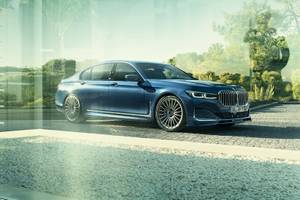
So Andreas Bovensiepen, the guy who runs Alpina, is wheeling the 2011 BMW Alpina B7 and he's just finished telling us that this car is all about luxury.
In the next moment we're hurtling into Turn One at Infineon Raceway in 4th gear, bending left up the hill and under the bridge and then straightening the car out for the short braking zone before the right-hander at the crest. Now we start sliding to the right, crossing the crest at Turn Three where the big curb can pitch the car out into the dirt bank beyond.
We're doing this in a 4,686-pound sedan with laurel-wood trim on the dash, you understand. Right then it becomes clear that Alpina's idea of luxury might be a little different from what you might think appropriate — or even possible.
Getting Serious About America
We are in Sonoma, California, to spend a little more time with the 2011 BMW Alpina B7 than we were able to get at the Monticello Motor Club for our First Drive. Alpina has long been the BMW equivalent of Mercedes-AMG, but it has been more like an engineering company than a purveyor of flashy wheels. Now the Bavarian company is finally getting serious about the U.S. market and it will import 1,000 examples of the BMW Alpina B7 between 2010 and 2011 through BMW dealers.
Burkhard Bovensiepen put Alpina on the map clear back in 1961 when he slapped a dual-carburetor setup from Weber on the BMW 1500 sedan. Soon enthusiasts were lining up at the door and Alpina became BMW's partner for specialty motorsports projects, like the 1972 BMW CSL 3.0 racecar. It's never looked back since.
Alpina Burkhard Bovensiepen GmbH is still in Buchloe, a little town far out in the Bavarian countryside southwest of Munich, where the girls still keep a traditional dirndl in the closet for special occasions. The corporate mailbox even remains in the original typewriter factory of the 1930s, though it's surrounded now by buildings where 180 people engineer the 1,000-1,500 Alpinas that are produced at its factory every year. But ever since Andreas Bovensiepen returned from seven years spent as an engineer with BMW to lead his father's company, Alpina has been relentlessly modernizing.
Infineon Raceway sloshes you this way and that as if you were the only cocktail olive in a very large jar.
Andreas Bovensiepen is particularly proud of the three transient dynamometer cells that have been created, which he hopes will help his company keep up with the rapid changes in air emissions regulations. The twin-turbo 4.4-liter V8 under the 2011 BMW Alpina B7's hood is a point of pride with him, as it's a 500-horsepower representation of what his company can do. This is no quick-and-dirty hot-rod motor with a reflashed ECU. After all, these are German engineers — relentlessly methodical.
The Pressure To Perform
The Alpina recipe for the B7's V8 starts with Mahle pistons that deliver a compression ratio of 9.2:1 and a pair of Garrett turbos with larger 44mm outlets. With 14.7 psi of boost, the engine now delivers 500 hp at 5,500 rpm and 516 pound-feet of torque at 3,000-4,750 rpm. Alpina's typically meticulous engineering includes new intercoolers with 35 percent more surface area, plus an additional radiator so the car can withstand the higher temperatures of the Mideast. Bovensiepen is also proud to note that the engine (like the car itself) is built right on the BMW assembly line in Dingolfing, which helps keep down the cost.
This engine certainly does the business on the Edmunds test track. The 2011 BMW Alpina B7 gets to 60 mph in 4.5 seconds with the traction control disengaged (4.3 seconds with 1 foot of rollout like on a drag strip), and the quarter-mile comes up in 12.7 seconds at 111.6 mph. It gets away from the starting line effortlessly and seems to accelerate harder the faster it goes. To cope with the power, the B7 carries the transmission of the BMW 760i.
The brakes from the 760i are also onboard, and the combination of their huge thermal capacity plus the enormous Michelin PS2 tires (245/35R21 in front and 285/30R21 in the rear) makes for prodigious stopping power. The B7 just shrugs off each stop with complete fade-resistance, coming to a halt from 60 mph in an amazing 107 feet.
Driving in the Real World
As we drove across the northern fringe of Sonoma county out to the rugged Pacific coast, the B7 really didn't feel much different from a conventional 7 Series. But as Bovensiepen points out, this is much harder to accomplish than it seems, since the B7 wears 21-inch examples of Alpina's famously lightweight, 20-spoke wheels (which also incorporate the air valve into a space beneath the center cap). By dispensing with run-flat tires, he says, the B7 is able to deliver the steering response of a high-performance car with its 21-inch Michelins, yet maintain the ride comfort of a 7 Series on 18-inch tires.
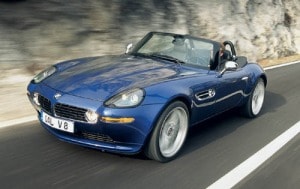
The B7 certainly doesn't feel like the usual motorsports monstrosity developed on the Nürburgring, yet Bovensiepen notes that his experience there as a racing driver (he won the Nürburgring 24 Hours overall in 1998 and has been a class winner three other times) has taught him that tires do their best work when they're on the pavement, not in the air. That's why he prefers progressive suspension rates, something he learned as a suspension engineer while developing the BMW Z8.
In Germany, an Alpina is thought of as executive transportation for long-distance commuting, so it must maintain its civilized nature. The fact that the B7 is available with all-wheel drive just like the new-generation 7 Series is part of this car's programming for real-world travel. No wonder our drive to Nick's Cove in Inverness, right on the shore of the long bay that defines the Point Reyes National Seashore, seemed so undramatic — aside from having 500 hp at our command, of course.
Doing That Track Thing
And of course the next day, we're hammering this car around Infineon Raceway and it hardly seems like a luxury car at all. Once you dial the chassis calibration to Sport+, the transmission shifts so quick and hard that it can be unpleasant, while the chassis maintains an evenly balanced poise even when the Michelin PS2s get hot, something you really notice in the Turn 1-Turn 3 combination, which sloshes you this way and that as if you were the only cocktail olive in a very large jar.
Bovensiepen is keen to point out that the car's goodness comes from engineering the mechanical package first, then overlaying it with the electronic safety net that everyday drivers expect. For example, the Alpina-calibrated stability control lets you skate the tires around as long as your inputs are smooth, but as soon as something happens abruptly, the electronics pull your leash short. It's a very sophisticated approach, one that encompasses the whole car.
The 2011 BMW Alpina B7 certainly puts up good handling numbers on the Edmunds test track. Around the skid pad, the B7 grips to the tune of 0.90g, plus its Alpina-tuned stability control lets it achieve this number with the stability control engaged. Nearly the same thing is possible in the slalom, where the car does 68.5 mph with the stability control disengaged and 68.1 mph with the system engaged.
Racing to Success in America
Alpina has been a long time coming to the U.S. While Burkhard Bovensiepen of Alpina and Hans-Werner Aufrecht of AMG are contemporaries (Bovensiepen's BMW 2800CS Alpina won the European touring car championship in 1970, while Aufrecht's AMG-prepared Mercedes-Benz 300 SEL 6.3 made his company's reputation by winning the 1971 touring car event at Spa-Francorchamps), AMG has had far greater commercial success in the ensuing decades.
Apparently Alpina was reluctant to commit to the quantity of cars that BMW dealers in the U.S.A. were eager to get and didn't want to undertake the expensive transformation of the company that would have been required. And it's useful to remember that AMG only acquired its sizable influence after Mercedes bought into the company in 1990, and then only because it lacked the equivalent of BMW's M Division.
Now that BMW can back up Alpina with its own distribution, financing and warranty, the Buchloe company's fortunes might be changing. And with the 2011 BMW Alpina B7, it has created something unique — a fast car that delivers the pinch of BMW M cars with an exquisite sense of balance and poise. It's not just more power; it's more of everything.
The manufacturer provided Edmunds this vehicle for the purposes of evaluation.

Add A Comment »
ak_nyc says:
09:02 PM, 01/12/2012
i own a 2011 alpina B7. great car when it isn't in the dealership having wheels and tires replaced. I have been through 10-15 tires and 6+ wheels in 6000 miles. No, no typos there! This configuration cannot handle NYC's potholes. And the runflat - when operable - goes for 20 miles max. I cant believe the local dealership recommended this car to me...
Does anybody know where i could get information on what other wheels (with thicker profile tires) might go on this car?
Ideally I'd like to give the car back to the dealership, but no go! Thank god for tire and wheel insurance!!!
ak_nyc says:
09:01 PM, 01/12/2012
i own a 2011 alpina B7. great car when it isn't in the dealership having wheels and tires replaced. I have been through 10-15 tires and 6+ wheels in 6000 miles. No, no typos there! This configuration cannot handle NYC's potholes. And the runflat - when operable - goes for 20 miles max. I cant believe the local dealership recommended this car to me...
Does anybody know where i could get information on what other wheels (with thicker profile tires) might go on this car?
Ideally I'd like to give the car back to the dealership, but no go! Thank god for tire and wheel insurance!!!
scottclark says:
07:58 AM, 01/30/2011
Help me understand how you can take a road trip on a car without a spare tire or runflats? Is it that you decide just to take the risk of your entire trip being ruined by countryside punctures?
In general... BMW's runflat strategy assumes that you are always within 50 miles of a dealership or other tire retailer that happens to have your needed tire. BMW dealerships do not stock the tires due to their inventory costs. So you will be faced with the potential of a multiple-day interruption of your trip.
I like the safety aspects of runflats, but dispise the lack of a spare tire well (even for a compact spare) on current models. I loved my 1995 BMW which had a full-size spare in the boot-well - and even sported the same wheel design as the car.
blackadder5639 says:
10:03 AM, 01/19/2011
In what way is the Aplina B7 better than the 760i? I mean, shouldn't the Alpina have at lest 600 hp, since the 760i already has 535 hp?
bimmerjay says:
05:43 PM, 01/16/2011
Pretty amazing numbers for a 4700 lb car. I'm also not much of a fan of the traditional Alpina body kit and wheels.
kosmo69 says:
06:56 AM, 01/15/2011
this is much better than the MB and at $125k it not crazy expensive.
Man I hate those 21in wheels. Isnt 20's good enough. Ask any past and current b7 owners about the wheel/tire issues w/ this car.
smallfield says:
06:07 PM, 01/14/2011
"I've ever read of the new 7 Series (Alpina, stock, or otherwise) contains the same conclusion time and time again: the 7 drives and handles like a much smaller car, and the overall experience is the better for it. I think that that is an engineering feat almost as impressive as the private myrtlewood forest. Okay, maybe a little more impressive..."
I agree. I'm tempted to drive one to see. I was thinking mid size luxury instead of full size concerned about S class handling and feel. I'll have to see if BMW really did it, or if they give it the benefit of the doubt for its size.
Now if only my local BMW dealer provided service worthy of a 100K car... or a 30K car even.
campi3ell says:
01:37 AM, 01/14/2011
That blue must be a required color on the Alpinas. Every Alpina I have seen has been that same shade of blue.
This seems more of a "gentleman's racer" than the M5 is (or a M7 if it were built). It seems to compete with the S63 (as someone else mentioned earlier) but is a bit softer than the hyper, edgier S63. I second the sentiment of comparing this to the S63. Hell, wait for the Audi S8 and have the familiar German Trio present.
icecubefosho says:
03:44 PM, 01/13/2011
The Jaguar XJ Supersport still cuts the Alpina B7 by a little over 500 lbs which is pretty considerable. Not to mention, it doesn't look quite as garish as the Alpina and the interior is steps ahead... Unless of course Jaguar's tradition with reliability problems take over and you can't read the TFT speedo screen.
fordfrenzy says:
12:13 PM, 01/13/2011
PRETTY IMPRESSIVE IVE ALWAYS LIKED THIS VERSION ALTHOUGH I WOULD BE FORCED TO SAY THAT THE JAGUAR XJ SUPERSPORT IS FASTER AND LOOKS BETTER GETTING THERE